
On this page
For digital leaders at high-volume enterprises, selecting a commerce platform is a strategic architectural decision that shapes operations for five to seven years. While Adobe Commerce (formerly Magento) is recognized for its event-driven architecture and code-level customization, many IT directors now seek alternatives that offer enterprise-grade control without the heavy maintenance overhead or fragmented mobile experiences. A unified commerce platform provides a cohesive alternative, integrating high-performance web and native mobile commerce into a single infrastructure designed for scale and deep integration. This approach addresses the modern need for agility, moving beyond the limitations of legacy monoliths and the extreme complexity of purely composable stacks.
The Enterprise Control Bottleneck: Beyond Code Customization
Adobe Commerce was built on the premise that code is the ultimate configuration layer. Its event-driven architecture and GraphQL API provide developers with granular control over every checkout and catalog behavior. However, this level of custom coding often leads to significant technical debt and a high total cost of ownership (TCO) once maintenance, security patches, and specialized agency hours are factored in. When a platform requires extensive refactoring for every version upgrade or to sync complex catalog rules across web and mobile, it becomes an operational bottleneck.
Modern enterprise control requires architectural flexibility that does not sacrifice merchandising velocity. The goal for CTOs is now to achieve the same level of granular control through a native integration fabric that connects seamlessly with ERP and PIM systems. This shift moves the focus from maintaining fragile middleware to driving business growth, ensuring that complex multi-brand or multi-region setups remain stable under high-load conditions.
Enterprise Alternatives Comparison
The alternative market is generally divided between modular (MACH) architectures, integrated ecosystems, and unified enterprise platforms. Each offers a different approach to balancing engineering capacity with business control.
| Platform | Architecture Type | Mobile Approach | Maintenance Intensity |
|---|---|---|---|
| Adobe Commerce | Monolithic / Headless | Hybrid / PWA | Very High (Specialized) |
| commercetools | Composable (MACH) | API-Driven Custom | Extremely High (Engineer-Heavy) |
| Salesforce CC | Integrated SaaS | Ecosystem-Specific | High (Certified Talent Required) |
| Supercommerce | Unified Enterprise | Native iOS & Android | Balanced (Enterprise IT) |
Selecting the right path depends on whether your organization prioritizes composing every component manually or leveraging a high-performance, unified core that handles infrastructure natively.
The Composable Route: commercetools and MACH
A headless, microservices-first MACH platform like commercetools is designed for teams with significant in-house engineering capacity that need to compose their stack from best-of-breed components. While this offers the highest ceiling for modularity, it places the burden of maintenance and integration stability entirely on the enterprise. Organizations are responsible for stitching together the CMS, search layer, and checkout engine. This introduces substantial complexity for brands managing complex catalogs or cross-region logistics, often requiring a dedicated DevOps team just to keep the various services synchronized.
The Ecosystem Route: Salesforce Commerce Cloud
Salesforce Commerce Cloud (SFCC) is a frequent choice for those already deeply invested in the Salesforce CRM. It provides powerful merchandising tools but is notoriously opaque for developers who lack specific Salesforce B2C Commerce certifications. This reliance on a closed ecosystem can lead to slower innovation cycles and a dependency on specialized talent. For enterprises processing over $100M in GMV, this ecosystem lock-in can make it difficult to pivot quickly or integrate with external, non-Salesforce systems without incurring significant professional service fees.
Supercommerce: Unified Architecture for Enterprise Scale
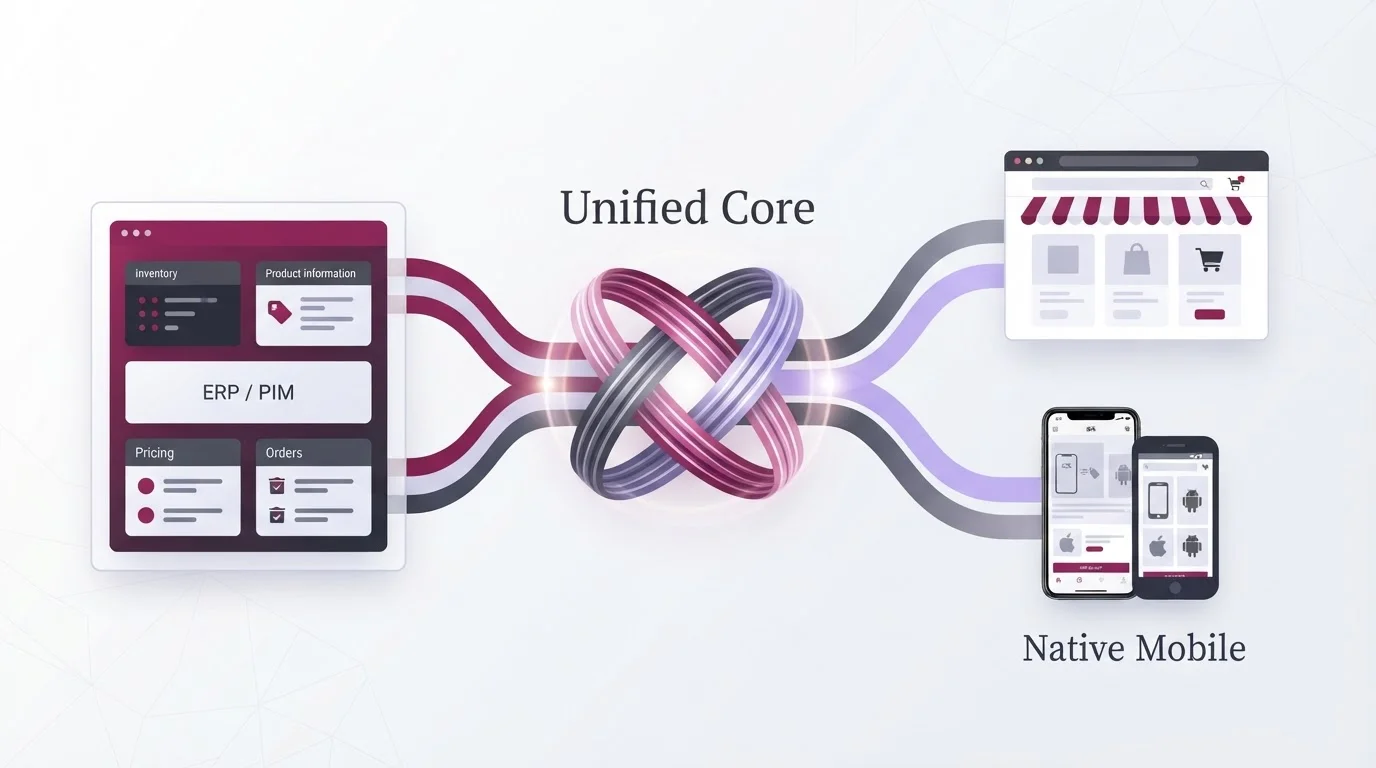
Supercommerce addresses the primary trade-off between power and simplicity by providing a unified enterprise fabric. Unlike generic solutions that treat mobile as a responsive website wrapped in a WebView, Supercommerce delivers native iOS and Android applications as part of the core infrastructure. This ensures that complex pricing rules, custom attributes, and real-time inventory are synchronized across every touchpoint without the need for custom bridge APIs. By consolidating the stack, Supercommerce allows large-scale operations to focus on growth rather than infrastructure maintenance.
For enterprises with $100M+ in annual GMV, the platform provides the scale, control, and deep integrations necessary for high-performance commerce. The unified dashboard manages both web and native mobile experiences, ensuring that promotions and catalog updates are applied universally. This eliminates the technical debt associated with managing separate front-end technologies and ensures a consistent, high-converting experience for customers on all devices.
Strategic Insights for Enterprise Commerce
Receive in-depth perspectives on unified platforms, scalability, and complex integrations for large-scale commerce operations.
Total Cost of Ownership: The True Cost of Growth
When evaluating Adobe Commerce alternatives, the license fee is only one component of the actual spend. The total cost of ownership includes hosting, security maintenance, and the constant refactoring required for versioning. In legacy monolithic setups, these costs often far exceed the initial licensing fees. A unified platform reduces this friction by consolidating web and mobile commerce into a single system, eliminating the need for separate mobile vendors and dedicated mobile engineering teams.
By reducing the integration surface area and replacing dozens of third-party extensions with native features, enterprises can reallocate their budgets toward growth-focused innovation. Reducing the reliance on custom-coded middleware not only lowers costs but also increases system stability. This is critical for large-scale businesses where even a few minutes of downtime during peak periods can result in significant revenue loss.
Strategic Framework: Selecting the Right Platform
To select a platform based on business fit rather than sales pressure, follow this evaluation sequence:
- Audit Mobile Performance: If mobile traffic is significant, prioritize platforms offering native app capabilities over those relying on PWAs or mobile browsers to ensure high conversion rates through biometric login and one-tap payments.
- Evaluate Integration Fabric: Document all Tier-1 systems (ERP, PIM, WMS) that must communicate with the commerce engine. Look for platforms with native integration capabilities to reduce reliance on fragile middleware.
- Assess Engineering Depth: If your team is not optimized for managing a complex microservices architecture, avoid pure composable stacks in favor of unified cores that handle infrastructure natively.
- Project a 5-Year Roadmap: Account for the cost of maintaining separate platforms for web and mobile. A unified choice is typically more sustainable for long-term operational efficiency and scaling across multiple brands.
Enterprise Commerce Platform FAQ
Q: Is native mobile really necessary for enterprise commerce?
Yes. Native apps provide superior performance, offline capabilities, and higher conversion rates through biometric login and one-tap payments, which mobile browsers cannot match.
Q: How does migration from Adobe Commerce work?
While moving data like order history is required, a unified platform simplifies the transition by replacing multiple third-party extensions with native, built-in features, significantly reducing integration complexity.
Q: Can a unified platform handle complex B2B pricing?
Yes. Enterprise-grade unified platforms are designed for complex requirements, including multi-tier negotiated pricing and multi-brand configurations, all managed within a single administrative dashboard.
Choosing an Adobe Commerce alternative is about reclaiming control over your digital roadmap. For large enterprises that must balance customization with operational efficiency, a unified commerce platform offers the most viable path forward. By consolidating high-performance web and native mobile commerce into one system, you eliminate the technical debt of legacy monoliths while gaining the scale and integration capabilities required for modern enterprise commerce. This architectural shift ensures your infrastructure supports growth rather than hindering it.