
On this page
Digital transformation in enterprise commerce is a fundamental realignment of data, business processes, and customer touchpoints. For leaders managing large-scale retail operations, this shift represents a move away from rigid, siloed systems toward agile architectures that support continuous growth. The goal is to create a seamless operational ecosystem where backend complexity does not hinder the frontend experience. Successful transformation requires a disciplined approach to bridge the gap between legacy infrastructure and modern consumer expectations. By prioritizing a unified architecture, enterprises can eliminate the technical bottlenecks that typically stifle expansion.
The Strategic Mandate: Why Legacy Architectures Fail at Scale
Many large enterprises struggle with significant technical debt—monolithic platforms that were not designed to handle the complexity of high-volume global commerce. These generic solutions often lack the flexibility required for custom pricing rules, multi-brand orchestration, and deep ERP integrations. When the technology stack becomes a barrier to change, digital transformation becomes a requirement for survival. According to the Shopify Digital Transformation Questions: Retail Guide (2026), successful transformations typically follow a structured four-phase framework: Assess, Plan, Execute, and Scale. The assessment phase is particularly critical for enterprise leaders, requiring a transparent evaluation of current technical constraints to identify exactly where legacy systems are eroding margins. Moving to a modern stack allows for a repeatable, lower-risk process for implementing change across the organization.
The Four Domains of Enterprise Architecture
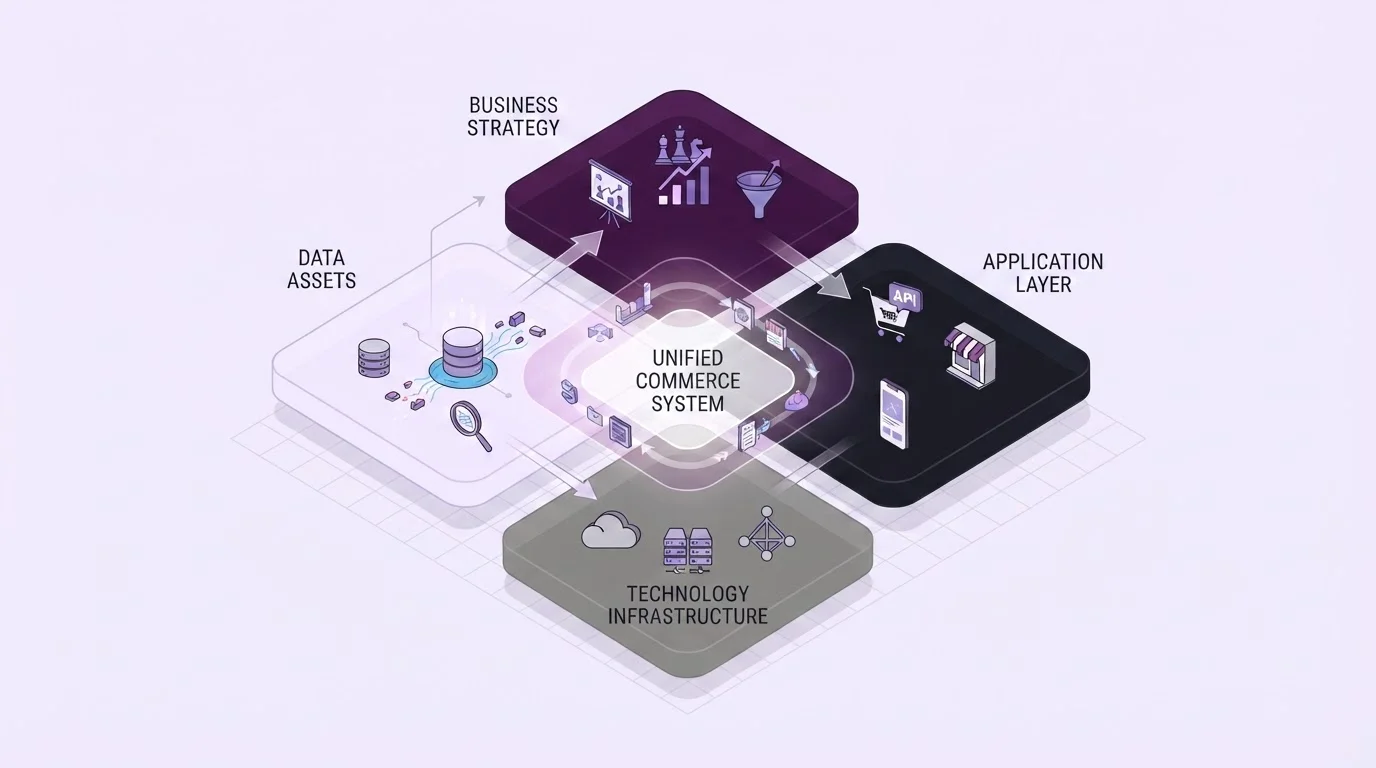
Enterprise architecture serves as the blueprint connecting high-level business goals to the underlying technical systems. In the commerce sector, this discipline spans four core domains that must remain in sync to deliver a cohesive experience. This structure ensures that every technology investment serves a specific strategic purpose rather than adding unnecessary complexity. Business Architecture defines the operational models and value chains that drive revenue, while Data Architecture establishes the single source of truth for inventory, customer profiles, and order history. Application Architecture governs how commerce engines, checkouts, and CRM tools interact. Finally, Technology Architecture builds the underlying cloud-native infrastructure and API-first frameworks that support these systems. By aligning these four domains, technology leaders can ensure that digital change is faster and more reliable.
Achieving Unity: The Shift to Unified Commerce
Unified commerce is the strategic evolution of omnichannel retailing. While omnichannel often involves disparate systems connected by fragile bridges, unified commerce merges all retail systems, channels, and data into a single, real-time platform. This integration is essential for managing the high-volume data flows required by modern retail enterprises. At the center of this strategy is the Unified Retail Stack, which serves as a centralized nervous system for all operations. This model eliminates the synchronization delays that lead to inventory errors and lost sales. For businesses with complex needs, this unified approach offers the control and deep integration necessary to manage an operation designed for $100M+ annual GMV. This single-platform approach provides the scale required to run high-performance web storefronts and native mobile commerce simultaneously.
The Native Mobile Advantage
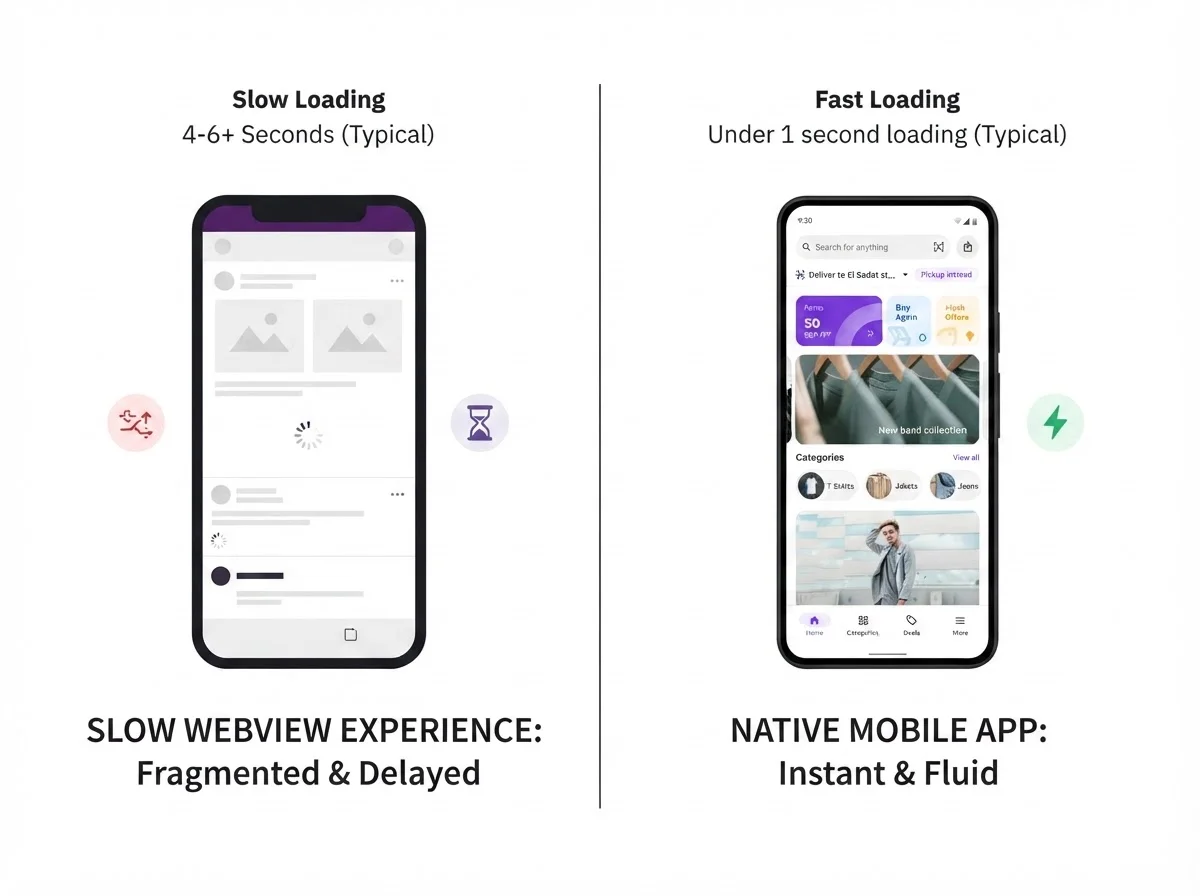
A common mistake in digital transformation is treating mobile as a secondary accessory to the web experience. Many enterprises rely on responsive websites wrapped in basic WebViews, which often results in slow load times and poor user engagement. Modern consumers demand native experiences that leverage the full performance capabilities of their devices. Native mobile apps provide performance that responsive web pages cannot match, often loading complex product catalogs in under one second. This performance gap directly impacts the bottom line, as native apps typically see significantly higher conversion rates than mobile websites for the same audience. A mature transformation strategy treats native mobile as a primary revenue driver, ensuring it receives the same architectural focus as the desktop storefront.
Quantifying Success: The Enterprise ROI Framework
Measuring the Return on Investment (ROI) is essential to justify and sustain large-scale digital initiatives. Retail leaders should evaluate success through three distinct stages of the implementation lifecycle: Launch, Scale, and Optimize. Each stage requires specific KPIs to accurately track progress and identify areas for improvement. Launch metrics serve as leading indicators, focusing on integration stability and initial platform performance. Scale metrics focus on growth indicators such as Customer Lifetime Value (CLTV) and Average Order Value (AOV). Optimize metrics target operational efficiency, measuring fulfillment speed and the cost per transaction. Research from KPMG suggests that by measuring and incentivizing these specific KPIs, retailers can eliminate channel silos and align their leadership teams around the consumer experience.
Future-Proofing Through Composable Strategy
The digital market is in a state of constant flux, requiring architectures that can adapt to new technologies. Future-proofing involves moving away from rigid monoliths toward a composable commerce architecture. This modular, API-first approach allows businesses to integrate best-of-breed components—such as specialized search engines or headless CMS tools—that can be swapped out as business needs change. Integrating AI and Machine Learning is the next critical step in this evolution. By building an architecture ready to ingest and act on AI-driven data, enterprises can automate complex backend processes and personalize interactions at scale. This proactive stance ensures the organization remains resilient against both competitive disruption and rapid technological shifts, turning the commerce engine into a sustainable growth driver.
Strategic Questions for Retail Leaders
Q: How does digital transformation differ from a standard IT upgrade?
Digital transformation is a comprehensive overhaul of business processes and culture to create new value, while IT upgrades focus on maintaining existing functions. Transformation reimagines how these functions serve the bottom line.
Q: Why is enterprise architecture critical for high-volume brands?
At scale, complexity becomes the greatest threat to growth. Enterprise architecture provides the discipline to connect business goals to technical systems, ensuring that changes are repeatable rather than ad hoc.
Q: How do unified platforms reduce operational costs?
By merging systems into a single real-time platform, unified commerce reduces the cost of maintaining multiple disparate integrations. It also minimizes data errors and synchronization delays that lead to costly inventory mistakes.
Q: What is the most effective way to overcome internal resistance to change?
Resistance is often rooted in a lack of clear vision. Leaders must communicate the strategic purpose of the transformation and involve stakeholders early, demonstrating early wins through a phased implementation to build momentum.
For enterprise retail leaders, digital transformation is a journey from fragmentation to unity. By focusing on a robust architecture, prioritizing native mobile performance, and adopting unified platforms, organizations can overcome the limitations of legacy debt. Success requires more than just new tools; it demands a strategic commitment to data integrity and measurable outcomes. As the retail market continues to evolve, the brands that invest in a flexible, future-proof foundation today will be the ones that lead their categories tomorrow. The result is a high-performance commerce ecosystem that scales effortlessly with the complexity and volume of an enterprise operation.