
On this page
By 2027, the future of retail technology will be defined by a definitive move away from fragmented, channel-specific strategies toward unified commerce ecosystems. For enterprise leaders, the standard for success is no longer just having a functional website; it is the ability to orchestrate hyper-personalized experiences across native mobile apps, web storefronts, and AI-driven touchpoints in real time. As global retail e-commerce sales are projected to reach $8.03 trillion by 2027, the distinction between digital and physical operations will effectively vanish, replaced by a single, data-rich operational truth.
The Rise of the $3.38 Trillion Mobile Mandate
Mobile commerce is no longer a secondary channel or a scaled-down version of the desktop experience. Data from Statista indicates that mobile e-commerce sales will reach approximately $3.38 trillion globally by 2027. This shift represents a fundamental change in how high-GMV enterprises must approach their digital footprint.
Traditional responsive websites often fail to meet the performance demands of 2027 consumers. Large enterprises frequently struggle with 'WebView' wrappers that feel sluggish and disconnected from the device. To capture this market, category-leading brands are shifting toward native mobile commerce. Native applications provide the speed, biometric security, and offline capabilities that responsive web cannot match, leading to higher engagement and lower cart abandonment rates.
Strategic Benchmarks: Retail Technology 2024 vs. 2027
Understanding the scale of this transition requires looking at the quantified growth of specific technology sectors. The following table highlights the shift in key retail metrics based on industry forecasts from eMarketer, Statista, and IDC.

| Metric | 2024 Estimate | 2027 Projection | Source |
|---|---|---|---|
| Global Retail E-commerce Sales | $6.33 Trillion | $8.03 Trillion | eMarketer |
| Global M-Commerce Sales | $2.52 Trillion | $3.38 Trillion | Statista |
| Retail AI Spending | $19.3 Billion | $31.1 Billion (by 2028) | IDC |
| Digital Wallet Share (E-comm) | 50% | 61% | Worldpay |
The Evolution of Composable Architecture and Agentic AI
Rigid, monolithic platforms are becoming the primary bottleneck for innovation. Industry trends suggest a rapid shift toward composable architectures, where modular components allow enterprises to swap out search engines, checkout modules, or content managers without re-platforming the entire system. This agility is essential for high-volume retailers who need to deploy updates daily rather than quarterly.
Parallel to this structural shift is the rise of Agentic AI. Unlike basic chatbots, these autonomous systems use unified data platforms to manage inventory, personalize dynamic pricing, and execute customer service resolutions without human intervention. Spending on AI-related infrastructure in retail is expected to reach $31.1 billion by 2028 according to IDC. These systems require a commerce foundation that can feed real-time data to AI models across every customer touchpoint.
Strategic Insights for Enterprise Commerce
Receive in-depth perspectives on unified platforms, scalability, and complex integrations for large-scale commerce operations.
Strategic Requirements for High-Volume Enterprises
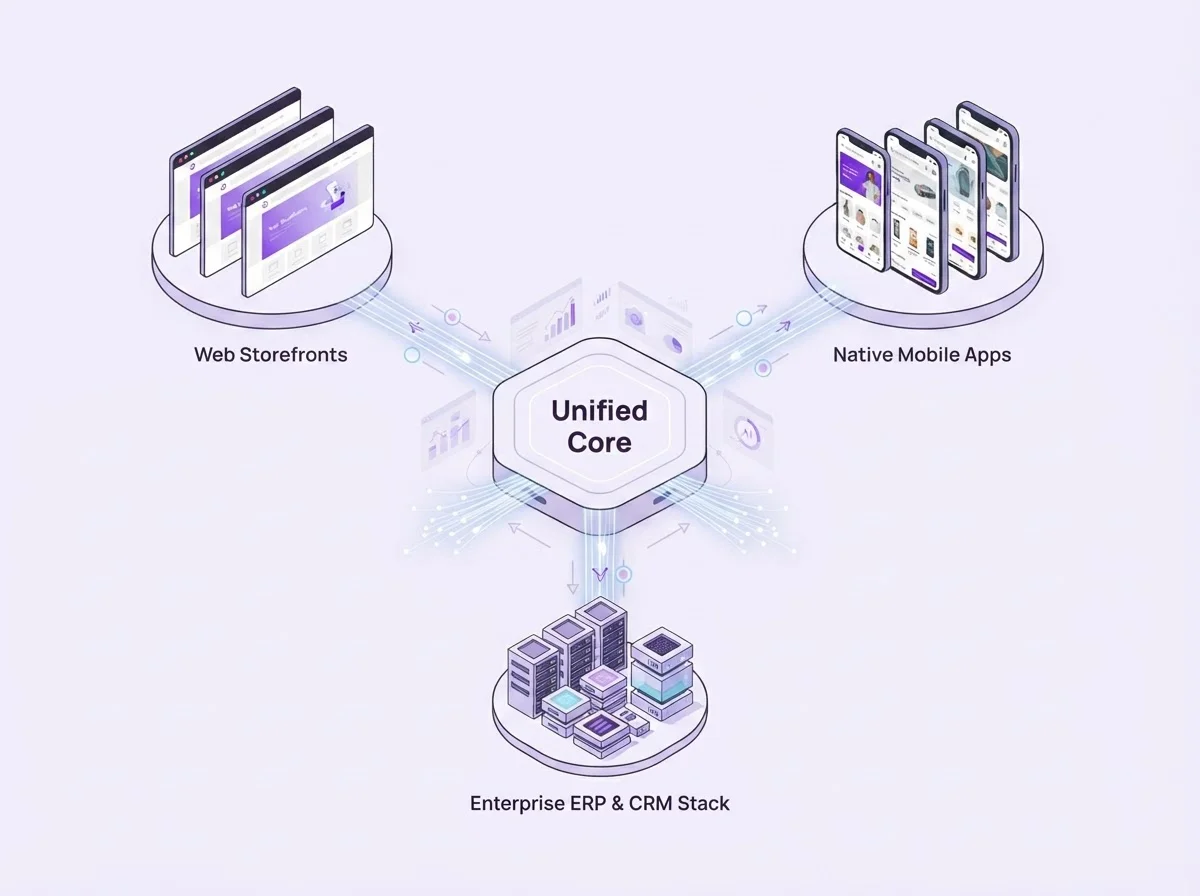
Strategic planning for 2027 requires a rigorous audit of current technical debt. For enterprises processing $100M+ in annual GMV, the challenge is rarely a lack of data, but rather the inability to act on it due to system rigidity. Future-ready platforms must prioritize three core pillars:
- Deep Integration and Control: Systems must integrate directly with complex ERP and CRM stacks to provide a single source of truth for inventory and customer identity.
- Native-First Mobile Performance: Moving beyond basic mobile-responsive sites to high-performance native apps that offer sub-second load times and integrated digital wallet support.
- Scalability for Complex Catalogs: The ability to manage multi-brand setups, custom pricing rules, and massive product hierarchies without performance degradation during peak traffic events.
Supercommerce is built specifically for this transition. By providing a unified enterprise commerce platform, Supercommerce enables large businesses to run high-performance web storefronts and native mobile commerce on a single foundation. This approach eliminates the friction of maintaining disparate systems, giving brands the control they need to implement AI-driven personalization today.
Frequently Asked Questions
Q: What is the biggest risk for large retailers in 2027?
The primary risk is technical debt associated with monolithic legacy platforms. As consumer behavior shifts toward mobile and AI-assisted shopping, rigid systems will prevent enterprises from deploying integrations fast enough to remain competitive.
Q: Why is native mobile commerce more important than a mobile-responsive website?
Native apps offer access to device-specific features like biometric authentication and push notifications. These factors contribute to significantly higher conversion rates compared to mobile web for most enterprise retailers.
Q: How does composable commerce affect operational agility?
Composable commerce allows brands to upgrade individual parts of their stack rather than performing expensive, full-scale re-platforming. This modularity enables faster responses to market shifts.
Q: Will physical stores still be relevant in 2027?
Yes, but their role is shifting. Successful stores will act as fulfillment hubs for BOPIS (Buy Online, Pick Up In Store) and experiential showrooms powered by unified data, bridging the gap between digital and physical browsing.
The future of retail technology is not a distant vision—it is an active transition toward a unified, mobile-dominated reality. Enterprises that invest in native mobile experiences, composable agility, and unified data will be positioned to capture the growth of the $8 trillion e-commerce market. Preparing your infrastructure now ensures that your commerce operations remain resilient and scalable well beyond 2027.