
On this page
Deploying a high-performance mobile strategy requires balancing backend operational stability with low-latency frontend execution. SAP Commerce Cloud remains a heavily utilized engine for transactional workloads, offering robust capabilities for complex catalogs and deep ERP integrations. However, achieving a high-tier mobile experience is rarely an out-of-the-box reality. While the core platform provides foundational APIs, establishing a native mobile framework introduces specific architectural layers and ongoing development overhead.
For enterprise technology leaders evaluating native app development commerce, the core challenge is decoupling a legacy backend from modern mobile touchpoints. Connecting specialized iOS and Android frontends to a monolithic system often demands extensive middleware and custom orchestration. Businesses aiming for streamlined channel execution are increasingly analyzing whether to build these bridges manually or adopt a unified commerce mobile platform designed to support multiple frontends natively.
The Architectural Framework of Mobile in SAP Commerce Cloud
SAP's primary approach to modern, decoupled frontends centers on its Composable Storefront, an Angular-based Progressive Web App (PWA). A PWA offers deployment efficiency and operates in a mobile browser environment, but it does not deliver the execution speed, deep hardware access, or performance optimization of a true native application.
To drive native mobile workloads, the platform exposes core capabilities through Omni Commerce Connect (OCC) RESTful APIs. These endpoints deliver commerce services—such as cart management, catalog searching, and checkout verification—to external client applications. When architecting native frontends, development teams must build custom interfaces using native languages like Swift and Kotlin or cross-platform frameworks like React Native and Flutter. Connecting these mobile clients directly to a monolithic Java application backend requires a dedicated orchestration layer to tailor responses and reduce payload sizes for mobile networks.
Technical Capabilities and Integration Tools
For technical architects tasked with building native workflows on top of the SAP ecosystem, the platform provides specialized integration tools within the SAP Business Technology Platform (BTP):
- SAP BTP SDK Assistant: A macOS utility that generates Swift proxy classes for OData services, automating the communication bridge between the iOS mobile client and backend data layers.
- Business Configuration Maintenance Objects: Developers can leverage the ABAP Repository Object Generator to build maintenance objects, ensuring that foundational transaction data and custom channel configurations remain aligned.
- Prototyping and Environments: Technical teams can set up an ABAP cloud project and establish trial users within the SAP BTP ABAP environment to create database tables and generate UI services without impacting production environments.
- Connectivity Management: The architecture allows developers to configure destinations within the SAP BTP cockpit, granting mobile applications secure, monitored access to external endpoints like Northwind OData services.
- Vulnerability Reporting: Security within mobile operations is managed via explicit protocols. When reporting system vulnerabilities, the platform requires precise documentation, including the issue category, affected version, support package and patch levels, necessary pre- and post-conditions, and a functioning proof of concept.
Operational Impact and Long-Term Maintenance Lifecycle
The long-term viability of an enterprise mobile commerce strategy depends on maintenance efficiency. When organizations plan core system updates or cloud migrations, the presentation layer often requires parallel re-engineering. Shifting legacy backend applications to modern hosting models does not automatically modernize or optimize the customer-facing mobile application.
If mobile channels represent a critical vector for customer retention and revenue generation, keeping frontends disconnected from the core transactional engine creates structural drag. Tech leaders must carefully evaluate whether to sink significant engineering capital into building and maintaining custom API pipelines or pivot toward a unified platform architecture that eliminates the custom integration tax.
Hidden Operational Bottlenecks of Custom Native Builds
Developing and scaling native applications via separate SDKs and custom OCC API routing introduces several long-term operational challenges for enterprise brands:
- Codebase Fragmentation: Implementing a native mobile strategy usually requires maintaining multiple distinct frontend codebases—one for the web storefront, one for iOS, and one for Android. This means business logic, complex catalog rules, and localized promotional campaigns must be developed, tested, and deployed across three isolated code environments.
- Talent Allocation Silos: Finding engineering talent proficient in legacy enterprise backend structures as well as modern mobile frameworks is difficult. This often forces organizations to maintain siloed web and mobile engineering groups, creating feature disparities between channels.
- Integration Complexity: Connecting systems like SAP S/4HANA via OData or REST APIs to mobile clients requires constant oversight. This complexity multiplies when companies attempt to embed advanced technical workflows, such as automated data classification or predictive maintenance algorithms, directly into the mobile application layer.
Strategic Insights for Enterprise Commerce
Receive in-depth perspectives on unified platforms, scalability, and complex integrations for large-scale commerce operations.
Supercommerce: High-Performance Native Mobile by Design
For large enterprises that require extensive scale, deep backend control, and complex custom integrations, Supercommerce provides a comprehensive alternative to rigid legacy architectures. Built from the ground up to eliminate frontend fragmentation, Supercommerce operates a single, high-performance engine that powers both web storefronts and native mobile applications simultaneously.
Rather than forcing IT teams to wrap web pages in low-performance WebViews or build custom client logic over detached REST APIs, Supercommerce natively compiles true iOS and Android applications alongside the web experience. Core operational rules, real-time inventory systems, and enterprise-grade checkouts stay perfectly synchronized. This architecture gives your organization complete control over complex catalogs and pricing models without the multi-year development timelines and heavy middleware maintenance typical of legacy software ecosystems.
Architectural Comparison: Custom Mobile Frontends vs. Unified Platform
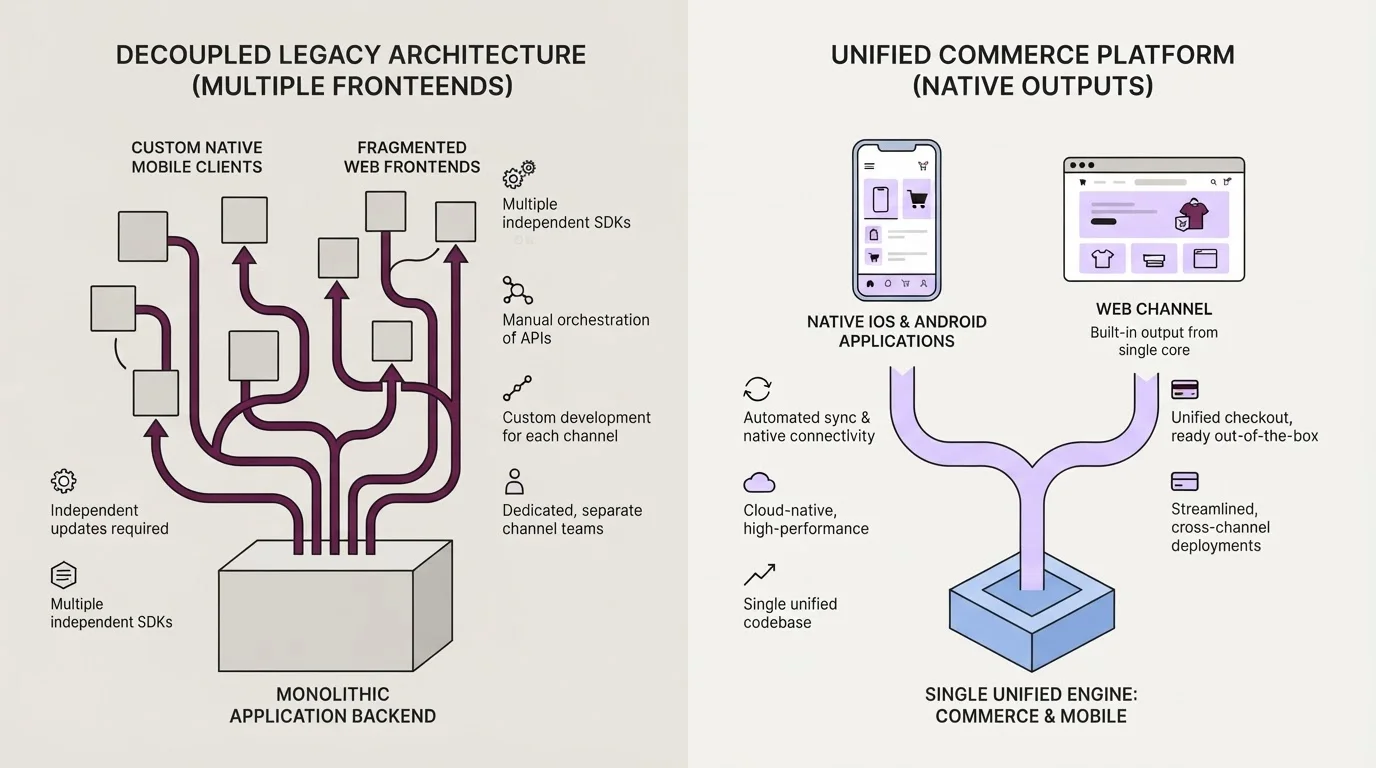
The table below highlights the structural and operational differences between building a custom native mobile frontend on top of SAP Commerce Cloud and deploying a natively unified commerce architecture.
| Architectural Dimension | SAP BTP Native Strategy | Supercommerce Unified Platform |
|---|---|---|
| Application Delivery | Custom native clients built via individual SDKs | Built-in native iOS and Android application output |
| Codebase Efficiency | Multiple fragmented frontends requiring independent updates | Single unified engine managing web and mobile channels |
| Core Infrastructure | Monolithic Java application backend | Cloud-native, high-performance architecture |
| API Coordination | Manual orchestration and payload tuning via OCC & OData | Native enterprise connectivity and automated sync |
| Checkout Optimization | Custom development required for mobile checkout flow | Native, high-performance checkout ready out of the box |
| Engineering Overhead | High (Requires dedicated, separate channel teams) | Streamlined (Cross-channel deployments from one platform) |
Enterprise Mobile Commerce FAQ
Q: Does SAP Commerce Cloud provide ready-to-deploy native mobile applications?
No. SAP Commerce Cloud provides foundational OCC REST APIs and developer SDKs through SAP BTP, but the actual native iOS and Android applications must be custom-built, designed, and maintained by your internal engineering team or an external systems integrator.
Q: Is the Composable Storefront a viable solution for true native mobile applications?
No. The Composable Storefront is an Angular-based Progressive Web App (PWA). While it delivers an app-like user experience inside a mobile web browser, it runs within a browser sandbox and lacks the performance advantages and native device-level capabilities of a native iOS or Android app.
Q: What are the primary benefits of a unified commerce mobile platform over a decoupled custom build?
A unified platform like Supercommerce eliminates codebase fragmentation. By running high-performance web experiences and native mobile apps from a single core engine, it ensures absolute feature parity, removes the need for complex custom middleware, and drastically lowers the long-term total cost of ownership.
Q: What documentation is required when reporting mobile security vulnerabilities in the SAP ecosystem?
Security incident management protocols require submittal of specific details. This includes the issue category, the exact product version along with its support package and patch levels, any necessary pre- and post-conditions for the vulnerability, and a detailed proof of concept or exploit code.
Strategic Evaluation
SAP Commerce Cloud continues to serve as an authoritative back-office transactional engine for extensive global operations, earning recognition as an industry leader in digital commerce. For brands that require deep execution control over intricate back-end workflows, the platform provides strong capability. However, when the business objective shifts to agility, fast deployment, and high-converting native mobile experiences, the development overhead of a legacy monolithic core can slow momentum.
If your organization wants to avoid the long engineering lifecycles, manual API payload tuning, and permanent codebase fragmentation of a custom-built infrastructure, Supercommerce offers a direct path forward. By fusing enterprise-grade catalog control with native mobile applications compiled directly from the core engine, Supercommerce ensures your customers get a premium, fast mobile experience without compromising backend scale or operational control.