
On this page
SAP Commerce Cloud is a long-standing choice for large enterprises that require deep alignment with the SAP ecosystem and need to manage complex, multi-brand B2B or B2C operations. It excels at anchoring massive, multi-site deployments that depend heavily on complex backend data synchronization. However, its comprehensive architecture comes with structural trade-offs in setup complexity and operational velocity. For organizations processing over $100M in Gross Merchandise Volume (GMV), evaluating the platform requires weighing the benefit of traditional ERP-driven stability against the need for modern enterprise commerce agility.
Core Architecture and Integration Framework
SAP Commerce Cloud, which evolved from the original Hybris platform, is built on a Java-based Spring framework hosted within a cloud-native infrastructure on Microsoft Azure. Its core architecture relies on a specialized extension framework. This design allows enterprise developers to add custom modules and tailor platform functionality without altering the core system code, preserving upgrade paths while accommodating complex business logic.
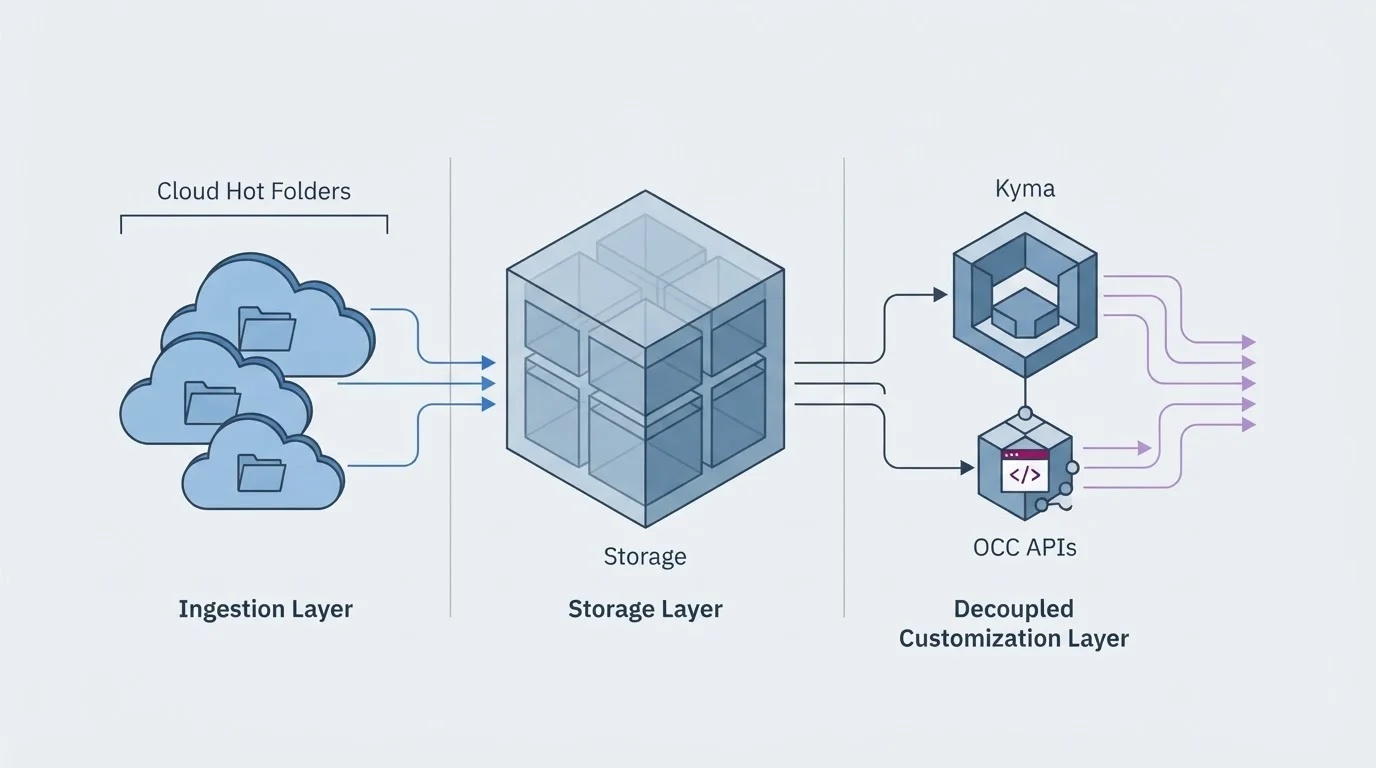
Integration is where the platform establishes its primary value proposition for unified commerce for sap users. It employs several ingestion and extensibility pathways:
- Cloud Hot Folders: This mechanism leverages Azure Blob Storage to ingest high-volume data asynchronously. It processes incoming CSV files directly into ImpEx scripts for backend database execution, making it highly effective for bulk catalog updates.
- SAP BTP and Kyma: For modern, decoupled customization, the platform connects with the SAP Business Technology Platform (BTP) using Kyma. This allows developers to build event-driven microservices and serverless functions that operate entirely outside the core application codebase, minimizing system dependencies.
- Omni Commerce Connect (OCC) APIs: The platform exposes its commerce engine through a set of RESTful OCC APIs, enabling headless commerce configurations and integration with separate frontends or the Composable Storefront.
By tying into wider SAP infrastructure, such as S/4HANA or Customer Data Solutions, the platform helps businesses deliver personalized customer journeys. It actively synchronizes real-time inventory, pricing Matrices, and customer profiles across legacy software stacks. The downside is that maintaining these complex, multi-layered data links typically demands a dedicated team of specialized Java and SAP developers.
Typical Enterprise Workflow and Governance
The daily operational workflow within SAP Commerce Cloud focuses heavily on enterprise data governance, compliance, and multi-user collaboration. Its content and data management tools utilize role-based access controls to guarantee information accuracy before any update goes live.
In product information management (PIM) and catalog administration, users can centralize and enrich complex product configurations. The platform relies on a flexible dynamic type system alongside a native Solr-based search engine to manage millions of SKUs across distinct regional sites. This configuration supports segment-specific B2B pricing models, custom volume discount rules, and isolated B2C catalogs from a single backend instance.
Operational compliance also extends to enterprise risk mitigation. For example, the platform includes a structured security incident management framework aligned with corporate governance protocols. When documenting security anomalies or operational exploits, corporate IT teams can compile specific diagnostic variables, including the precise issue category, affected support packages, patch levels, and required pre- or post-conditions. This rigorous structure ensures that technical vulnerabilities are evaluated with full enterprise accountability.
The Agility Gap: Mobile Commerce and TCO Trade-offs
While SAP Commerce Cloud provides a resilient foundation for deep ERP integration, it frequently introduces friction regarding digital speed and total cost of ownership (TCO). Large-scale enterprises often find that the technical overhead of managing a heavy, Java-based legacy architecture slows down frontend experimentation and market adaptability.
Mobile execution represents a critical hurdle for many modern brands. Although SAP Commerce Cloud provides headless connectivity via OCC APIs, delivering a truly premium mobile experience requires extensive internal engineering or the integration of separate front-end layers. Many enterprises attempt to bridge this gap by deploying standard responsive web storefronts wrapped inside native application shells (WebViews).
This approach rarely satisfies modern mobile expectations. Because your customers live on mobile, they deserve a tailored, frictionless experience that web-responsive wrappers cannot deliver. Building fully native mobile applications on top of SAP's architecture means funding and managing distinct, disconnected codebases, compounding an already high infrastructure TCO.
SAP Commerce Cloud vs. Supercommerce
For many $100M+ GMV organizations, the administrative overhead of SAP is an acceptable cost for complete backend ERP alignment. However, businesses seeking an agile, unified commerce solution that natively pairs high-performance web storefronts with true native mobile capabilities often find the legacy ecosystem overly restrictive. Supercommerce acts as a direct alternative, engineered for scale, control, and high-velocity deployment without the complexity of a legacy multi-layered architecture.
Comparing Enterprise Commerce Capabilities
| Capability Dimension | SAP Commerce Cloud | Supercommerce |
|---|---|---|
| Core Architecture | Java-based Extension Framework / PaaS | Unified Multi-tenant SaaS |
| Mobile Strategy | Headless via OCC APIs (Build Your Own) | Built-In Native Mobile App Commerce |
| Data Ingestion | Cloud Hot Folders & ImpEx Scripts | Unified High-Performance APIs |
| Extensibility Model | Serverless Kyma Microservices & SAP BTP | Streamlined Platform Customization |
| Operational Focus | Legacy ERP Alignment & Stability | Enterprise Commerce Agility & Scale |
Evaluating Product Fit for Your Organization
Determining whether SAP Commerce Cloud fits your enterprise depends on an objective analysis of your active technical debt, developer competencies, and primary channels of customer engagement.
When SAP Commerce Cloud is the Right Choice: Your operational logic is deeply embedded within the SAP environment, utilizing platforms like S/4HANA for global enterprise resource planning. Under these conditions, the automated data mapping and core stability of a single vendor stack justify the ongoing developer overhead and lower frontend execution speed.
When to Pursue SAP Commerce Cloud Alternatives: Your brand prioritizes high conversion rates on mobile channels, requires absolute control over fast-moving digital customer experiences, or lacks a large team of specialized Java/SAP infrastructure specialists. If your digital strategy demands rapid multi-channel launches, evaluating a more nimble, unified enterprise solution prevents your core transaction platform from acting as an operational bottleneck.
Frequently Asked Questions
Q: Is SAP Commerce Cloud headless?
Yes. The platform supports headless e-commerce deployment through its Omni Commerce Connect (OCC) REST APIs and its Composable Storefront architecture, which decouples user-facing experiences from the backend commerce core.
Q: How does the platform handle massive product catalogs?
It leverages a flexible dynamic type system combined with integrated Solr-based search functionality. This enables enterprises to manage millions of distinct SKUs with intricate attribute structures while preserving multi-site data isolation.
Q: What is the main structural difference between Hybris and SAP Commerce Cloud?
Hybris was the legacy, on-premise incarnation of the platform. SAP Commerce Cloud represents the modern iteration hosted on Microsoft Azure cloud infrastructure, incorporating cloud-native extension toolsets like Kyma and SAP BTP.
Q: Can it support both B2B and B2C channels simultaneously?
Yes. One of its main architectural highlights is the capability to centralize and operate multiple distinct business models, localized digital stores, and corporate brands out of a single consolidated administrative backend.
Strategic Insights for Enterprise Commerce
Receive in-depth perspectives on unified platforms, scalability, and complex integrations for large-scale commerce operations.
SAP Commerce Cloud remains a robust solution for large-scale operations that require absolute structural alignment with an existing SAP core. However, its heavy infrastructure can limit your team's ongoing enterprise commerce agility. For large organizations processing more than $100M in annual GMV that want to escape generic layouts, eliminate underperforming mobile web wrappers, and regain complete strategic control, Supercommerce delivers a high-performance alternative tailored for enterprise scale.