
On this page
Choosing an enterprise commerce architecture requires balancing total customizability against deployment complexity. Platforms like Spryker offer an alternative to traditional, rigid monoliths by decoupling capabilities into an API-first framework. Understanding Spryker's specific features and product fit, along with its integration workflows and inherent trade-offs, is essential to determine whether its developer-centric model aligns with your strategic goals or if a unified approach better serves your business.
Core Features and Architectural Workflow
Spryker is engineered around a modular, headless framework that separates frontend touchpoints from backend logic. Rather than bundling capabilities into an inseparable stack, Spryker composes its commerce OS from over 750 independently deployable modules. This highly decoupled layout has led to Spryker's inclusion in Gartner’s annual Hype Cycle for Digital Commerce across categories like API-Based Digital Commerce, Composable Commerce, and Enterprise Marketplaces.
Visual Logic and Greenfield Strategies
This architecture supports a workflow where business logic is highly customizable. Developers can replace brittle code with a visual state machine to build and debug complex processes efficiently. For businesses executing a greenfield strategy, Spryker allows teams to collect user feedback and test demand before committing to full-scale development. This modularity is particularly effective for industry-specific verticals, such as automotive brands and suppliers looking to capture growth across the entire customer lifecycle.
Composable Commerce and ERP Integration Methods
In enterprise deployments, a platform's value is often determined by its integration performance. Spryker approaches this through an API-first core using Glue APIs and specialized Data Exchange APIs for data synchronization. This facilitates unified commerce ERP integration by connecting internal systems like PIMs and CPQs without requiring a high-risk overhaul of legacy infrastructure.
Connectors and App Composition
To accelerate implementation, Spryker offers Eco Modules—certified prebuilt connectors for systems like SAP, Microsoft Dynamics 365, and Oracle ERP. Additionally, its App Composition Platform (ACP) allows teams to deploy certified third-party services with minimal development effort. For companies conducting an enterprise system integration comparison, Spryker also supports file exchange protocols to embed the platform into external business processes.
Evaluating Best-Fit Use Cases for Spryker
Spryker’s modular mechanics excel in highly intricate, non-standard digital sales models. In industrial manufacturing, it enables centralized self-service portals that provide 24/7 access to documentation and spare parts. Customers can complete transactions tied to specific machines, such as ordering service plans or requesting paid maintenance, all while managing recurring orders through a single interface.
Specialized Operational Depth
For procurement and buy-side marketplaces, Spryker includes approval workflows, quick order tools, and enterprise-grade dashboards for merchants. In life sciences and medical technology, the platform integrates with IoT and patient data to support predictive maintenance and compliant spare parts ordering. This operational depth streamlines workflows and minimizes manual processes for wholesale distributors and multi-brand manufacturers.
Important Trade-Offs: Technical Debt vs. Resource Overhead
While a composable approach provides flexibility, it demands a significant, ongoing commitment of specialized engineering resources. Spryker is a developer-centric framework requiring strong internal technology ownership. Organizations without established in-house engineering teams or deep expertise in microservices often face steep operational overhead and demanding setup timelines.
Internal Development Responsibility
The ability to customize every layer means internal teams bear responsibility for system design decisions and data routing stability. Spryker provides tools like Spryker Safari for developer training and conversational AI search for support, but mastery of the underlying framework is still required. Without this capacity, the framework can introduce implementation risks and delayed time-to-market.
The Unified Alternative: Supercommerce for Enterprise Scale
For organizations operating at high volume, orchestrating a complex, decoupled ecosystem of distinct frontends and custom middle layers can become an operational bottleneck. When reviewing an enterprise system integration comparison, many leaders find that a single unified solution provides superior execution velocity. This is the gap Supercommerce addresses for category-leading brands.
High-Performance Unified Commerce
Supercommerce provides a single platform to run high-performance web storefronts and native mobile commerce with the scale and control enterprises require. Rather than relying on responsive websites wrapped in unstable WebViews, Supercommerce delivers true native mobile experiences from a single core. This eliminates the resource overhead of managing distinct decoupled architectures while maintaining deep integration capabilities for ERP, CRM, and PIM systems.
Architectural Comparison: Composable vs. Unified
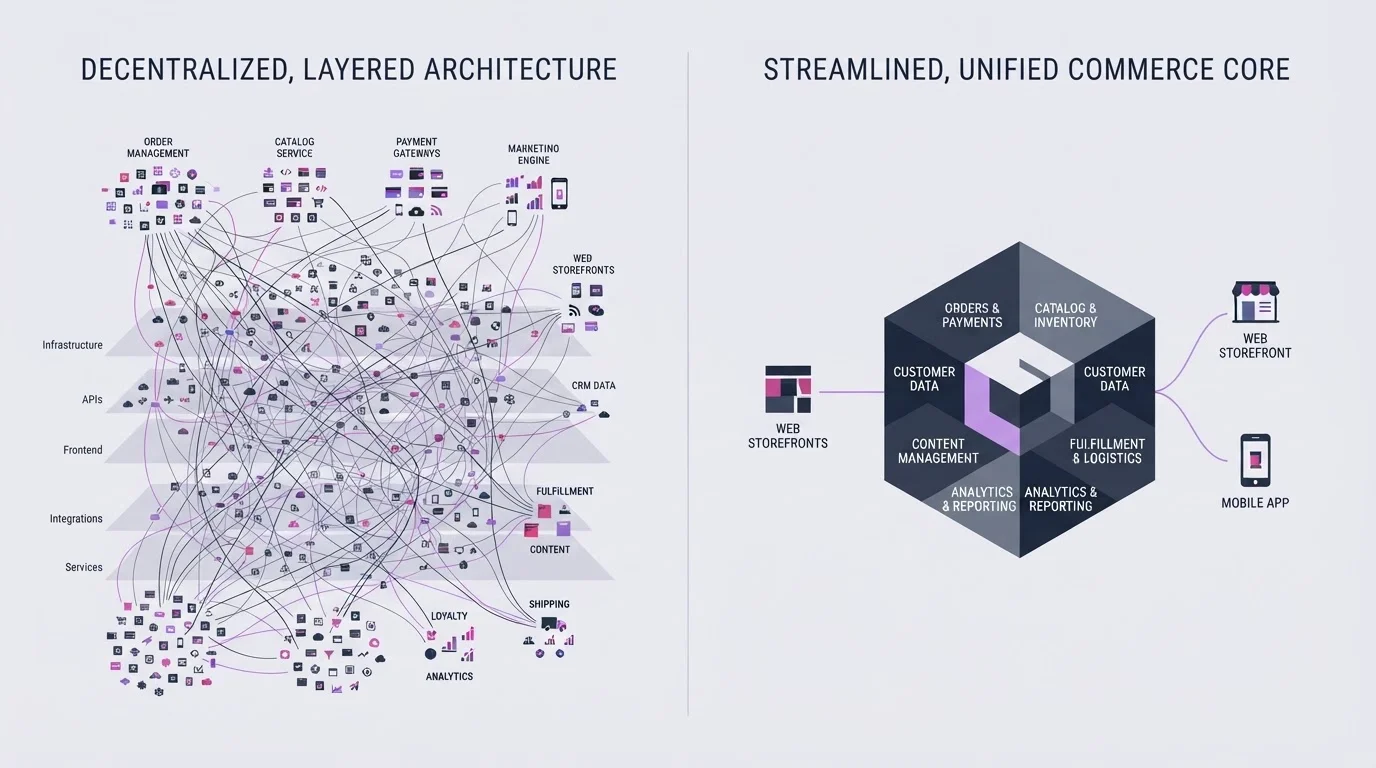
| Architectural Metric | Composable Architecture (Spryker) | Unified Enterprise Platform (Supercommerce) |
|---|---|---|
| System Design | Modular & decoupled (750+ modules) | Unified single core for all channels |
| Mobile Experience | Headless frontend development required | Built-in native mobile commerce |
| Integration Path | Glue APIs & Eco Modules (SAP, Oracle) | Deep, unified native enterprise integrations |
| Engineering Dependency | High (Framework expertise required) | Balanced (Focus on configuration and scale) |
| Target Use Case | Highly custom non-standard workflows | High-performance, multi-channel scale |
Spryker provides an advanced, flexible architecture for organizations with complex commerce requirements and the internal technical talent to leverage a modular framework. However, for large enterprises seeking to launch high-performance web and native mobile commerce without the developer overhead of multi-component orchestration, a unified platform like Supercommerce offers a faster, highly integrated path to scale.
Strategic Insights for Enterprise Commerce
Receive in-depth perspectives on unified platforms, scalability, and complex integrations for large-scale commerce operations.
Frequently Asked Questions
Q: How many modules does the Spryker Commerce OS include?
Spryker features over 750 independently deployable modules that allow businesses to build a custom commerce stack.
Q: Does Spryker support standard ERP systems?
Yes, Spryker uses Eco Modules to provide certified connectors for major systems including SAP, Microsoft Dynamics 365, and Oracle ERP.
Q: What is the difference between headless and unified commerce?
Headless commerce decouples the frontend from the backend, often requiring multiple vendors or custom layers. Unified commerce, like Supercommerce, manages web and native mobile experiences from a single, integrated core.