
On this page
For digital leaders navigating high-volume retail operations, evaluating an enterprise commerce platform comparison is a foundational architectural decision. The choice between a unified commerce platform and a composable stack shapes how an organization handles complex catalogs, deep enterprise resource planning (ERP) systems, and multi-channel fulfillment. While marketing narratives frequently celebrate the granular modularity of composable setups, operational reality often reveals a stark trade-off between conceptual flexibility and the heavy technical debt of managing multiple disconnected vendors. Selecting the right model requires looking past industry buzzwords to analyze how each architecture supports workflows, technical scaling, and modern storefront performance.
Core Architecture: Integration vs. Orchestration
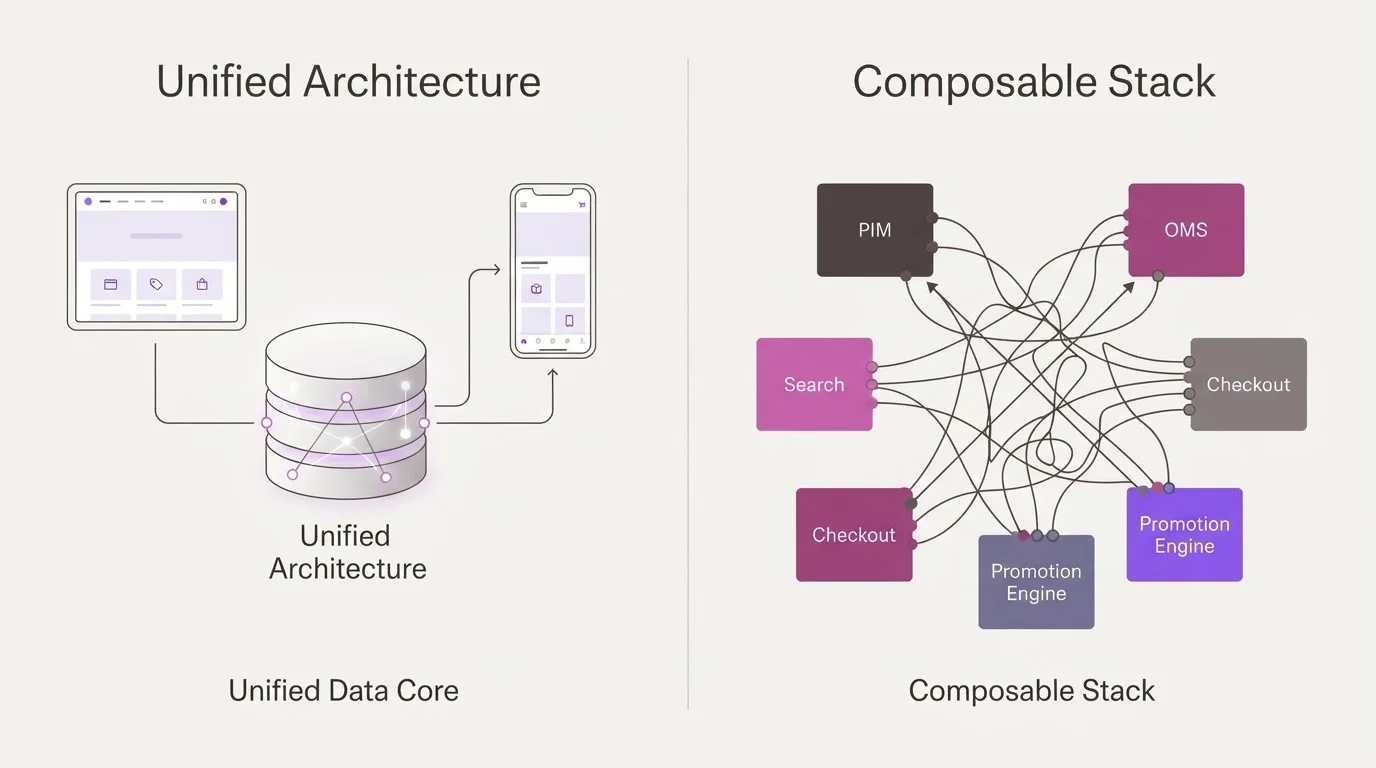
The primary operational divide between these paradigms lies in where data logic and orchestration reside. In a unified commerce platform, the core modules—such as the Product Information Management (PIM) system, Order Management System (OMS), inventory tracking, and frontend rendering engines—share a single native data layer. This structural alignment allows updates to product details, custom pricing matrices, and global inventory counts to sync automatically across all customer touchpoints without reliance on custom middleware or batch synchronization jobs.
Conversely, composable commerce vs unified frameworks involve assembling separate microservices, often using an API-first, cloud-native, and headless approach. While this theoretical modularity lets teams pick separate tools for checkout, search, and content management, it shifts the entire burden of data integrity and system orchestration to your internal software engineers. Instead of working with a predictable platform ecosystem, your IT organization becomes a software integrator tasked with managing multiple contracts, monitoring disparate service level agreements (SLAs), and preventing API updates from disrupting downstream transaction flows.
The Unified Workflow: Operational Efficiency at Scale
A unified platform is engineered to remove the structural fragmentation that often slows down large enterprises. When web storefronts and native mobile channels operate on the same data architecture, back-office administration becomes highly efficient. For example, modifying a localized pricing tier or updating a complex product configuration rule happens once at the platform level and reflects immediately everywhere. This centralized workflow eliminates the cross-platform communication errors that frequently delay product rollouts across multi-brand or international storefronts.
The Composable Workflow: Granular Custom Component Control
Composable workflows prioritize the absolute independence of individual system parts. This structural independence can be advantageous for organizations with highly unique requirements, such as a legacy proprietary manufacturing configuration engine that standard architectures cannot accommodate. However, achieving this degree of control requires a permanent platform engineering team dedicated to building, testing, and securing the custom glue code that binds these distinct services together. When a single checkout failure occurs, identifying the root cause demands auditing multiple API layers, which can extend resolution timelines.
Unified vs. Composable: Core Architectural Comparison
For teams managing a high GMV ecommerce platform, analyzing long-term maintenance against initial setup agility is essential. The table below outlines how these two architectural philosophies function across key operational categories.
| Evaluation Metric | Unified Enterprise Platform | Composable Commerce Stacks |
|---|---|---|
| Data Architecture | Single, synchronized native data model | Distributed microservices & independent databases |
| Deployment Speed | Rapid deployment via native features | Protracted timeline for custom API assembly |
| Mobile Architecture | Native mobile & web built into core platform | Separate custom mobile application builds required |
| Integration Tax | Lower via native ERP, CRM, and system connectors | High ongoing maintenance of custom orchestration layers |
| Cost Predictability | Single consolidated platform license fee | Fragmented multi-vendor software and support fees |
| Primary Requirement | Operational scale, speed, and platform control | Highly unique niche functionality with large internal dev teams |
Strategic Insights for Enterprise Commerce
Receive in-depth perspectives on unified platforms, scalability, and complex integrations for large-scale commerce operations.
The Total Cost of Ownership Reality
Total Cost of Ownership (TCO) is a critical yet frequently miscalculated metric in enterprise commerce platform comparison evaluations. While standalone composable microservices can appear cost-effective on individual software vendor bills, the cumulative cost of custom frontend development, cloud hosting orchestration, and security monitoring can grow rapidly.
Unified platforms eliminate this financial unpredictability by providing a single point of technical accountability. When performance anomalies arise, there is no vendor finger-pointing between independent payment, cart, or search providers. For high-scale businesses, an integrated infrastructure translates into more reliable uptime, simpler security compliance audits, and a significantly reduced maintenance burden on the internal engineering organization.
Product Fit: Resolving the Native Mobile Gap
A notable limitation of legacy enterprise platforms and generic headless frameworks is their historical neglect of the mobile experience. Many installations rely heavily on responsive web design or basic hybrid WebViews to serve mobile users. These web wrappers often suffer from high latency, rigid user interfaces, and inconsistent checkout performance, which directly impacts customer retention.
Supercommerce explicitly solves this challenge by delivering a high-performance native mobile experience and web storefronts straight out of the box from a single platform. For brands aiming to build long-term customer loyalty, this unified architecture removes the multi-million dollar development hurdle of building and maintaining standalone iOS and Android codebases. By aligning native mobile commerce directly with web backends, enterprises ensure their customers receive fast, frictionless purchasing workflows across every single digital channel.
Frequently Asked Questions
Q: Is a modern unified commerce platform simply a rebranded legacy monolith?
No. Modern unified solutions like Supercommerce leverage cloud-native architectures and API-first designs. They provide the deep integration and speed of a single data model without the rigid, unmodifiable codebases that characterized legacy ecommerce platforms.
Q: Does composable commerce guarantee superior site performance?
Theoretically, choosing specialized individual engines for search or checkout can optimize specific actions. In practice, however, the networks of API calls and data round-trips between different vendors can introduce latency, whereas a finely tuned unified system processes transactions efficiently on a single infrastructure.
Q: When should an enterprise select a composable stack over a unified platform?
A composable approach is most appropriate when a business possesses highly customized, non-standard business logic that no enterprise product can support, alongside the substantial engineering budget necessary to sustain a dedicated internal development and orchestration team indefinitely.
Selecting an enterprise commerce platform is a decisive operational choice that influences your brand's growth trajectory for years to come. While the modular appeal of composable architecture is clear, the streamlined management and native mobile performance of a unified platform like Supercommerce offer a practical, highly scalable path for large enterprises. By bringing web storefronts, native mobile applications, and complex backend workflows under one reliable environment, your team can spend less time managing complex infrastructure and more time expanding your digital market share.