
On this page
Global enterprises face a distinct challenge in multi-brand and multi-region commerce: orchestrating immense technical complexity without sacrificing operational control. While basic storefronts are easily deployed, the underlying infrastructure must support localized pricing, regional logistics, and disparate brand identities across dozens of markets. VTEX addresses these needs through a modular, MACH-based architecture that utilizes Accounts and Trade Policies to segment global operations.
This architectural choice offers significant flexibility for organizations with diverse business models, but it introduces a specific set of trade-offs regarding administrative overhead and data fragmentation. Selecting the right platform requires a clear understanding of your tolerance for integration debt versus the necessity for a unified commerce engine. This evaluation explores how VTEX manages global scale and where its composable nature may conflict with the centralized control required by enterprise IT leaders. We also examine how unified alternatives like Supercommerce address the performance and mobile-first needs that often become bottlenecks in account-based architectures.
The Architecture of Scale: How VTEX Manages Multiple Environments
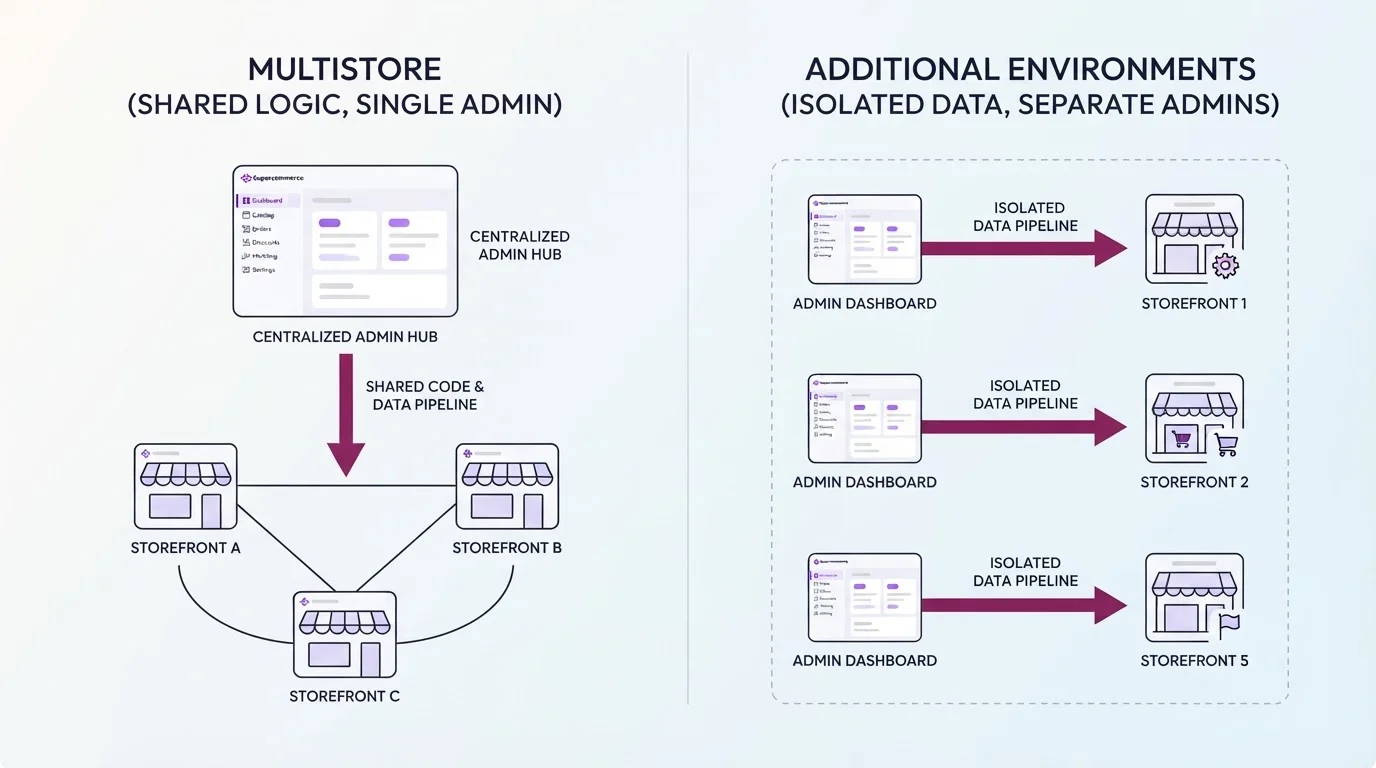
VTEX manages multi-brand and multi-region operations through a hierarchical account structure designed to isolate business units while allowing for varying degrees of shared logic. For IT directors, the choice between a Multistore setup and Additional Environments is the most consequential decision in the planning phase.
In a Multistore (or Multidomain) setup, multiple brands or regional storefronts exist within a single VTEX account. This model is generally ideal for brands that share a logistics infrastructure, payment providers, and a core catalog. However, because these stores share a single Admin, administrative permissions are less granular. If one regional team requires strict data siloing from another, the shared Admin environment can pose significant governance and security challenges.
Conversely, an Additional Environment provides a completely independent VTEX Admin. This is the preferred route for enterprises operating across vastly different regulatory regions where data residency, tax logic, and local management teams require total autonomy. While this provides the highest level of control, it creates a fragmented management experience. Settings, promotions, and third-party integrations must often be maintained separately for every account, leading to a "management tax" that scales with every new region added.
Bindings and Trade Policies: The Logic Behind Localization
The technical engine behind VTEX's localization is the relationship between Bindings and Trade Policies. A Binding acts as the unique identifier that links a specific URL and store name to a specific Trade Policy and sales channel. This mechanism is essential for managing multiple stores within a single VTEX account without overlapping logic.
Trade Policies function as the rule-setters for the commerce operation. They define catalog assortment, pricing strategies, and logistics fulfillment. For a CTO, the complexity lies in the maintenance of these rules across a global footprint. As an enterprise scales to dozens of regions, the matrix of Trade Policies can become difficult to audit. Without robust middleware or a centralized PIM to synchronize inventory logic, the risk of pricing errors or fulfillment failures increases.
Evaluating Enterprise Control and Global Customization
Enterprise control is not merely about managing SKUs; it is about how the platform interacts with the broader tech stack. VTEX utilizes an API-first, MACH (Microservices, API-first, Cloud-native, Headless) approach for composable commerce. This allows for integration with third-party systems via a robust API gateway, enabling teams to swap out components as regional needs evolve.
VTEX supports integration with external identity providers via SAML 2.0 for Admin access and OAuth 2.0 for storefronts, enabling Single Sign-On (SSO) across global teams. Furthermore, the VTEX IO development platform allows teams to build custom components and integrate specialized regional tools, such as local tax engines or country-specific ERPs.
However, the composable nature of the platform means the enterprise is ultimately responsible for the orchestration layer. If a global strategy involves different CRMs or loyalty engines for different continents, the IT team must manage those disparate data flows. This frequently leads to business logic being buried in custom middleware that is expensive to maintain and difficult to update during global platform migrations.
AI-Native Localization: Managing Content at Scale
Managing localized content is a primary friction point for multi-region brands. VTEX has introduced GenAI-powered content optimization through its AI Workspace to address this. This tool allows commerce teams to generate and optimize product descriptions and SEO metadata across different markets simultaneously.
For enterprises, the value lies in brand voice consistency. The AI can be trained on brand-specific context, ensuring that a product description in one language maintains the same tone in another. However, regional brand managers still play a critical role. AI localization is a significant productivity booster, but it does not replace the need for oversight regarding regional dialects and cultural nuances that automated systems might miss.
Comparing VTEX with Unified Enterprise Alternatives
While VTEX provides a powerful toolkit for composable commerce, the complexity of managing multiple accounts and third-party integrations can slow time-to-market. This is where a unified commerce platform like Supercommerce offers a different strategic path.
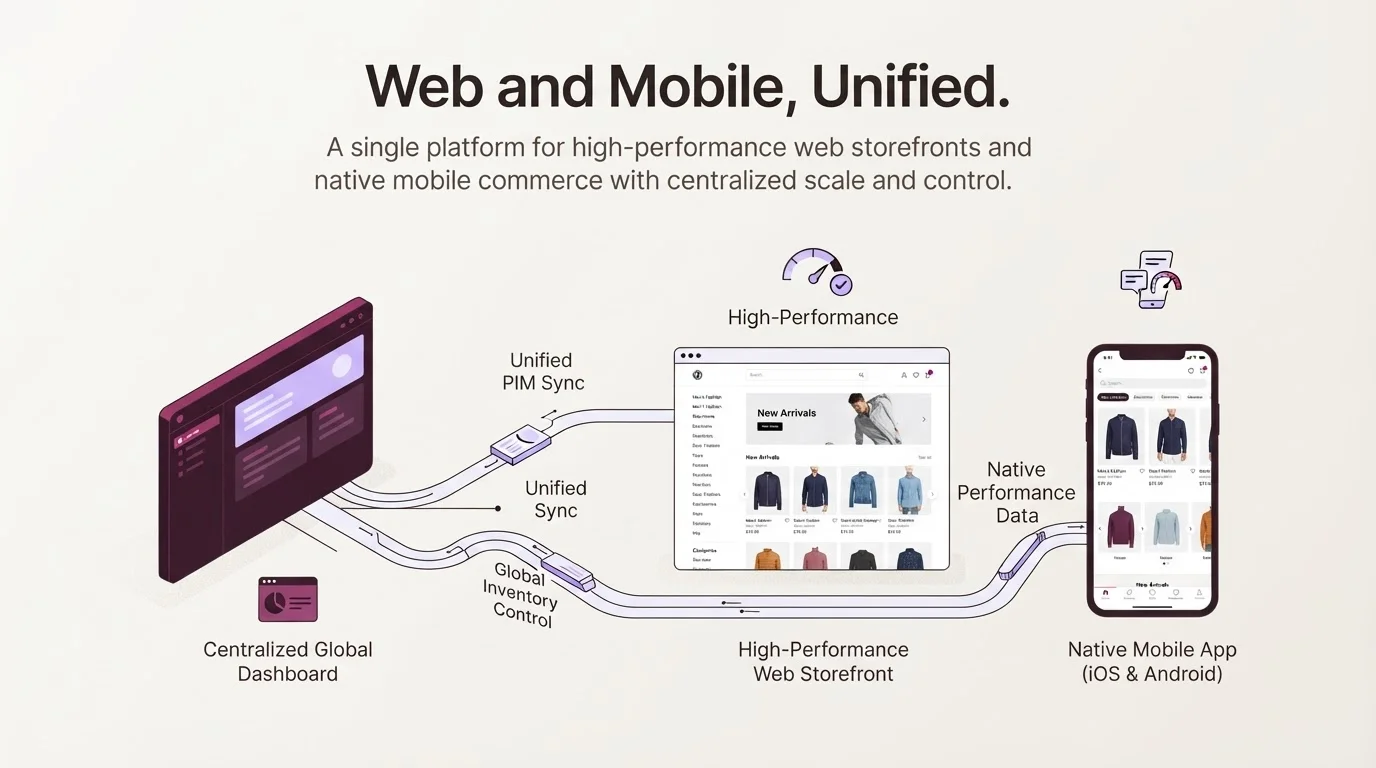
Supercommerce is built for enterprises that require a single, unified solution for high-performance web storefronts and native mobile commerce. Unlike platforms that rely on independent accounts for each region, Supercommerce consolidates core functions like the PIM and OMS into a single environment. For IT teams, this translates to a single source of truth for global inventory and customer data, eliminating the need for complex middleware syncs between regional silos.
Strategic Insights for Enterprise Commerce
Receive in-depth perspectives on unified platforms, scalability, and complex integrations for large-scale commerce operations.
Feature Comparison: VTEX vs. Supercommerce
| Feature | VTEX for Enterprise | Supercommerce |
|---|---|---|
| Core Architecture | Composable MACH (Account-based) | Unified Enterprise Stack |
| Multi-Region Management | Independent Admins or Bindings | Centralized Global Dashboard |
| Mobile Experience | Headless / PWA / Responsive | Native iOS & Android (Not WebView) |
| Catalog Complexity | Segmented by Trade Policies | Unified PIM for Multi-Brand Scales |
| Integration Needs | High (Requires Middleware for Sync) | Low (Native OMS/PIM/CRM) |
| Identity Management | SAML 2.0 / OAuth 2.0 | Enterprise SSO + RBAC |
| Mobile Performance | Depends on Front-end Implementation | High-Performance Native Code |
The Strategic Trade-offs: Integration Debt vs. Control
When evaluating VTEX for a global rollout, IT leaders must weigh specific operational risks. If you choose the Additional Environment route for total regional autonomy, your global IT team inherits multiple instances to patch, update, and audit. A simple change in global pricing strategy might require manual updates across every account, increasing the likelihood of human error.
Another critical consideration is the mobile strategy. VTEX offers headless capabilities, but many enterprises fall back on responsive web storefronts to save development time. For category-leading brands, a responsive site wrapped in a WebView is often insufficient for high-conversion mobile shopping. Supercommerce differentiates by providing native mobile commerce that is deeply integrated into the core platform, ensuring high performance where modern customers actually spend their time.
Finally, customer data fragmentation is a risk in multi-account setups. If a customer shops with Brand A in one region and Brand B in another, the enterprise may struggle to create a unified profile without an expensive Customer Data Platform (CDP) integration. This fragmentation can hinder cross-brand loyalty programs and dilute global marketing efforts.
Supercommerce: The Unified Alternative for Large-Scale Enterprise
Supercommerce is designed for the high-volume enterprise that has outgrown the complexity of composable silos. By providing a single platform to run high-performance web storefronts and native mobile commerce, it offers the scale and control that complex catalogs require without the heavy "integration tax" associated with multi-account architectures.
For CIOs, the value proposition is focused on reducing the number of moving parts. Instead of managing a separate PIM, a separate OMS, and various regional commerce accounts, Supercommerce provides these as native capabilities. This leads to faster deployment cycles, lower total cost of ownership (TCO), and a truly unified customer experience across every brand and region in the portfolio.
Frequently Asked Questions
Q: Can VTEX handle different tax rules for dozens of countries?
Yes, VTEX allows for custom checkout logic and integrates with third-party tax engines like Avalara or Vertex through its API gateway to manage regional compliance.
Q: Does VTEX share inventory across different brands?
In a Multistore setup, inventory can be shared but is segmented by Trade Policies. In an Additional Environment setup, inventory is siloed by default unless integrated via a central OMS or external middleware.
Q: How does VTEX ensure mobile performance for global brands?
VTEX supports headless commerce and Progressive Web Apps (PWA) via VTEX IO. However, for high-performance native experiences, enterprises typically need to build and maintain separate native mobile applications.
Q: Is VTEX’s GenAI available for all languages?
VTEX’s AI Workspace is designed for global scale and supports major commercial languages for content localization, though regional dialects should be reviewed by local brand managers for accuracy.
Strategic Decision: Composable or Unified?
VTEX remains a robust choice for enterprises that want to build a highly customized, composable commerce ecosystem and possess the engineering resources to manage the resulting integration layers. Its account-based architecture provides the autonomy regional teams often prioritize, though it comes at the cost of administrative complexity and potential data fragmentation.
For enterprises processing significant annual GMV that prioritize speed, native mobile performance, and centralized control, the unified approach of Supercommerce is often the more sustainable path. By eliminating the need for disparate regional accounts and providing a single, high-performance engine for both web and native mobile, Supercommerce allows IT leaders to focus on market growth rather than managing the friction of their own infrastructure.