
On this page
For enterprise-scale commerce, the transition to Shopify Plus often hinges on two critical architectural questions: Can the platform handle a complex, multi-layered product catalog without degrading performance, and can it execute intricate, contract-based pricing logic at the checkout? As product data grows in volume and variety, the technical debt of maintaining a standard SaaS storefront can become a significant operational burden for $100M+ GMV companies.
Shopify Plus has evolved to address these needs by increasing its variant limits and introducing Shopify Functions for custom logic. However, for businesses processing high annual transaction volumes, the platform's reliance on a fragmented app ecosystem and native constraints on product options can create performance bottlenecks. While Shopify Plus is a powerful tool for high-growth brands, enterprises with deeply complex data structures may find that a unified platform like Supercommerce offers the control and native mobile integration that generic solutions lack.
Managing Complex Catalogs: Variants, Options, and Metaobjects
A primary friction point for enterprise merchants has long been the ceiling on product variations. Shopify recently addressed this by increasing the limit to 2,000 variants per product, which better accommodates large apparel matrices and complex electronics. This allows brands to manage extensive SKUs under a single product record, simplifying inventory tracking across multiple locations.
Despite this increase, the native system often restricts products to a limited number of options, such as size, color, and material. If your product requires additional attributes like voltage, finish, or regional compliance standards, you must often turn to custom development or third-party apps. This can lead to "app creep," where multiple external scripts interact with your catalog, potentially slowing down front-end performance and complicating data synchronization.
Scalable Data with Metaobjects
To manage data beyond standard fields, Shopify Plus leverages Metaobjects. These allow you to define custom data structures—like technical specifications, brand profiles, or assembly instructions—that can be reused across thousands of products. Metaobjects provide the scalability needed for massive content libraries without cluttering the primary product database.
For large-scale brands, the challenge is often not storage but rendering speed. Large catalogs requiring complex loops through thousands of variants can strain standard Liquid templates. In these high-stakes environments, enterprises often adopt a headless architecture or a dedicated Product Information Management (PIM) system to maintain sub-second load times while managing complex attribute relationships across different global markets.
Custom Pricing Rules: B2B Catalogs and Shopify Functions
Enterprise pricing is rarely static, especially in B2B environments where negotiated rates and contract pricing are the standard. Shopify Plus manages this through Catalogs, which allow you to assign specific price lists to company profiles. This enables you to offer different prices to different customers without creating duplicate products or separate storefronts.
For logic that falls outside standard discounts, Shopify Functions provides a way to inject custom code into the backend. These functions are compiled to WebAssembly and run in the checkout process, ensuring high performance even with complex rules. Common use cases include tiered volume discounts, dynamic bundling, and shipping validation rules tailored to specific customer groups.
The Operational Cost of Complexity
While Shopify Functions are powerful, they still operate within the constraints of the Shopify core architecture. Large enterprises often face variable platform fees on B2B orders, which are typically calculated as a percentage of GMV. Additionally, complex loyalty integrations or sophisticated multi-tier pricing often require multiple third-party subscriptions, which can fragment your data and increase the total cost of ownership over time.
Strategic Insights for Enterprise Commerce
Receive in-depth perspectives on unified platforms, scalability, and complex integrations for large-scale commerce operations.
Unified Performance: Comparing Shopify Plus to Supercommerce
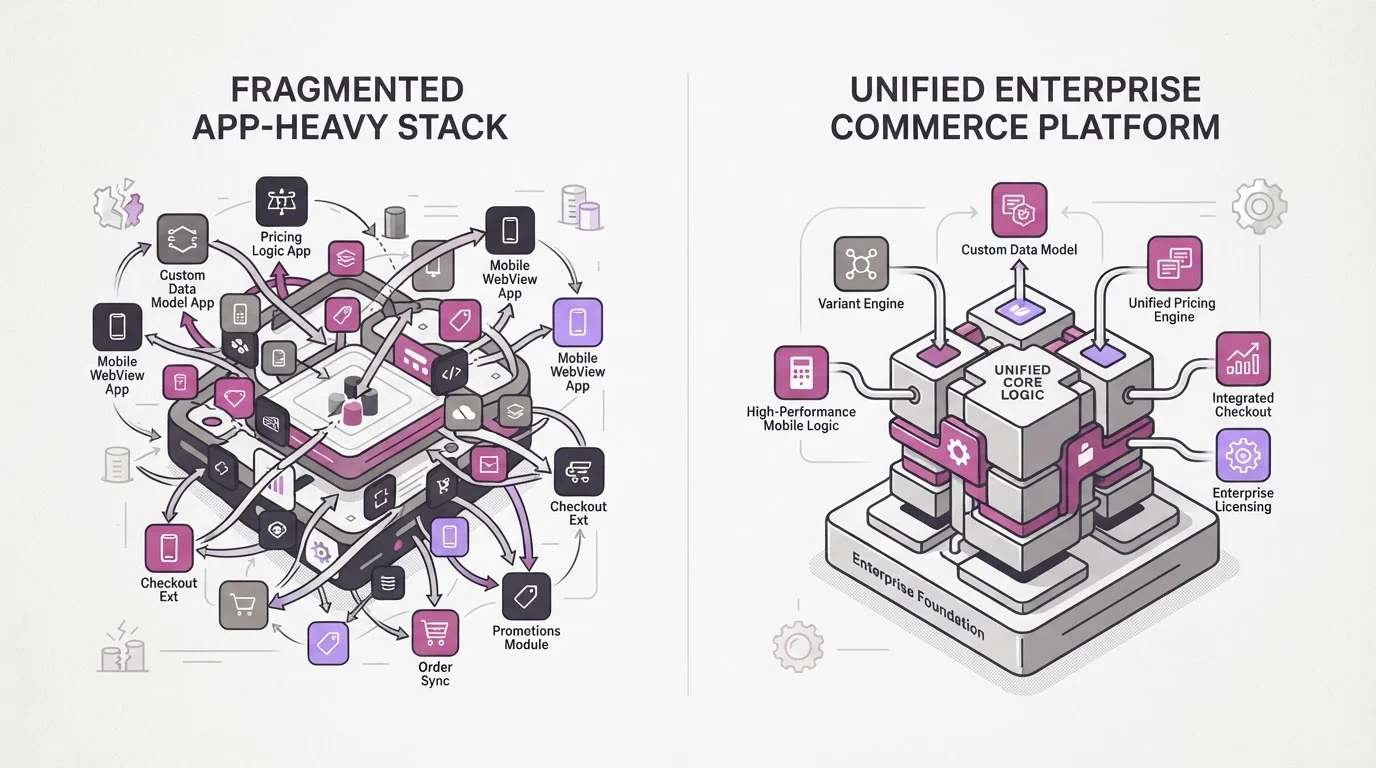
For many large enterprises, the primary trade-off is between ecosystem depth and native control. Shopify Plus offers a massive marketplace of apps, but these can lead to data silos and neglected mobile experiences. Supercommerce provides a unified enterprise commerce platform built specifically for high-performance web and native mobile commerce, eliminating the friction of a fragmented stack.
| Feature | Shopify Plus | Supercommerce |
|---|---|---|
| Variant Support | Up to 2,000 Variants | Custom Data Models |
| Pricing Engine | Catalogs + Shopify Functions | Native Unified Pricing Engine |
| Mobile Strategy | Responsive Web / WebView Apps | High-Performance Native Mobile |
| Logic Customization | App-Heavy Extensions | Unified Core Logic |
| Licensing | Subscription + GMV % Fees | Custom Enterprise Licensing |
When Should You Move Beyond Shopify Plus?
Shopify Plus is an excellent fit for brands that value speed-to-market and a wide variety of off-the-shelf marketing tools. However, you should evaluate alternatives if your business faces specific complexity thresholds. If you require native Request for Quote (RFQ) engines or complex multi-tier approval workflows, the custom engineering required on Shopify may outweigh the benefits of the platform.
Mobile revenue is another critical factor. If the majority of your traffic is mobile, a responsive website wrapped in a WebView will not convert as effectively as a native mobile experience. Supercommerce is designed for these high-stakes environments, offering a single source of truth that powers both the high-performance web storefront and the native mobile app without the overhead of dozens of third-party apps.
Frequently Asked Questions
Q: Can Shopify Plus handle products with more than 3 options?
Natively, Shopify is structured for a limited number of options like size and color. To add more, you must use custom Metaobjects or the new product model, which allows for expanded attributes but may require updated API versions.
Q: How does Shopify Plus handle dynamic pricing for B2B?
It uses Catalogs to set fixed prices or percentage discounts for specific companies. For more advanced logic, such as category-specific bulk discounts, you must implement Shopify Functions.
Q: Is there a limit on the number of B2B price lists?
Shopify Plus allows for an unlimited number of catalogs, whereas lower-tier Shopify plans are restricted to a much smaller number or do not have access to these features.
Q: Does Shopify Plus charge fees for B2B sales?
Yes, Shopify Plus typically applies variable platform fees to B2B orders based on the total GMV, regardless of whether the payment is processed through their gateway or via external methods like bank transfers.
Conclusion
Shopify Plus has made significant strides in accommodating complex catalogs through its 2,000-variant expansion and Metaobject framework. It remains a top-tier choice for merchants who need a broad ecosystem of marketing tools. However, for large enterprises where scale, control, and a unified mobile experience are non-negotiable, native constraints can lead to operational overhead. Platforms like Supercommerce are built to eliminate this friction, providing a high-performance alternative for businesses that have outgrown generic SaaS solutions.