
On this page
Evaluating a commerce platform for high-volume enterprise operations requires moving beyond standard feature checklists. For organizations managing substantial annual transaction volumes, the primary objective is ensuring the underlying architecture supports complex catalogs, high-frequency workflows, and seamless multi-channel synchronization without creating massive maintenance overhead.
BigCommerce Enterprise positions itself as an "Open SaaS" platform, aiming to blend the operational simplicity of a managed cloud environment with the architectural flexibility of an API-first framework. This guide provides an objective evaluation of BigCommerce Enterprise features and product fit, analyzing its core capabilities, specialized B2B workflows, and architectural trade-offs to help IT directors and enterprise commerce leaders make an informed decision.
Core Features for Complex Enterprise Catalogs
The core value proposition of BigCommerce Enterprise centers on centralizing large-scale data and orchestrating multiple sales channels from a unified backend. For technology leaders managing complex infrastructure, the main architectural consideration is how efficiently data flows across disparate touchpoints.
A primary capability of the platform is its capacity to let users sync, automate, and optimize their data across 150+ leading marketplaces, social commerce, and advertising channels. This centralized data synchronization helps mitigate the operational friction that typically occurs when businesses expand across multiple third-party channels such as Amazon, Walmart, or eBay.
In addition to external channel syndication, the platform provides specific tools to help users manage their store's privacy and security. By maintaining structural compliance and offering a dedicated Trust Center, the architecture allows security teams to verify protocols and ensure alignment with global data protection mandates and internal enterprise risk compliance frameworks.
Multi-Storefront (MSF) Architecture
For multi-brand organizations and corporate entities operating across disparate markets, the Multi-Storefront (MSF) feature serves as a foundational component. MSF enables digital teams to deploy and govern multiple distinct storefronts—each with unique domains, layouts, and product assortments—directly from a single administrative control panel.
This architecture lets users connect with shoppers around the globe by tailoring storefront presentation to localized customer segments. Because these localized environments run on a shared backend infrastructure, enterprise teams can maintain uniform inventory tracking and centralized order fulfillment rules without replicating core operational logic across multiple separate software instances.
Enterprise B2B Workflows and Account Management
Traditional business-to-business purchasing patterns frequently break standard retail e-commerce configurations. BigCommerce Enterprise addresses complex B2B needs through its specialized B2B Edition, which embeds workflows tailored around relationship-based procurement and multi-tiered corporate accounts into the system architecture.
Rather than forcing a linear checkout process, these B2B workflows prioritize the nuances of contract-driven commerce:
- Customer-Specific Pricing: Digital teams can assign unique price lists to precise corporate accounts or defined customer groups, enforcing pre-negotiated buyer contracts automatically.
- Purchase Order (PO) Management: The checkout flow accommodates standard enterprise purchasing habits by enabling payment via automated PO systems alongside traditional digital payment rails.
- Shared Shopping Lists: Multiple buyers operating under a single corporate umbrella account can collaborate, review, and add items to a shared requisition list prior to final procurement approval.
- Quote Management Engines: An integrated request-for-quote (RFQ) mechanism allows sales personnel to review, modify, and approve custom quotes directly within the administrative dashboard before a buyer commits to a transaction.
Assessing the Financial and Operational Fit
Understanding total cost of ownership (TCO) requires analyzing both platform licensing fees and downstream system integration requirements. For organizations demanding maximum performance, dedicated infrastructure capacity, and priority API routing, the top-tier configuration is explicitly structured: BigCommerce Enterprise Scale is listed at $33,333 per month.
While the underlying platform operates as a fully hosted SaaS model to reduce baseline server maintenance, enterprise deployment timelines depend heavily on integration complexity. The platform's API-first structure facilitates connections with legacy technology stacks, but linking the transactional engine to existing Enterprise Resource Planning (ERP) applications, Warehouse Management Systems (WMS), and Customer Relationship Management (CRM) tools will require structured engineering resources and rigorous middleware validation.
Strategic Insights for Enterprise Commerce
Receive in-depth perspectives on unified platforms, scalability, and complex integrations for large-scale commerce operations.
Architectural Trade-offs and the Native Mobile Gap
While the platform delivers strong multi-channel web storefront capabilities, large-scale enterprises must carefully evaluate how its architectural focus aligns with their mobile commerce strategies. Most enterprise SaaS platforms focus fundamentally on mobile-responsive web development—meaning the core storefront is a web application that shrinks to fit handheld screens.
For major brands where mobile apps represent a primary channel for loyalty, retention, and repeat ordering, relying entirely on a responsive website wrapped inside a basic container can introduce performance penalties. Mobile web pages often lack the instant load times, offline availability, and deep device hardware integrations that modern procurement professionals and consumers expect from an application experience.
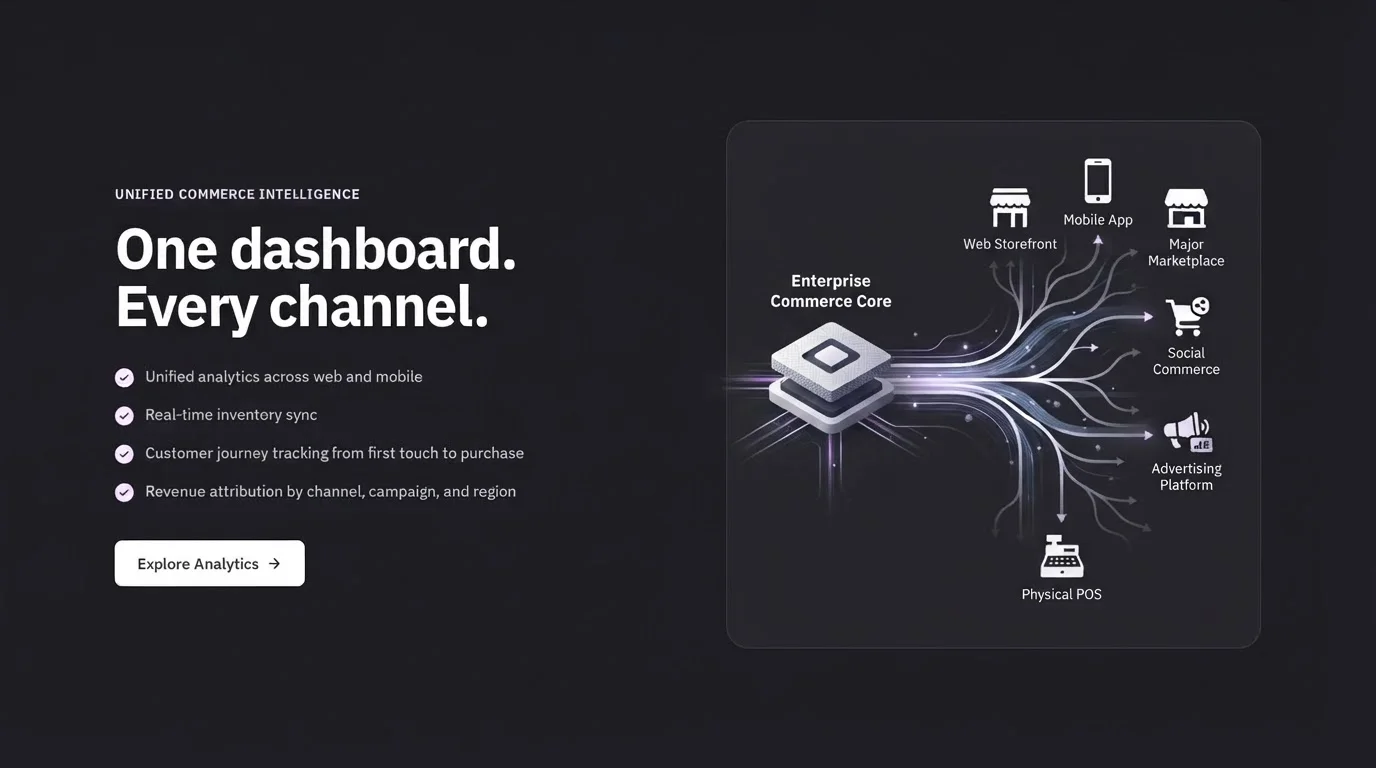
This specific operational gap highlights the distinction between a web-first SaaS model and platforms designed from the ground up for unified commerce. For instance, Supercommerce provides a single, unified solution for high-performance web storefronts and native mobile commerce out of the box. By managing both architectures simultaneously, it eliminates the need to maintain a separate web backend and a fragmented mobile application development pipeline.
Additionally, enterprise teams with exceptionally dense catalogs must perform thorough technical validation. While top-tier plans offer high API volume allowances, physical data handling thresholds still apply. Organizations processing heavy catalog mutations or massive variant matrices should systematically map their catalog schemas against platform thresholds to avoid indexing delays or data latency during large inventory updates.
A Structured Process to Evaluate Product Fit
To determine whether BigCommerce Enterprise aligns with your organizational growth objectives and technical architecture, execute this structured evaluation framework:
- Analyze Peak Infrastructure Demands: Verify if the platform’s performance tier can sustain your forecasted concurrent user volumes and transactional spikes during peak demand periods without performance degradation.
- Audit the Integration Matrix: Map every data synchronization point between the commerce backend and your corporate ERP, CRM, or PIM. Determine if out-of-the-box connectors fulfill your requirements or if custom API development is required.
- Evaluate Your Mobile Strategy: Assess whether a responsive web experience satisfies your user base, or if your operational goals require a native mobile application to optimize conversion rates and buyer engagement.
- Calculate Complete TCO: Model your multi-year expenditure by combining base platform subscription fees—benchmarking against the $33,333 per month Scale tier if your volume requires maximum infrastructure priority—with custom development, third-party applications, and continuous integration maintenance.
Frequently Asked Questions
Q: Does BigCommerce Enterprise offer unlimited API calls?
Yes, BigCommerce Enterprise plans typically offer unlimited API calls, though usage is still subject to the platform’s stability terms and physical infrastructure constraints to ensure reliable performance for all users.
Q: How does the Multi-Storefront (MSF) feature affect billing?
MSF allows you to manage multiple storefronts from one account, but billing is generally influenced by the total GMV processed across all storefronts and the specific service level agreement (SLA) required for your contract.
Q: Is the BigCommerce B2B Edition a separate product?
The B2B Edition is a specific bundle of functionality and applications offered to BigCommerce Enterprise customers to provide advanced wholesale and account management features natively.
BigCommerce Enterprise represents a robust solution for brands scaling their digital operations, providing substantial architectural agility via an open API framework and effective multi-channel data synchronization. However, for high-volume enterprises that view native mobile touchpoints as a core revenue driver, selecting a responsive-first platform requires balancing the trade-offs of secondary development pipelines. Comparing these models against a unified platform like Supercommerce, which handles high-performance web and native mobile code bases simultaneously, ensures your final architectural selection supports long-term operational scale and control.