
On this page
For technology leaders at $100M+ GMV organizations, a commerce platform is not merely a digital storefront; it is an active orchestration layer within a complex technical ecosystem. Evaluating SAP Commerce Cloud for complex enterprise integrations requires looking past UI features to analyze how the platform handles high-volume data flows, custom business logic, and backend synchronization. While the SAP ecosystem offers deep native alignment for existing SAP users, it introduces significant architectural weight that demands specialized management.
Successfully navigating this environment requires a balance between the capabilities of the SAP Business Technology Platform (BTP) and the reality of long-term operational maintenance. This guide provides a technical framework to assess SAP's integration mechanisms, identify systemic latency points in multi-layered architectures, and evaluate unified alternatives designed to streamline enterprise commerce.
The Strategic Role of Integration in Enterprise Commerce Architecture
In large-scale enterprise environments, integrations connect applications across disparate platforms to transmit data and adapt workflows seamlessly. Effective integration goes beyond moving records between databases; it governs process orchestration across the entire value chain. When these connections suffer from latency or structural failures, the business faces immediate consequences: inaccurate inventory levels, delayed order fulfillment, and fragmented customer experiences.
Treating integration as a secondary phase rather than a core foundational requirement is a common pitfall. Technology leaders must map every data flow—from real-time, customer-specific pricing requests to multi-node warehouse updates. Gaps in these automated streams force organizations back to manual data entry into backend systems like SAP S/4HANA Cloud, which creates error-prone bottlenecks and limits the ability to scale. To achieve operational efficiency, the commerce engine must handle complex ERP data structures without relying on fragile, highly customized middleware.
Technical Deep Dive: SAP Commerce Cloud’s Integration Ecosystem
SAP Commerce Cloud utilizes the SAP Business Technology Platform (BTP) to orchestrate data flows between the storefront and external systems. Understanding this framework is necessary to verify if your engineering team has the specific skills required to maintain it. The platform offers several pathways for custom extension and backend connectivity, particularly for IT departments with extensive experience in SAP-specific languages.
One common pathway is creating an ABAP cloud project within the SAP BTP ABAP environment. This allows development teams to build custom extensions and manage repository objects using standard SAP languages. For instance, engineers can use the ABAP Repository Object Generator to build Business Configuration Maintenance Objects, facilitating structured backend data administration directly within the cloud environment. External data ingestion and communication are typically executed via OData services. Within the SAP BTP cockpit, developers configure explicit destinations to govern application access—such as establishing connectivity to external Northwind OData services for development and operational data verification.
While these specialized tools provide architectural flexibility, they also increase the number of independent layers your team must monitor. Developers can create a database table and generate UI services entirely within the SAP BTP ABAP environment, but every additional layer adds to the complexity of the overall system monitoring and security posture.
Navigating Challenges: ERP Connectivity and Resource Management
Integrating SAP Commerce Cloud with sophisticated ERPs like SAP S/4HANA Cloud surfaces clear technical hurdles. A primary obstacle is managing the resources available on the customer tenant. Developing enterprise-grade integration flows requires diligent tenant resource management; unoptimized data pipelines quickly exhaust compute boundaries, triggering service latency that degrades the live customer experience.
Beyond resource management, technology leaders must account for the operational pressures of legacy syncing. As transaction volumes climb, the frequency of API calls to backend systems grows. If the integration tier lacks native high-concurrency capabilities, it becomes a systemic bottleneck during seasonal peak traffic. This latency leaves organizations vulnerable to desynchronized data states, disrupting real-time order processing and inventory accuracy.
Furthermore, operating within this ecosystem demands strict compliance with official security and incident tracking protocols. When an exploit or technical issue is discovered, formal reports to SAP must document precise details, including the issue category, the exact affected product version (with support package and patch levels), the necessary pre- and post-conditions for the exploit to function, and a detailed description accompanied by a proof of concept. This level of administrative overhead is a necessary component of maintaining a legacy-aligned suite.
Total Cost of Ownership Analysis for Legacy Suites
The long-term cost of implementing and maintaining complex enterprise integrations extends far beyond initial software licensing. For organizations operating at scale, the primary financial drivers accumulate during post-launch maintenance, custom development, and version updates. Building and managing repository objects or generating customized UI services within the SAP BTP ABAP environment demands highly certified, specialized engineering talent. These skills are often more expensive to recruit and retain than those required for platforms built on widely adopted modern web standards.
Organizations must also account for the baseline costs of running SAP BTP, data egress fees, and the infrastructure needed to support integration middleware. Over a standard five-year horizon, point-to-point custom integrations accumulate significant technical debt. Every mandatory software update or patch requires full regression testing across every custom-mapped integration flow, diverting development resources away from customer-facing product innovation and toward basic system maintenance.
SAP Commerce Cloud vs. Supercommerce: Architectural Integration
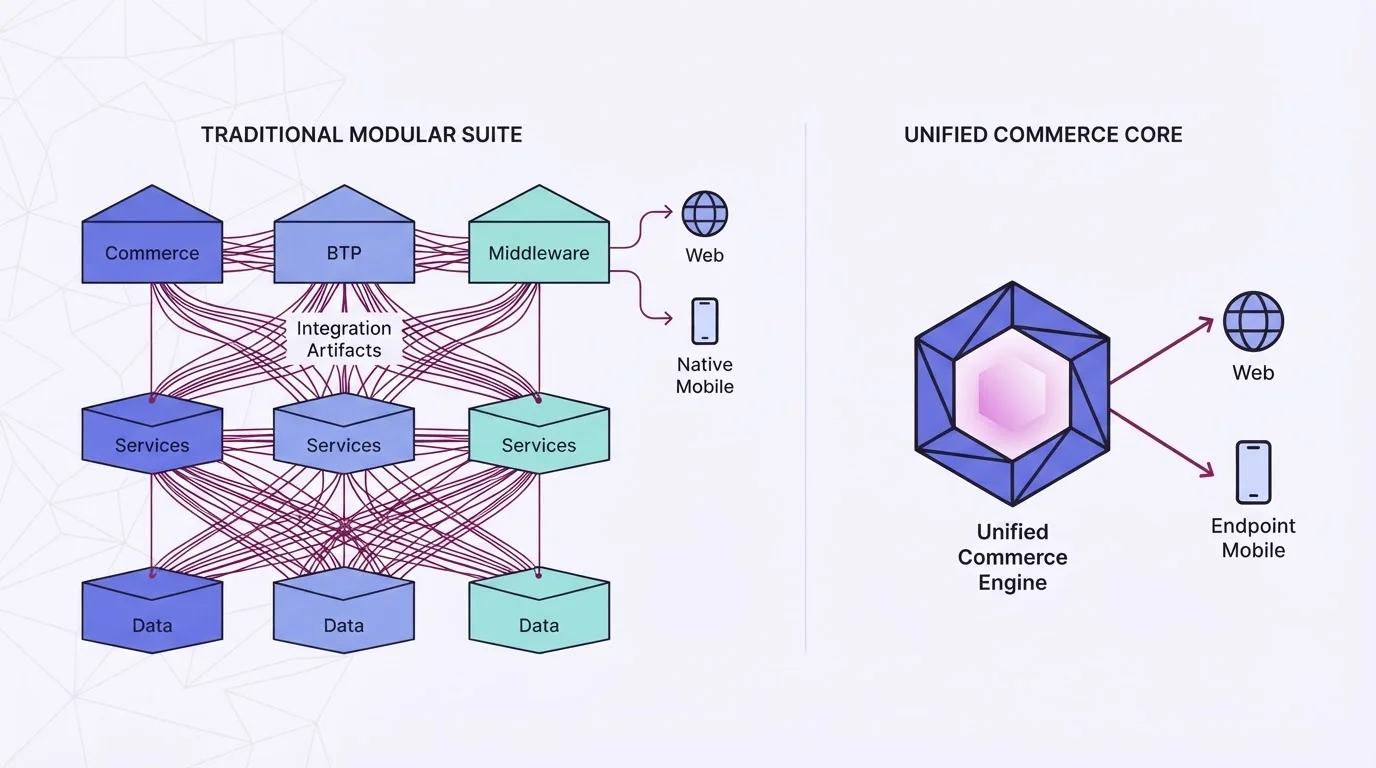
When evaluating legacy suites against a unified commerce architecture like Supercommerce, the critical distinction lies in structural complexity. SAP setups frequently mandate a multi-module, multi-vendor deployment model consisting of the core Commerce engine, SAP BTP, and specialized integration packages. In contrast, Supercommerce provides a single platform that handles enterprise commerce channels without brittle middleware layers.
| Integration Dimension | SAP Commerce Cloud | Supercommerce |
|---|---|---|
| Core Architecture | Modular & Layered (Requires SAP BTP) | Unified (Single High-Performance Engine) |
| Integration Logic | Custom ABAP Projects & OData Destinations | API-First with Native Enterprise Connectors |
| Resource Management | Diligent Customer Tenant Monitoring Required | Fully Managed Cloud-Native Infrastructure |
| Talent Requirements | Specialized (SAP BTP and ABAP Certifications) | Open Modern Web Standards (Node, Go, React) |
| Mobile Experience | Often Responsive Web or WebViews | Native Mobile Commerce Out-of-the-Box |
Supercommerce replaces multi-tiered middleware by running high-performance web storefronts and native mobile commerce from a single core engine. This architecture removes translation barriers, ensuring that the same high-performance logic powers every digital touchpoint.
Strategic Insights for Enterprise Commerce
Receive in-depth perspectives on unified platforms, scalability, and complex integrations for large-scale commerce operations.
Why Unified Platforms Reduce Integration Artifacts
Multi-module legacy architectures rely on preconfigured integration packages that contain numerous separate integration flows and value mappings—collectively known as integration artifacts. For example, a standard sales order fulfillment process between SAP S/4HANA Cloud and SAP Commerce Cloud depends on these artifacts to synchronize data fields across separate systems. While these packages provide a starting point, modifying them to support custom, enterprise-specific business rules requires complex custom mappings.
Unified commerce platforms eliminate this step by utilizing a shared data schema for all operational channels. When product information or pricing rules change in the central dashboard, those changes are reflected across web and native mobile channels without executing complex backend data transfers. This architectural shift eliminates a major source of integration failure and ensures that customers see consistent data regardless of the channel they choose.
A Framework for Evaluating Your Integration Strategy
To minimize architectural risk, CTOs can apply structured methodologies to align software capabilities with operational requirements. For example, the SAP Integration Solution Advisory Methodology evaluates technology selections by mapping them against customer context factors. Similarly, the initial scope of known integrations is typically captured via a Digital Discovery Assessment (DDA) during the early Discover phase of the SAP Activate Methodology.
CTOs can adapt these principles into a practical six-step framework to evaluate any enterprise commerce integration:
- Document the System Landscape: Catalog every active ERP, CRM, and PIM system, identifying legacy databases that lack modern web API compliance.
- Profile Data Throughput: Quantify the exact volume and update frequency for inventory, price lists, and customer profiles during peak transactional hours.
- Audit Engineering Skill Sets: Determine if your internal team possesses the specialized expertise required to manage ABAP cloud projects and SAP BTP, or if your roadmap favors open standards.
- Map Manual Gaps: Pinpoint where internal teams must execute manual data entries into the ERP, prioritizing integration patterns that natively automate these workflows.
- Project 5-Year Total Cost: Compile licenses, middleware subscriptions, specialized engineering payroll, and regression testing hours needed for mandatory upgrades.
- Execute a High-Stress Proof of Concept: Run a targeted pilot of a complex integration workflow—such as volume-tiered customer contract pricing—to verify system response latencies under heavy simulated loads.
Frequently Asked Questions
Q: What does a standard SAP integration package consist of?
An integration package consists of several preconfigured integration flows and value mappings designed for a specific business process. These individual components are formally referred to as integration artifacts.
Q: Is SAP BTP required to build custom code extensions for SAP Commerce Cloud?
While alternative models exist, creating an ABAP cloud project within the SAP BTP ABAP environment is the primary supported pathway to generate custom repository objects and manage backend services using SAP languages.
Q: How does a unified platform handle backend ERP synchronization differently?
A unified platform like Supercommerce avoids multi-layered middleware dependencies by utilizing high-speed API ingestion. Rather than synchronizing data across independent web and mobile databases via complex flows, all channels pull from a single core data engine.
Q: What is the purpose of the Digital Discovery Assessment (DDA)?
The DDA is executed during the initial Discover phase of the SAP Activate Methodology to formally document integration scopes and assess technical implementation complexity before development begins.
Selecting an enterprise commerce architecture requires balancing ecosystem capabilities against ongoing technical agility. SAP Commerce Cloud provides a robust environment for enterprises committed to an all-SAP infrastructure, though it demands ongoing alignment with BTP resource limits and specialized development workflows. For CTOs focused on maximizing execution velocity and minimizing technical debt, a unified enterprise platform presents a clear alternative.
By unifying core commerce logic and removing intermediate middleware translation layers, Supercommerce allows large enterprises to run high-performance digital storefronts that scale predictably. If your priority is to regain control over your technical roadmap and deliver a seamless, native mobile and web commerce experience, exploring a high-performance unified platform is the logical next step.