
On this page
Evaluating an sap commerce cloud multi brand configuration for global enterprise operations requires balancing robust transactional tools against severe implementation complexity and long-term development overhead. While the platform provides deep features to manage distinct storefronts and localized user experiences, enterprises routinely face deployment timelines spanning 8 to 18 months for complex multi-brand rollouts. For large organizations processing over $100M in annual Gross Merchandise Volume (GMV), these lengthy deployment cycles and structural rigidities can stifle international growth and delay critical market entries. This analysis explores how the platform handles global multi-site architectures, where its technical limitations manifest, and how modern unified alternatives like Supercommerce offer a more agile, high-performance path for multi-brand operations.
The Architecture of Global Scaling: Base Stores, Sites, and Multi-Brand Realities
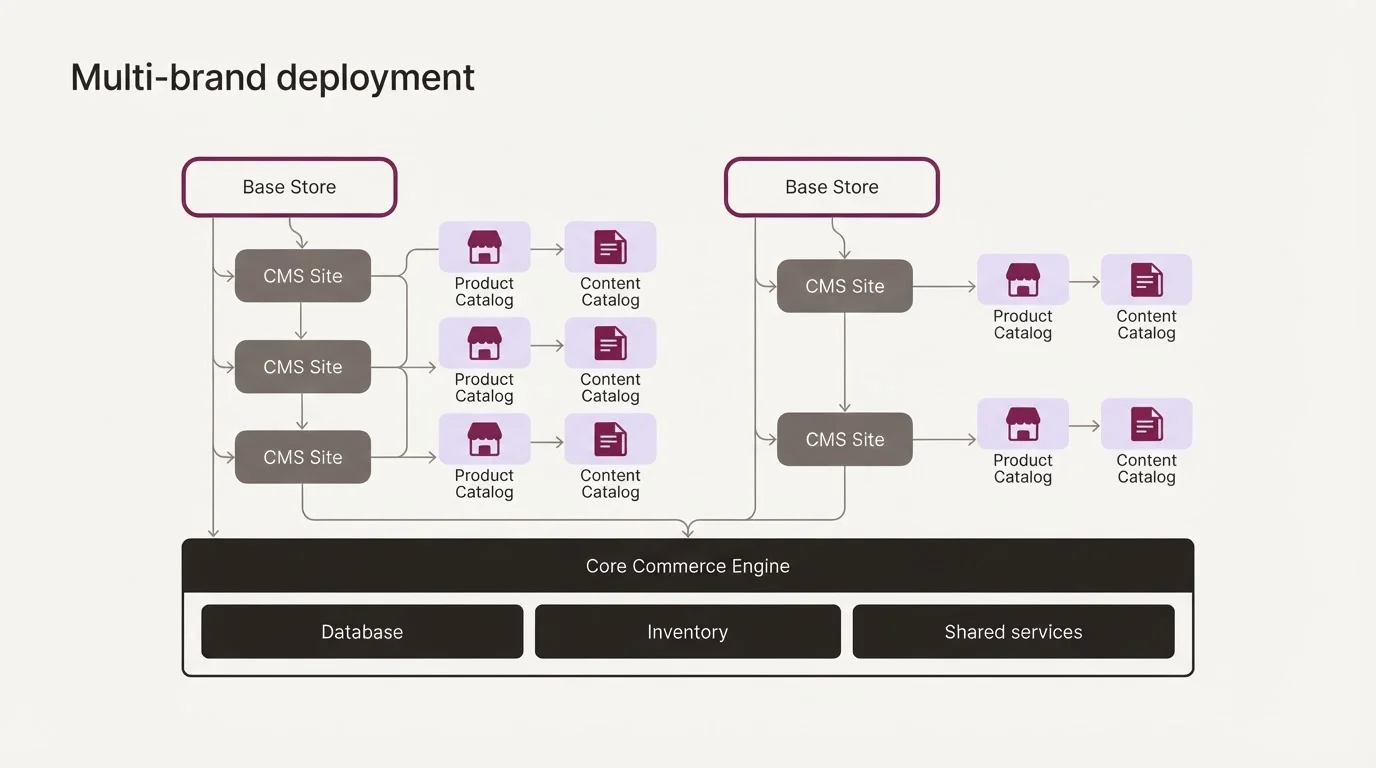
SAP Commerce Cloud addresses multi-market complexity through a tiered structural hierarchy composed of Base Stores, CMS Sites, and inherited catalogs. A Base Store functions as the primary operational entity, centralizing backend configurations such as localized currencies, warehouse assignments, and delivery regions. Linked beneath the Base Store are the digital storefronts, or CMS Sites, which utilize specific Content Catalogs to deliver localized user interfaces. This model allows multi-brand enterprises to maintain distinct consumer-facing brand identities while sharing underlying database infrastructures and master product catalogs.
For conglomerates overseeing a mixed portfolio, the commerce core must bridge different transactional paradigms seamlessly. According to SAP Commerce Cloud: Strategic Guide for Enterprise Digital Commerce, the platform is engineered for the intricate, high-volume requirements of modern B2B e-commerce, offering a unified, omni-channel experience. However, because its B2B capabilities are fundamentally built as structural extensions layered on top of a legacy B2C core, scaling this model across multiple distinct brands introduces profound configuration challenges. As content managers and developers attempt to coordinate independent release schedules across different business units, the shared codebase often suffers from cross-brand bug risks and complex deployment bottlenecks.
Managing catalog inheritance across diverse regions presents another structural layer of operational friction. In theory, product managers can define a master catalog and pass attributes down to regional variants, but structural divergence between brands makes this difficult to sustain over time. When one specific brand requires custom product variants or alternative data models, developers must manually extend the platform's core code. This structural breakdown of the out-of-the-box catalog model quickly turns a centralized system into a collection of highly isolated custom codebases that require continuous development support.
Technical Extensibility via SAP BTP: Core Capabilities and Overhead
Adapting the core commerce platform to unique regional requirements or complex corporate governance structures involves utilizing the SAP Business Technology Platform (BTP) and the ABAP cloud environment. For example, SAP Commerce Cloud lets users create an ABAP cloud project with SAP BTP ABAP environment, enabling the isolation of specific custom code blocks for regional teams. To help govern operational rules across multiple brands, SAP Commerce Cloud lets users create a Business Configuration Maintenance Object using the ABAP Repository Object Generator. When testing these intricate custom frameworks, SAP Commerce Cloud lets users create a trial user with SAP BTP ABAP environment to validate structural configurations before moving them to production.
Furthermore, managing specialized data requirements or local compliance fields mandates direct database manipulation. SAP Commerce Cloud lets users create a database table and generate UI services with SAP BTP ABAP environment, which provides a pathway for tracking region-specific transactions or custom product attributes. To pull foundational data from external operational systems or legacy internal databases, SAP Commerce Cloud lets users create a destination in the SAP BTP cockpit to allow application access to the Northwind OData services. While these technical entry points demonstrate the platform's extensive customizability, they highlight a persistent enterprise reality: every modification requires substantial, highly specialized engineering effort that increases technical debt.
Beyond basic configuration management, the operational dependencies within the BTP environment require rigid lifecycle coordination. While code isolation tools exist, the underlying database deployment store places localized attributes in highly synchronized single-table models. When multiple parallel development teams make concurrent changes to these shared architectures, release conflicts multiply rapidly. Consequently, corporate IT teams spend more time managing Git branches, release stabilization tracks, and staging environments than delivering customer-facing features that impact the business bottom line.
Key Operational Challenges: Shipping, Security, and Local Governance
Operating a global commerce platform means solving deep logistical and security discrepancies across international borders. Logistics vary enormously by country, demanding highly adaptable checkout workflows that go far beyond standard shipping calculations. According to Key Considerations for Launching Successful Multi-... - SAP Community, in the checkout shipping option process, multiple strategies are followed in e-commerce all over the world. Replicating these distinct localized strategies within a single, monolithic platform instance frequently requires overwriting core checkout components, creating substantial testing overhead for internal IT teams.
Corporate governance and security reporting add another layer of operational friction when managing a consolidated instance for multiple business units. Due to the high visibility of enterprise infrastructure, corporate risk compliance teams require exhaustive detail during security reviews. For instance, SAP Commerce Cloud lets users include the following details in the report, as applicable: issue category, affected product version with support package and patch level, necessary pre- and post-conditions for the exploit to work, description with proof of concept or exploit code, and impact of the issue if exploited. Managing this level of administrative overhead across dozens of brands and regional sites requires dedicated technical management, distracting teams from driving digital revenue growth.
SAP Commerce Cloud Limitations: Customization Bottlenecks and Deployment Timelines
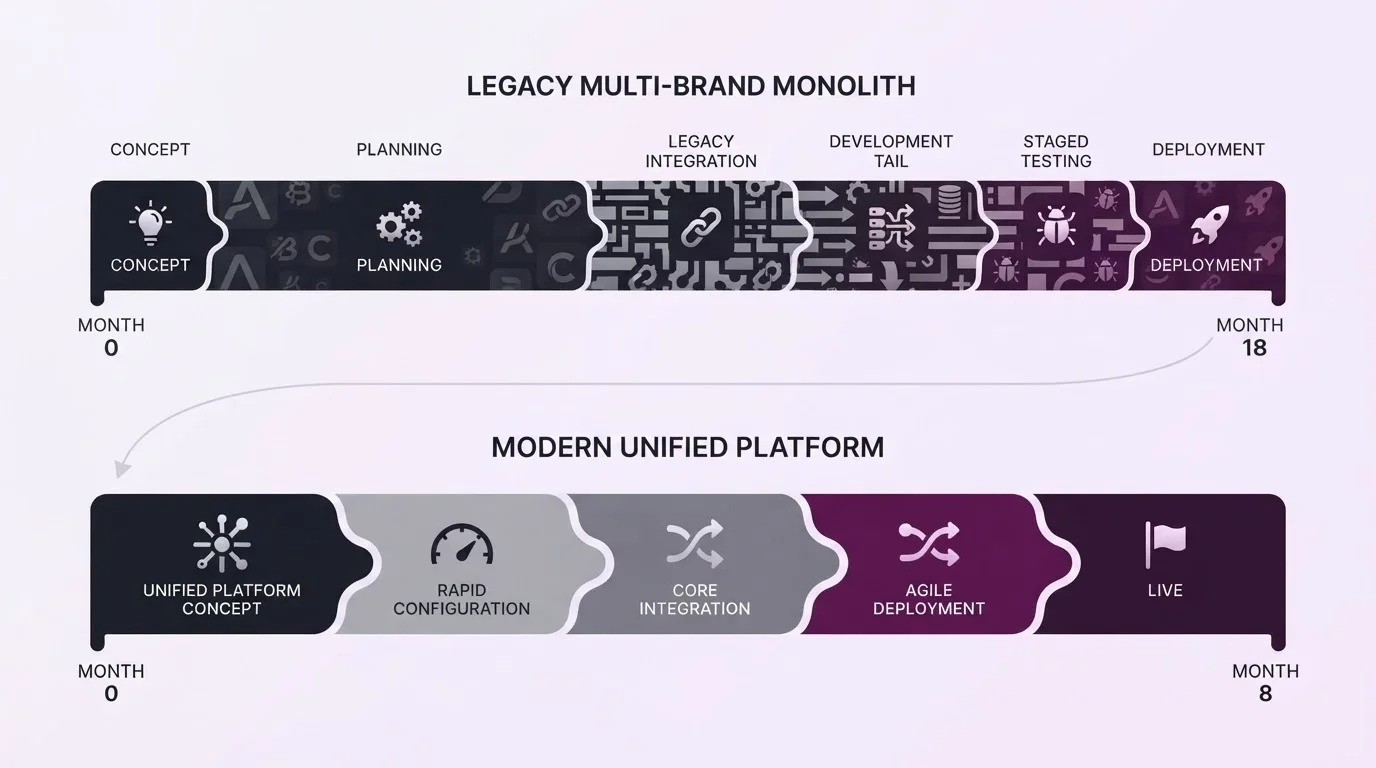
The primary drawback of deploying SAP Commerce Cloud in a multi-brand ecosystem is its inherent development rigidity. Because the underlying architecture is built around a heavy Type System that generates database schemas from XML definitions, modifications to data models affect the entire core system. This structural design means that a customization executed for one brand can inadvertently impact or break the functionality of a sister brand sharing the same instance. Consequently, instead of accelerating market expansion, IT organizations find themselves bogged down by complex release coordination and extensive regression testing.
These technical barriers directly translate into prolonged implementation schedules and elevated total cost of ownership (TCO). A standard multi-region or multi-brand implementation on SAP Commerce Cloud typically demands an implementation timeline of 8 to 18 months to achieve full production stability. Furthermore, when the platform requires a major version upgrade, the highly customized extensions and complex single-table inheritance models must be completely re-evaluated and re-tested. Additionally, enterprise buyers frequently note that mobile user experiences are neglected in this environment, often resulting in responsive desktop sites wrapped in restrictive web views rather than high-performance, native mobile applications.
Strategic Insights for Enterprise Commerce
Receive in-depth perspectives on unified platforms, scalability, and complex integrations for large-scale commerce operations.
Enterprise Commerce Platform Comparison: SAP Commerce Cloud vs. Supercommerce
When evaluating an enterprise commerce platform comparison, large organizations must weigh traditional monolithic software packages against modern, unified architectures designed for high performance. Large enterprises with complex needs require speed, control, and flawless cross-device execution. The following matrix contrasts the core structural approaches of SAP Commerce Cloud and Supercommerce for multi-brand global operations.
| Evaluation Dimension | SAP Commerce Cloud | Supercommerce |
|---|---|---|
| Multi-Brand Catalog Consolidation | Managed via complex inheritance layers across Base Stores and Product Catalogs; prone to synchronization lags. | Native multi-tenant core supporting separate brand catalogs and centralized control from a single dashboard. |
| Deployment Timeframe (Multi-Brand) | Typically 8 to 18 months due to heavy custom extension requirements. | Rapid deployment via high-performance unified web and native mobile application frameworks. |
| Native Mobile Infrastructure | Composable storefront layers (Angular-based) that require separate development for native iOS/Android mobile commerce. | Unified core offering high-performance web storefronts and native mobile commerce out of the box. |
| ERP & System Extensibility | Relies on custom ABAP cloud projects, SAP BTP cockpit configurations, and middleware extensions. | Deep enterprise integrations built natively for complex catalogs and real-time custom pricing engines. |
| Operational Maintenance Burden | High; platform upgrades require extensive testing of custom extensions and single-table database inheritance models. | Low operational overhead with a stable API core that decouples presentation layers from backend logic. |
Supercommerce: A Unified Alternative for Streamlined Multi-Brand Management
Supercommerce provides a modern, unified alternative engineered from the ground up for large enterprises processing over $100M in annual GMV. Unlike legacy environments that treat mobile commerce as an afterthought, Supercommerce gives large enterprises a single platform to run high-performance web storefronts and native mobile commerce simultaneously. This unified architecture eliminates the need for separate frontend engineering streams or complex API wrappers, ensuring that brand identity and high speed coexist natively across all consumer touchpoints.
By shifting away from the rigid database architectures that complicate multi-brand management, Supercommerce allows corporate teams to centralize core commerce capabilities while granting individual brands complete autonomy over their digital presentation layers. This decoupled approach drastically reduces operational overhead, turning product catalog updates, localized pricing rules, and international shipping configurations into simple administrative tasks rather than deep development sprints. Enterprises can launch new brands or enter new geographical regions in a fraction of the time, bypassing the traditional 8 to 18 months deployment tail associated with legacy monoliths.
Frequently Asked Questions
Q: How long does it typically take to deploy a multi-brand setup on SAP Commerce Cloud?
A multi-brand or multi-region deployment on SAP Commerce Cloud typically takes between 8 and 18 months due to the heavy custom extension development, integration mapping, and regression testing required to isolate brand-specific configurations within the monolithic framework.
Q: What are the primary sap commerce cloud limitations regarding multi-brand operations?
The main limitations include severe development rigidity caused by a shared type system, the high risk of cross-brand bugs within shared codebases, complex upgrade paths that break custom extensions, and a historical neglect of native mobile commerce experiences.
Q: How does Supercommerce handle multi-brand and multi-region operations differently?
Supercommerce provides a unified platform built for businesses with over $100M GMV, offering high-performance web storefronts and native mobile commerce out of the box with deep ERP integrations, eliminating the need for rigid custom middleware or massive development timelines.
Q: Can individual brands maintain complete operational autonomy on a unified platform?
Yes, a modern unified architecture centralizes global infrastructure and core order data while giving individual brands independent control over localized content, catalogs, unique pricing rules, and storefront layouts without technical interference.
Conclusion: Strategic Platform Choices for Global Enterprise Expansion
Choosing the right infrastructure for multi-brand, multi-region operations is a critical decision that determines an enterprise's agility and long-term cost structure. SAP Commerce Cloud remains a robust solution for organizations heavily anchored within the broader SAP ecosystem that possess the technical resources to manage its configuration complexity. However, the associated 8 to 18 months deployment timeline and high operational maintenance burden can severely limit time-to-market for fast-growing global brands. For enterprises generating over $100M in annual GMV that require ultimate scale, control, and high-performance native mobile execution, a unified solution like Supercommerce eliminates architectural fragmentation and provides a streamlined foundation for global expansion.