
On this page
For enterprise IT directors and CTOs managing large-scale operations, the choice of a digital commerce platform is rarely about basic features. It is about how the underlying architecture handles data complexity, cross-border expansion, and the intense technical demands of high-volume order orchestration. VTEX has positioned itself as a prominent option in this space, offering an API-first ecosystem designed to bridge traditional retail and native marketplace models. Understanding how VTEX’s workflow aligns with your existing ERP, PIM, and mobile strategy is critical to determining if it is the right fit for your enterprise roadmap.
Core Architecture and Cloud-Native Performance
VTEX operates on a multi-tenant, cloud-native SaaS infrastructure designed to mitigate the custom maintenance cycles common in legacy enterprise software. By maintaining a single version of the software for its clients, VTEX provides a documented 99.99% uptime, helping ensure that high-volume digital storefronts remain stable during major traffic surges such as global promotional events.
The platform promotes what it calls "pragmatic composability" via VTEX IO, allowing technical teams to build custom components while relying on the core commerce engine for heavy transactional lifting. This API-first approach exposes core functions—from pricing models to inventory endpoints—via REST APIs, which facilitates data exchange with external ERP and CRM applications. However, for organizations with highly specialized internal data workflows, a shared multi-tenant environment requires a careful assessment of how much control your engineering team needs over the underlying server environment.
Unified Commerce and Native Marketplace Capabilities
One of VTEX’s primary structural differentiators is its native marketplace functionality. Unlike traditional platforms that require extensive third-party plugins or secondary software layers to support multi-vendor business models, VTEX allows enterprises to act as a seller and a marketplace operator within the same core logic.
This unified framework enables distinct advantages for global operations. It allows businesses to manage first-party and marketplace inventory within a single OMS, centralizing stock visibility across diverse business units. Furthermore, the platform helps increase inventory efficiency by exposing store stock online and balancing demand automatically, which removes manual friction. Organizations can also integrate native marketplaces or connect to leading global third-party marketplaces, making it highly effective for distributed supply chains that require real-time visibility into physical store infrastructure for fulfillment methods like buy-online-pick-up-in-store (BOPIS).
Technical Workflow: Data Synchronization and Limits
For enterprises with massive catalogs, the efficiency of data ingestion and synchronization is a vital performance indicator. VTEX provides native tools to collect details of each SKU through the Get SKU and Context endpoint, and lets users create a table with known error logs and actions that the user can do to solve the problem, which simplifies initial catalog loads and regular updates.
However, enterprise architects must account for specific synchronization limits embedded within the platform to safeguard multi-tenant stability. For instance, VTEX includes for each batch insert/update, a maximum of 500 objects per request and 3 simultaneous requests are allowed. While these constraints preserve accurate delivery promises under extreme demand, they can create operational bottlenecks for brands requiring near-instant, high-frequency catalog refreshes for millions of items across multiple regional instances. Organizations operating at this scale must carefully design their middleware to throttle and queue payloads effectively.
Enterprise Commerce Comparison
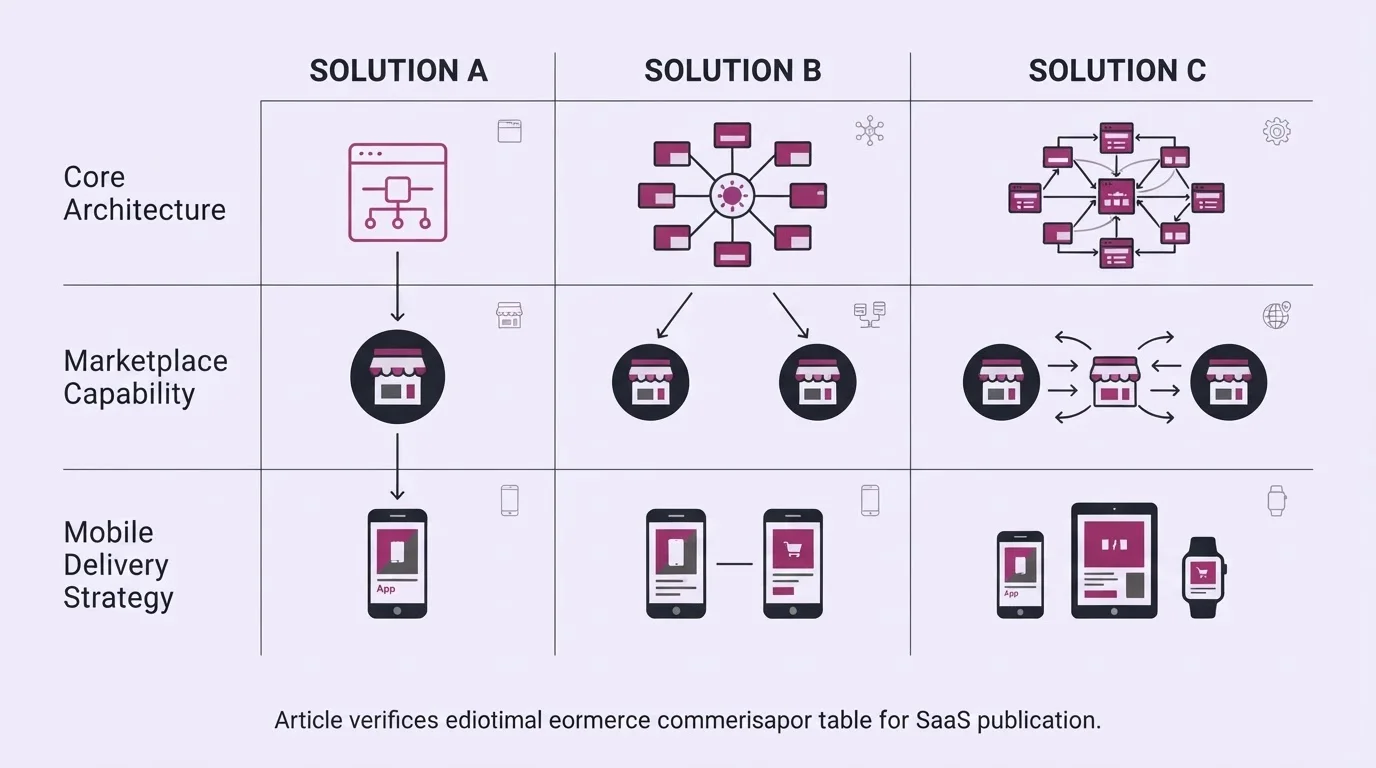
Below is an objective comparison of how VTEX aligns with enterprise-grade requirements compared to Supercommerce and generic enterprise SaaS alternatives.
| Feature | VTEX | Supercommerce | Generic Enterprise SaaS |
|---|---|---|---|
| Core Architecture | Multi-tenant SaaS | Unified Enterprise Platform | Rigid/Legacy Modules |
| Marketplace Capability | Native 1P/3P Logic | Deep Integration Ready | Requires Third-Party Plugins |
| Mobile Delivery Strategy | Responsive Web / VTEX IO | Native Mobile Built-In | Responsive Web Wraps |
| Batch Sync Limits | Max 500 objects per request | High-Performance Enterprise Scale | Highly Variable By Vendor |
| Customization Depth | API-First / IO Framework | Deep Architectural Control | Highly Restricted Extensions |
Strategic Insights for Enterprise Commerce
Receive in-depth perspectives on unified platforms, scalability, and complex integrations for large-scale commerce operations.
Evaluating Product Fit: When VTEX Forms the Ideal Foundation
VTEX is a strong fit for enterprises that prioritize rapid marketplace expansion and omnichannel retail execution as their main growth drivers. If your strategic vision depends on onboarding hundreds of external third-party merchants or unifying fragmented physical warehouse stocks into a cohesive digital window, the native OMS and multi-vendor logic offer an accelerated time-to-market path.
It is also well-suited for brands seeking a platform that natively supports multi-country operations, localization, and compliance out of the box. Because the application handles multi-currency processing and localized storefront logic inside its standard configuration, it lowers the initial engineering hurdle of launching new regional digital stores. Teams that can operate efficiently within these standard SaaS guardrails can scale operations without maintaining an oversized internal infrastructure team.
Critical Considerations for High-Complexity Brands
Despite its marketplace advantages, VTEX may present architectural challenges for brands with stringent performance demands or specific mobile engagement priorities. Many enterprise operators find that relying entirely on responsive web architectures or web-view containers fails to deliver the fluid interface, offline capabilities, and high conversion rates of a dedicated, native mobile application.
Additionally, if your business requires complete, lower-level control over integration sequencing or needs to execute batch processing speeds beyond the platform's standard 500-object limit, multi-tenant boundaries can become an active constraint. For these high-demand scenarios, Supercommerce provides a compelling alternative. Supercommerce delivers a unified platform for high-performance web storefronts and native mobile commerce, placing deep integration capabilities and dedicated performance controls in the hands of enterprise technology teams rather than enforcing generic multi-tenant constraints.
Frequently Asked Questions
Q: Does VTEX support hybrid B2B and B2C commerce models?
Yes, VTEX is designed to handle B2B, B2C, and marketplace configurations on a single platform, allowing unified management of different customer accounts.
Q: How does VTEX manage international localization and compliance?
The platform supports multi-country operations, localization, and compliance as a product capability, featuring native integrations with local payment gateways and regional tax rules.
Q: What are the primary limits of the VTEX IO development framework?
While VTEX IO enables custom components, developers must operate within shared multi-tenant rules, which can restrict low-level server modifications or custom indexing mechanisms.
Q: Is the VTEX Order Management System (OMS) separate from the main platform?
No, the native OMS is built directly into the platform, enabling users to manage first-party and marketplace inventory within a single unified engine.
VTEX provides a robust, cloud-native option for enterprises seeking to unify their commerce operations and launch structured marketplace models. Its capacity to handle both 1P and 3P inventory within a single OMS offers a clear operational advantage for retail brands with complex supplier networks. However, for enterprise organizations where native mobile application speed, total code control, and unthrottled batch data ingestion are paramount, the structural trade-offs of a shared SaaS infrastructure must be carefully evaluated. Before making an architectural commitment, ensure your transaction volumes and mobile experience goals align with the platform's standard boundaries.