
On this page
For enterprises processing over $100M in annual GMV, the primary commerce challenge is no longer basic transaction processing; it is the management of scale without the friction of legacy IT debt. Many large-scale brands find themselves trapped between rigid monolithic suites and fragmented headless stacks that leave mobile experiences lagging behind web performance. Supercommerce addresses this gap with a unified platform designed to power both high-performance web storefronts and branded native mobile apps through a single commerce engine.
Rather than forcing teams to manage disparate environments for desktop and mobile, the platform centralizes product data, promotions, and order fulfillment. This approach ensures that as your brand scales, your customer experience remains consistent across all touchpoints. This analysis examines the technical architecture, operational workflows, and the specific integration tiers that define Supercommerce’s fit for enterprise operations.
Unified Architecture for Enterprise Control
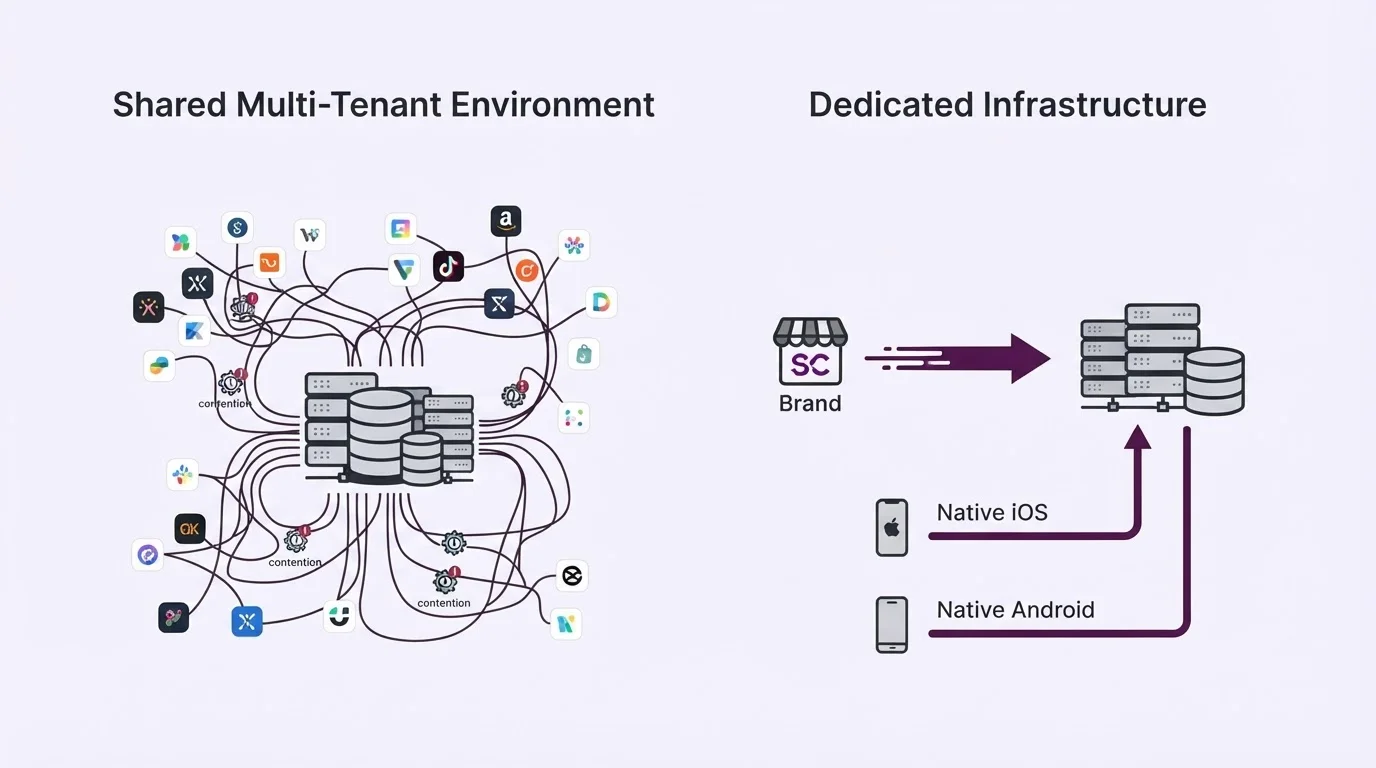
Supercommerce utilizes a dedicated infrastructure model to ensure performance stability for high-volume brands. Unlike shared multi-tenant SaaS environments where one merchant's traffic spike can impact another's checkout speed, this isolated architecture protects your storefront during peak shopping events. This technical isolation is critical for brands managing complex catalogs and high transaction volumes that require guaranteed uptime.
One of the platform's most significant technical differentiators is its approach to mobile. While many competitors rely on "webviews"—which essentially wrap a responsive website in a thin mobile shell—Supercommerce deploys branded native mobile apps for iOS and Android. These native apps offer hardware-level performance, superior UX, and higher conversion rates than standard responsive mobile sites. The platform manages the entire lifecycle of these apps, including store submission and maintenance, effectively removing the technical burden from your internal dev team.
Operational Workflow: From Catalog to Conversion
The Supercommerce workflow is designed for speed-to-market, enabling digital commerce teams to execute complex strategies without deep developer intervention. The operational core is built around three integrated modules that synchronize in real-time. This efficiency allows IT directors to shift their focus from maintenance to innovation.
- Unified Product Management: Teams define complex product hierarchies, custom attributes, and pricing rules once. These updates reflect across web and native mobile apps instantly, ensuring inventory accuracy.
- Dynamic Promotion Engine: Marketers can launch regional or global campaigns with granular discount logic that does not degrade site latency, even under heavy load.
- Integrated Order Management: The platform provides a centralized view of fulfillment status and connects to existing warehouse management systems (WMS) to coordinate inventory across multiple locations.
For technical leaders wanting to evaluate the administrative experience, the Supercommerce dashboard and mobile app demo are available with no signup required, providing immediate access to the platform's interface and performance benchmarks.
Supercommerce vs. Oracle Commerce Cloud
When comparing Supercommerce to legacy solutions like Oracle Commerce Cloud (OCC), the distinction lies in enterprise commerce agility. Oracle offers a massive ecosystem, but its legacy architecture often leads to rigid implementation cycles. Updates and customizations in OCC frequently require extensive professional services and long lead times, which can stifle a brand's ability to react to market shifts.
Supercommerce prioritizes a unified, mobile-first transaction engine. While legacy suites often treat mobile as an afterthought or a responsive extension, Supercommerce treats native mobile as a core pillar. This reduces the total cost of ownership by eliminating the need to maintain a separate mobile codebase or bridge the gap between web and app functionality. For enterprises struggling with the maintenance costs of a monolithic suite, this unification provides a significant operational advantage.
Strategic Comparison Table
| Feature | Supercommerce | Oracle Commerce Cloud |
|---|---|---|
| Mobile Architecture | Branded Native iOS & Android | Responsive Web / Webview focus |
| Infrastructure | Dedicated for performance isolation | Often Multi-tenant / Shared |
| Agility | High (Unified Management) | Lower (Monolithic Complexity) |
| Deployment Speed | High (Streamlined native publishing) | Moderate (Requires heavy custom dev) |
Determining Product Fit and Integration Scalability
Supercommerce is engineered for organizations with complex requirements, but its value proposition is most effective for specific GMV tiers and integration needs. Understanding these limits is essential for IT directors planning long-term infrastructure.
Strategic Insights for Enterprise Commerce
Receive in-depth perspectives on unified platforms, scalability, and complex integrations for large-scale commerce operations.
The Ideal Customer Profile
The platform is optimized for brands processing $100M+ in annual GMV that view native mobile commerce as a strategic growth driver. It serves enterprises that have outgrown basic SaaS templates but want to avoid the extreme complexity and cost of building a custom headless architecture from scratch. It is a middle-path solution that provides enterprise-grade control with SaaS-like efficiency.
Navigating Integration Limits
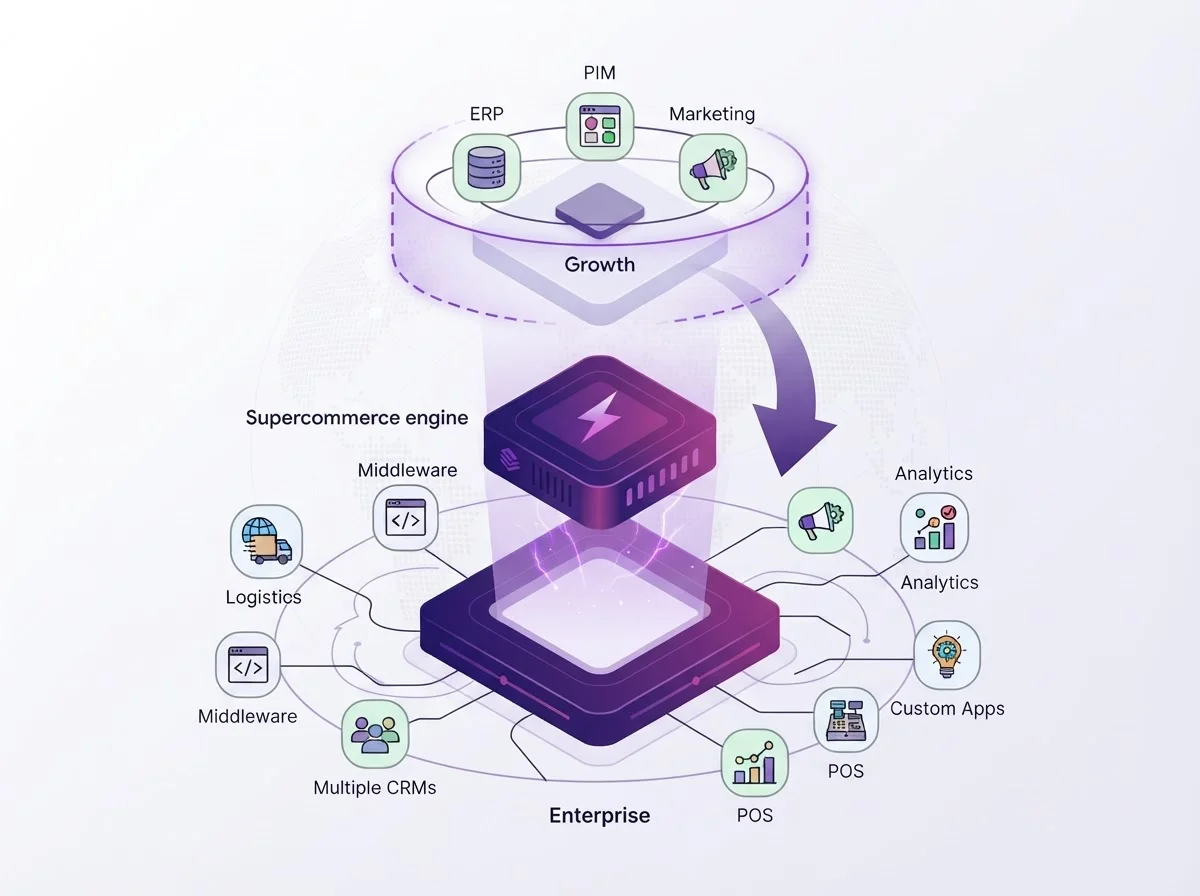
Scaling with Supercommerce requires selecting the right tier for your technology stack. The Growth plan is optimized for enterprises reaching up to $50M GMV and includes a limit of up to 3 integrations. This is typically sufficient for brands using a standard stack involving a single ERP, a PIM, and a marketing automation tool.
For organizations processing $100M+ GMV with deep technical requirements—such as custom middleware, global logistics platforms, or multiple CRMs—the Enterprise tier is required. This tier removes integration caps and assigns a dedicated implementation engineer to ensure complex workflows remain performant at scale. This level of support is vital for maintaining stability as third-party connections grow in number and complexity.
Frequently Asked Questions
Q: Does Supercommerce support native mobile apps or just responsive websites?
Supercommerce provides a single platform to run both high-performance web storefronts and branded native mobile apps for iOS and Android, which are published directly to the app stores.
Q: What is the typical GMV range for a Supercommerce customer?
The platform is designed for enterprises processing $100M+ in annual GMV, with plans scaling from $50M to over $500M.
Q: How does the integration process work for existing ERPs like SAP or Oracle?
Supercommerce provides native connectors for major ERP, PIM, and WMS systems. The Enterprise tier includes a dedicated implementation engineer to manage these deep integrations and ensure they scale efficiently.
Q: Can I test the platform without a formal sales process?
Yes, Supercommerce offers a live dashboard and mobile app demo that requires no signup, allowing IT leaders to evaluate the performance and interface immediately.
Securing Your Enterprise Commerce Future
Supercommerce provides a strategic path for enterprises that have outgrown the rigidity of legacy suites. By unifying web and native mobile commerce into a single, high-performance engine, it enables $100M+ GMV brands to regain the agility required for modern retail. If your current stack is burdened by siloed mobile experiences or high maintenance costs, Supercommerce offers the dedicated infrastructure and unified control needed to scale without compromise.