
On this page
For commerce leaders at large-scale enterprises, the primary barrier to growth is rarely a lack of features; it is the friction caused by fragmented systems. Legacy stacks often force a compromise between web performance and mobile utility, leading to a disjointed customer journey and operational bloat. Supercommerce addresses this by providing a unified enterprise commerce platform built to handle high-performance web storefronts and native mobile commerce within a single architectural flow.
Determining if Supercommerce is the right fit for your organization depends on your technical roadmap and how your team manages large-scale operations across channels. Unlike generic platforms that rely on third-party wrappers to simulate a mobile presence, this solution centralizes operations to reduce complexity. This guide examines the platform's core capabilities, the operational workflow for enterprise teams, and the strategic trade-offs of a unified commerce model.
The Supercommerce Workflow: Unified Management
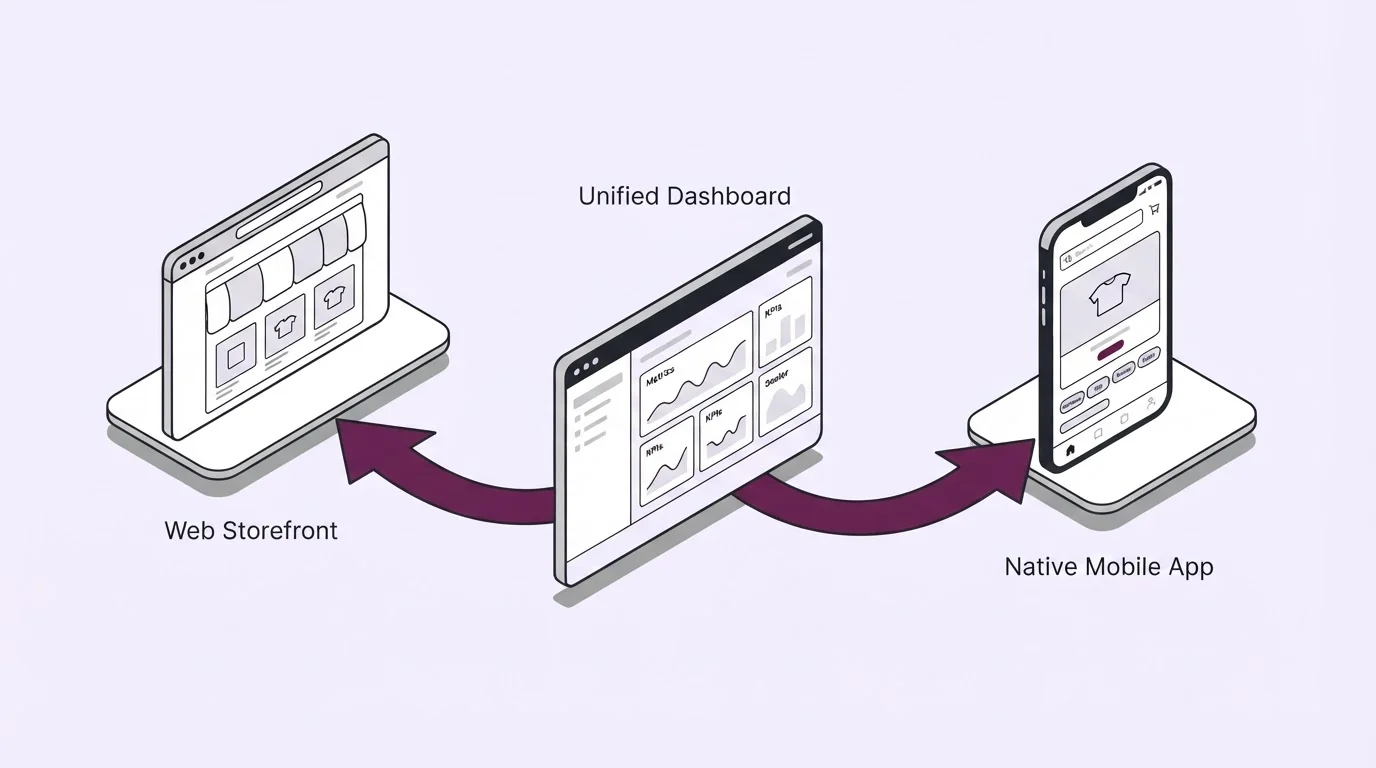
The operational philosophy of Supercommerce centers on removing the technical silos between web and mobile management. In many enterprise environments, launching a promotion or updating a product description requires separate efforts for the web team and the mobile app team. Supercommerce consolidates these functions into a single dashboard where changes propagate across all touchpoints simultaneously.
This unified approach is built around centralized product lifecycle management and real-time synchronization. By managing the entire stack from the database to the native UI, the platform reduces the risk of data desynchronization. This is a common failure point for enterprises that attempt to scale using disparate solutions that lack deep, native integration between the mobile and web layers.
Frictionless Architecture Exploration

A notable differentiator in the Supercommerce workflow is the ability for IT and digital leaders to interact with the platform’s core functions without immediate barriers. Decision-makers can manage products, orders, promotions, analytics, and team permissions with no signup required for initial exploration. This transparency allows for a direct assessment of the administrative logic and user interface before a formal discovery phase begins.
Being able to see the internal management mechanics—such as how inventory is allocated or how team permissions are structured—provides a level of clarity that is typically hidden behind sales calls and lengthy demo requests. This helps CTOs and Heads of Commerce determine if the interface aligns with their internal operational workflows before committing resources.
Native Mobile Deployment Strategy
For teams managing high-volume catalogs, the workflow begins in the centralized management module. Once products are live, the system enables the rapid deployment of promotional campaigns. Because the mobile experience is native rather than a web view, these promotions avoid the performance lag and UI glitches typically associated with responsive websites wrapped in mobile containers.
Native mobile commerce is not just about aesthetic; it is about performance at scale. By controlling the mobile UI natively, Supercommerce ensures that features like search filtering, image loading, and checkout transitions remain fluid even during peak traffic events. This architectural choice is critical for brands where mobile revenue represents a significant portion of total GMV.
Evaluating Product Fit for High-Volume Commerce
Supercommerce is engineered for enterprises processing over $100M in annual GMV that have outgrown rigid, generic solutions. Product fit is highest for organizations that require deep architectural control and high-performance native mobile experiences. If your organization is struggling with the 'responsive-only' trap—where mobile customers are forced into a subpar experience—Supercommerce offers a significant upgrade.
Ideal Fit Indicators include:
- Performance Requirements: Your brand requires high uptime and fast load speeds across both web and mobile.
- Mobile-First Audience: Your customers expect high-performance native app experiences that mirror leading consumer apps.
- Consolidated Operations: Your team wants to reduce the overhead of managing separate web and mobile codebases.
- Scale and Reliability: You are managing operations that require consistent performance across high-volume transaction periods.
Enterprise Trade-offs and Considerations
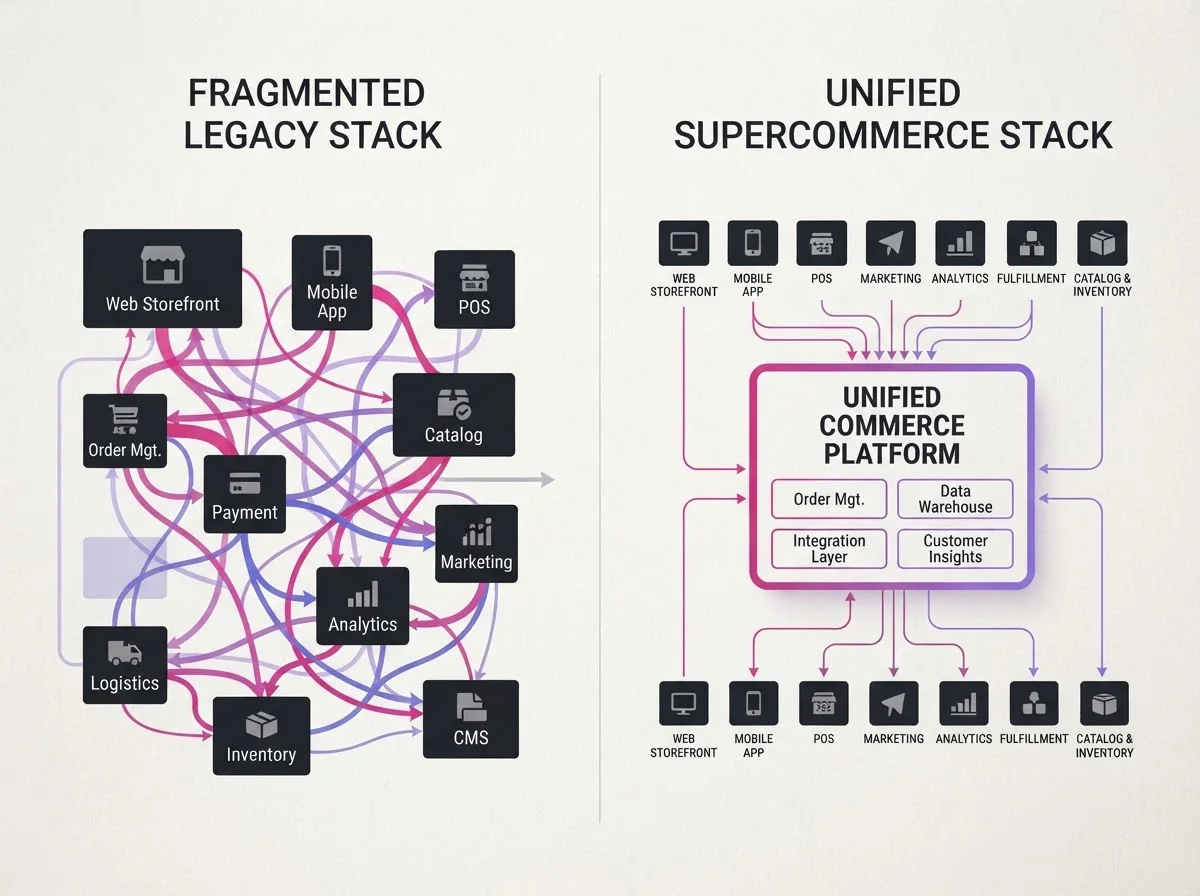
Selecting an enterprise platform involves weighing the benefits of a unified system against the hyper-flexibility of a fully custom-built headless stack. Supercommerce provides a high degree of control, but organizations must align the platform's constraints with their existing IT roadmap to ensure long-term success.
One critical consideration is the integration landscape. For many enterprise environments, Supercommerce includes up to 3 integrations as part of its standard scope. For organizations with highly fragmented tech stacks requiring dozens of bespoke connections, this necessitates a strategic review of which core systems—such as the ERP, CRM, or WMS—will be prioritized for native synchronization.
Strategic Insights for Enterprise Commerce
Receive in-depth perspectives on unified platforms, scalability, and complex integrations for large-scale commerce operations.
Customization vs. Deployment Velocity
While Supercommerce offers deep integration, it is designed for businesses that want to avoid the 'build from scratch' trap. The trade-off is often between extreme micro-service customization and deployment speed. Organizations requiring highly specialized business logic for every micro-service may prefer a headless framework, though this usually comes with a significantly higher total cost of ownership (TCO) and extended development timelines.
For most category-leading brands, the goal is to balance architectural control with a manageable maintenance load. The Supercommerce model prioritizes this balance by offering a single, stable core that serves both web and mobile native experiences without the complexity of managing a fragmented vendor ecosystem.
Adobe Commerce Alternatives and Market Positioning
When comparing Supercommerce to legacy solutions like Adobe Commerce, the distinction lies in the architectural foundation. Many legacy platforms were built in a web-centric era, adding mobile capabilities as an afterthought. This often results in a 'Frankenstein' stack where the mobile experience is perpetually catching up to the web storefront.
Supercommerce positions itself as a unified commerce alternative that solves for enterprise commerce control. By controlling the entire stack from the database to the native mobile UI, it eliminates the performance overhead that often plagues legacy installations once they are heavily customized with third-party extensions. This unified model ensures that performance remains consistent even as the enterprise scales its product volume and operational complexity.
Frequently Asked Questions
Q: Can Supercommerce handle multi-brand and international setups?
Yes, the platform is designed for enterprise scale, supporting high-volume configurations from a single administrative hub.
Q: Is the mobile experience really native?
Yes. Unlike platforms that use WebViews to wrap a website in an app, Supercommerce provides native mobile commerce. This results in faster load times and a smoother user experience.
Q: How does the 'no signup' demo function work?
Prospective users can access a live dashboard environment to test product management, orders, promotions, analytics, and team permissions immediately. This provides transparency into the workflow before any sales engagement.
Q: What if I need more than three integrations?
While the standard enterprise scope includes up to 3 integrations, specific needs are evaluated during the scoping phase to ensure critical systems like ERPs or loyalty programs are properly connected.
Supercommerce represents a move toward unified enterprise commerce, prioritizing high-performance native experiences and centralized control. For businesses managing high-volume operations, the platform offers a streamlined alternative to the complexity of legacy suites and the high maintenance requirements of custom headless builds.
By evaluating your integration requirements and testing the platform’s workflow through its accessible demo environment, you can determine if its unified architecture aligns with your digital transformation goals. The transition to a unified model is most effective for brands that view mobile as the cornerstone of their future growth rather than just another channel.