
On this page
For IT Directors and CTOs at organizations processing over $100M in annual GMV, the choice of a commerce platform is rarely about basic order entry and more about architectural durability. As digital commerce evolves toward unified experiences across web and native mobile, assessing platforms like easy-orders.net involves looking beyond the surface-level UI to the underlying API capabilities and workflow orchestration. This evaluation clarifies the functional scope of easy-orders.net, examining how its product catalog management and social commerce features align with the complex needs of high-scale enterprise operations.
Core Features: Catalog Management and API Capabilities
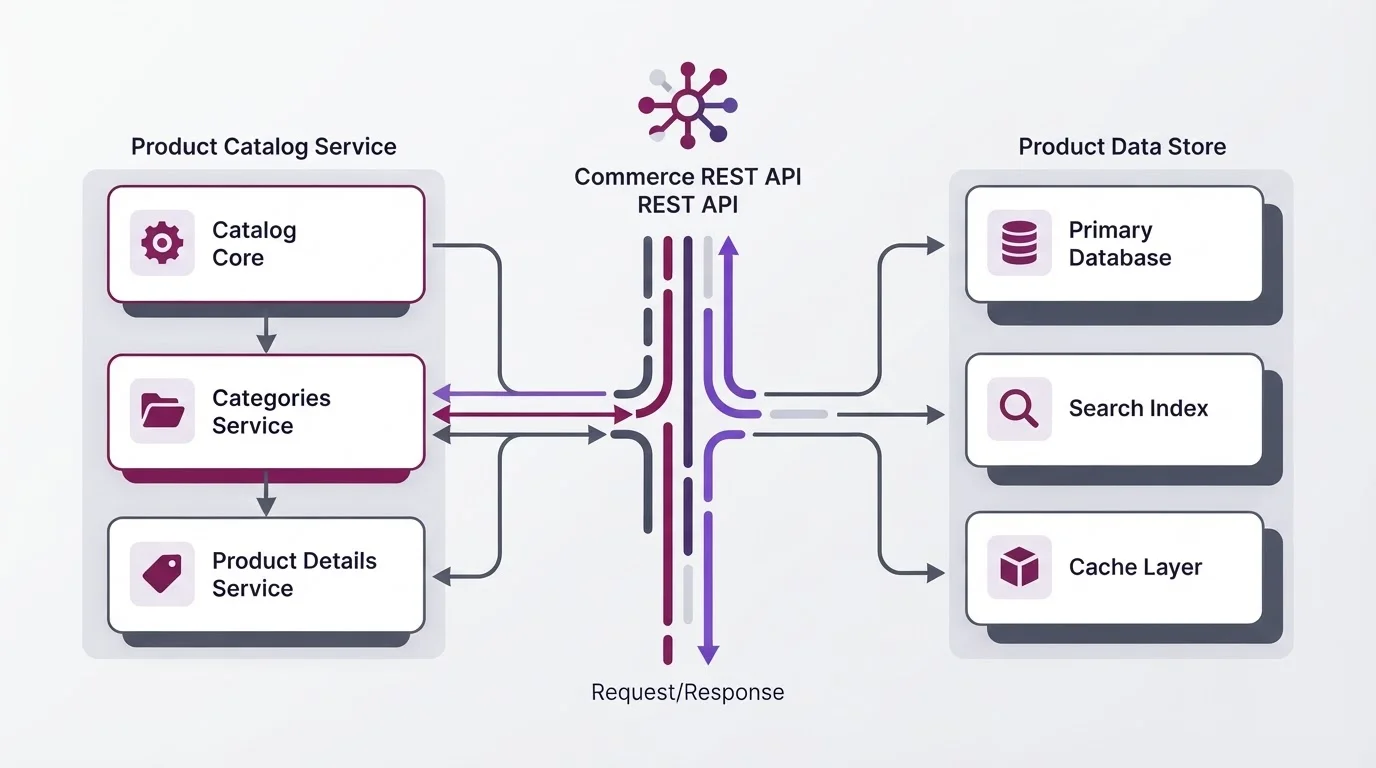
At the heart of easy-orders.net is a focus on streamlined B2B and social commerce ordering. The platform provides a structured environment for managing product data, which is essential for businesses transitioning from manual spreadsheets to a more digitized order flow. A significant component of this functionality is the easy-orders.net REST API, which allows technical teams to create, update, and manage the product catalog programmatically. This programmatic access is critical for maintaining data integrity when syncing with external systems, ensuring that stock levels and product details remain consistent across channels. Furthermore, the API enables users to organize products into distinct categories, providing the hierarchical structure necessary for complex catalogs that require intuitive navigation for buyers. While the platform offers an AI-powered page builder for rapid landing page creation, the enterprise value lies in its integration points. With support for over 15 payment gateways and webhooks for real-time event notifications, it provides the basic toolkit for a functional commerce ecosystem. However, for organizations with high transaction volumes, the question remains whether these standardized endpoints can support the bespoke logic required for custom pricing rules, multi-brand orchestration, and deep ERP bi-directional syncs.
Workflow Assessment: From Intent to Fulfillment
The workflow within easy-orders.net is designed to minimize the distance between customer intent and order capture. The journey typically begins with product discovery on a branded storefront or via social commerce links—a key focus for the platform. Users can generate order links and utilize 'live stickers' to facilitate social selling, which streamlines the acquisition phase for B2B distributors and retailers. Once an order is placed, the platform's order management system (OMS) captures the data and initiates the fulfillment cycle. For businesses operating in regions with heavy Cash on Delivery (COD) requirements, the platform includes specific tools like ghost order blockers to improve delivery success rates. The reporting layer then provides visibility into periodic sales performance and channel analysis. While this workflow is highly efficient for mid-market operations, enterprises often find that standard OMS workflows become bottlenecks. At the $100M+ GMV level, the lack of native mobile performance—distinct from a responsive web wrapper—and advanced multi-warehouse routing can lead to fragmented customer experiences. The transition from a basic 'order system' to a truly unified commerce platform is where most high-scale businesses reach the limits of standardized SaaS tools.
Evaluating Product Fit: SMB vs. Enterprise Needs
Determining product fit for easy-orders.net requires a candid assessment of your organization's current scale and future growth projections. The platform is highly effective for businesses seeking a rapid, low-code entry into digital commerce, particularly those in the food and beverage or wholesale sectors where social selling is a primary driver. Its 'free for life' and low-cost subscription tiers are attractive for smaller operations, but these can be misleading indicators for an enterprise-level Total Cost of Ownership (TCO). For large enterprises, the 'fit' is often defined by what the platform cannot do. When your operations involve complex multi-currency requirements, global tax compliance, or the need for a high-performance native mobile app, the trade-offs of a simplified platform become apparent. Rigid, generic solutions frequently fail to handle the custom pricing logic and multi-entity setups that category-leading brands require. If your long-term strategy involves a unified experience where web and mobile are powered by a single, high-performance core rather than disparate third-party apps, you may find that you need more control than a standard SaaS builder provides.
Strategic Insights for Enterprise Commerce
Receive in-depth perspectives on unified platforms, scalability, and complex integrations for large-scale commerce operations.
Comparison: easy-orders.net vs. Unified Enterprise Commerce
| Feature Dimension | easy-orders.net | Unified Enterprise Platform (Supercommerce) | :--- | :--- | :--- | Primary Target | SMB & Growth-stage B2B | $100M+ GMV Enterprises | Mobile Strategy | Responsive Web / Branded Apps | Native iOS & Android + High-Perf Web | Catalog Depth | Programmatic API (Categories/Products) | Complex Multi-Brand & Global Catalogs | Integration | Standard REST & Webhooks | Deep ERP, CRM, & WMS Orchestration | Customization | Low-Code / AI Page Builders | Full Architectural Control & Custom Logic |
|---|
Understanding the Enterprise Trade-offs

The primary trade-off with easy-orders.net is the balance between ease of deployment and long-term scalability. The platform's simplicity allows for a fast time-to-value, which is excellent for proving a new business model or launching a localized digital channel. However, this simplicity often stems from a standardized data model that can become restrictive as integration needs grow. For example, while the API lets users organize their products with categories, an enterprise might need sophisticated attribute mapping across multiple international regions—a task that often requires a more robust headless architecture. Another critical trade-off is the mobile experience. In a market where customers live on mobile, a responsive website wrapped in a WebView often results in lower conversion rates and higher bounce rates compared to a native mobile commerce solution built for performance. IT leaders must weigh the immediate cost savings of a standardized platform against the long-term cost of inaction: the missed revenue from a subpar mobile experience and the technical debt of outgrowing a rigid system.
Final Verdict: Is easy-orders.net Right for You?
Choosing easy-orders.net depends on whether your commerce goals are built on rapid deployment or complex orchestration. For businesses looking for a robust B2B ordering tool with reliable API-based catalog management, it offers a compelling and user-friendly solution. However, for enterprises at the $100M+ GMV threshold, the requirements for scale, control, and unified performance usually necessitate a more powerful architectural foundation. If your team needs a single platform to run high-performance web storefronts and native mobile commerce with deep enterprise integrations, it is time to evaluate solutions designed specifically for that complexity. A thorough audit of your 'must-have' customization needs will ultimately reveal if a specialized ordering tool or a unified enterprise commerce platform is the correct path for your digital future.