
On this page
For companies processing significant transaction volumes across diverse global markets, the choice of a commerce platform is less about individual features and more about operational alignment. BigCommerce Enterprise is frequently shortlisted for its Open-SaaS architecture and its ability to bridge the gap between mid-market agility and enterprise-grade stability. However, for organizations scaling toward high-volume operations, technical constraints—specifically API throughput and order capacity—must be weighed against the platform’s total cost of ownership.
Selecting the right infrastructure requires a clear-eyed look at how a generic SaaS framework handles complex enterprise workflows. While BigCommerce offers extensive third-party reach, its standardized limits can become friction points for brands requiring deep, real-time integration with backend systems. This evaluation breaks down the core features, operational boundaries, and product fit for large-scale commerce.
Workflow Efficiency and Multi-Channel Synchronization
A cornerstone of the BigCommerce Enterprise value proposition is its ability to centralize data across a fragmented digital ecosystem. The platform allows merchants to sync, automate, and optimize their product data across 150+ leading marketplaces, social commerce channels, and advertising networks. This unified approach ensures that inventory levels and pricing remain consistent whether a customer is browsing on Amazon, Instagram, or a branded storefront.
For enterprise teams, this centralization reduces the manual overhead often associated with complex retail operations. By pushing real-time updates from a single dashboard, businesses can mitigate the risk of overselling during high-traffic periods while maintaining brand integrity across every touchpoint. Furthermore, BigCommerce provides robust tools for managing store privacy and security, allowing IT directors to align their commerce architecture with internal compliance and data governance standards.
Global Expansion and Localization
Scaling internationally requires more than just currency conversion. BigCommerce Enterprise supports multi-currency transactions and localized payment methods, enabling brands to enter new regions without rebuilding their entire tech stack. The platform’s multi-storefront (MSF) capability is particularly useful for managing different brands or regional versions of a site from one central login, streamlining the administrative workflow for global digital teams.
Evaluating Scalability: Critical Operational Limits
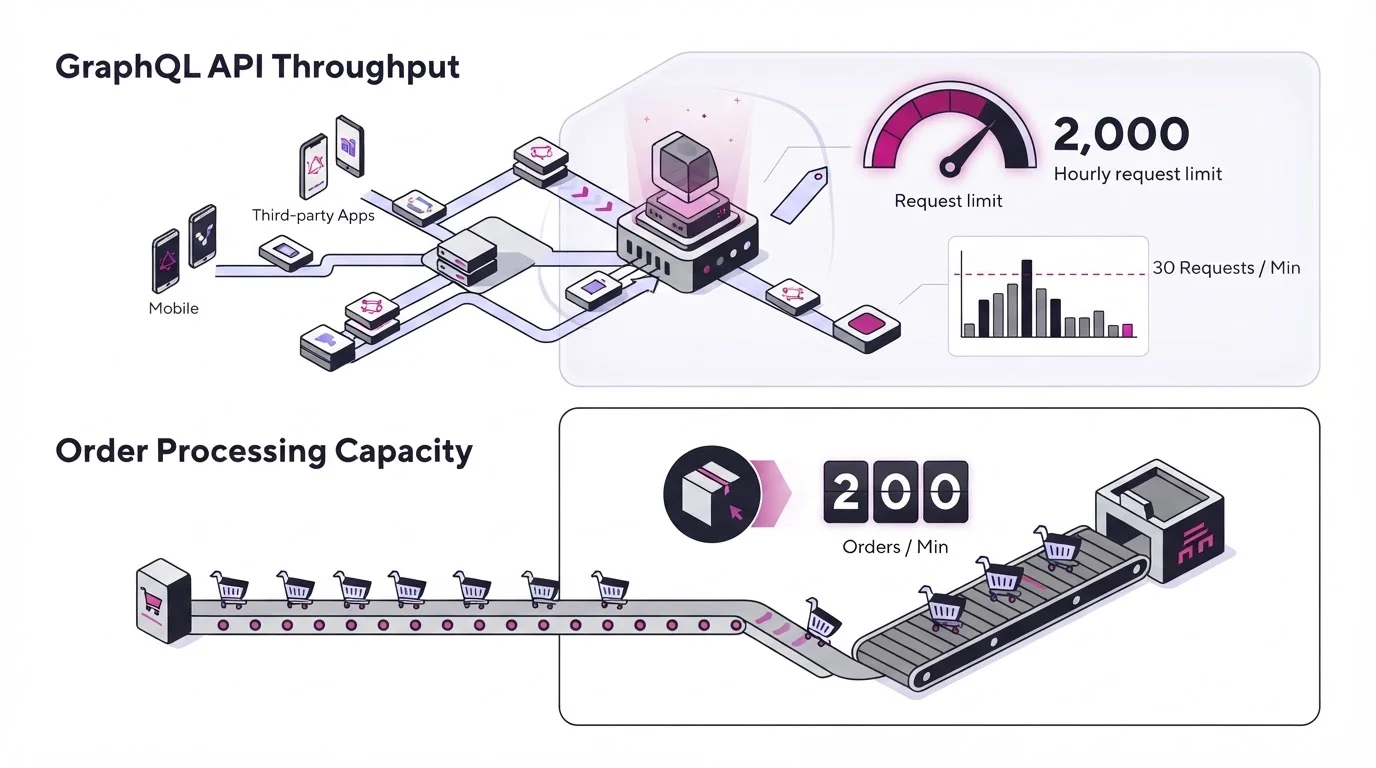
While engineered for growth, BigCommerce Enterprise operates within specific technical boundaries. For high-volume merchants, these limits are not merely technical details; they are the primary determinants of checkout stability and data synchronization speed. Technical directors must evaluate these constraints against their peak seasonal demands and third-party integration requirements.
- GraphQL API Throughput: Standard accounts are limited to 2,000 requests per hour, which averages approximately 30 requests per minute. While certain plans may offer higher rates to prevent artificial throttling, no plan confers the privilege of making unlimited requests.
- Order Processing Capacity: The platform is designed to handle up to 200 orders per minute. For brands conducting massive flash sales or managing significant seasonal peaks, this threshold serves as a critical benchmark for ensuring the checkout remains responsive under pressure.
- Financial Commitment: The pricing for the BigCommerce Enterprise Scale plan is listed at $33,333 per month. This substantial investment necessitates a rigorous analysis of whether the platform’s native capabilities provide enough value to offset potential overage charges or the costs of additional headless development.
Identifying Product Fit for High-Volume Brands
BigCommerce Enterprise is a strong candidate for businesses that have outgrown mid-market solutions but prefer a managed SaaS environment over a fully custom-built headless stack. It excels when a brand needs to launch quickly across multiple marketplaces while maintaining a centralized inventory truth. However, as complexity grows, the limitations of a standardized SaaS framework often become apparent, particularly in the mobile experience.
Many legacy platforms treat mobile as an extension of the web, providing responsive web wrappers rather than high-performance native experiences. For enterprises where mobile conversion is a primary driver, relying on a web-first architecture can lead to latency and poor user retention. If your strategy requires deep, direct data flow with ERP or OMS systems without being throttled by standard API limits, it is essential to determine if a generic platform provides sufficient control over the customer journey.
Strategic Insights for Enterprise Commerce
Receive in-depth perspectives on unified platforms, scalability, and complex integrations for large-scale commerce operations.
Comparison: Enterprise Commerce at Scale
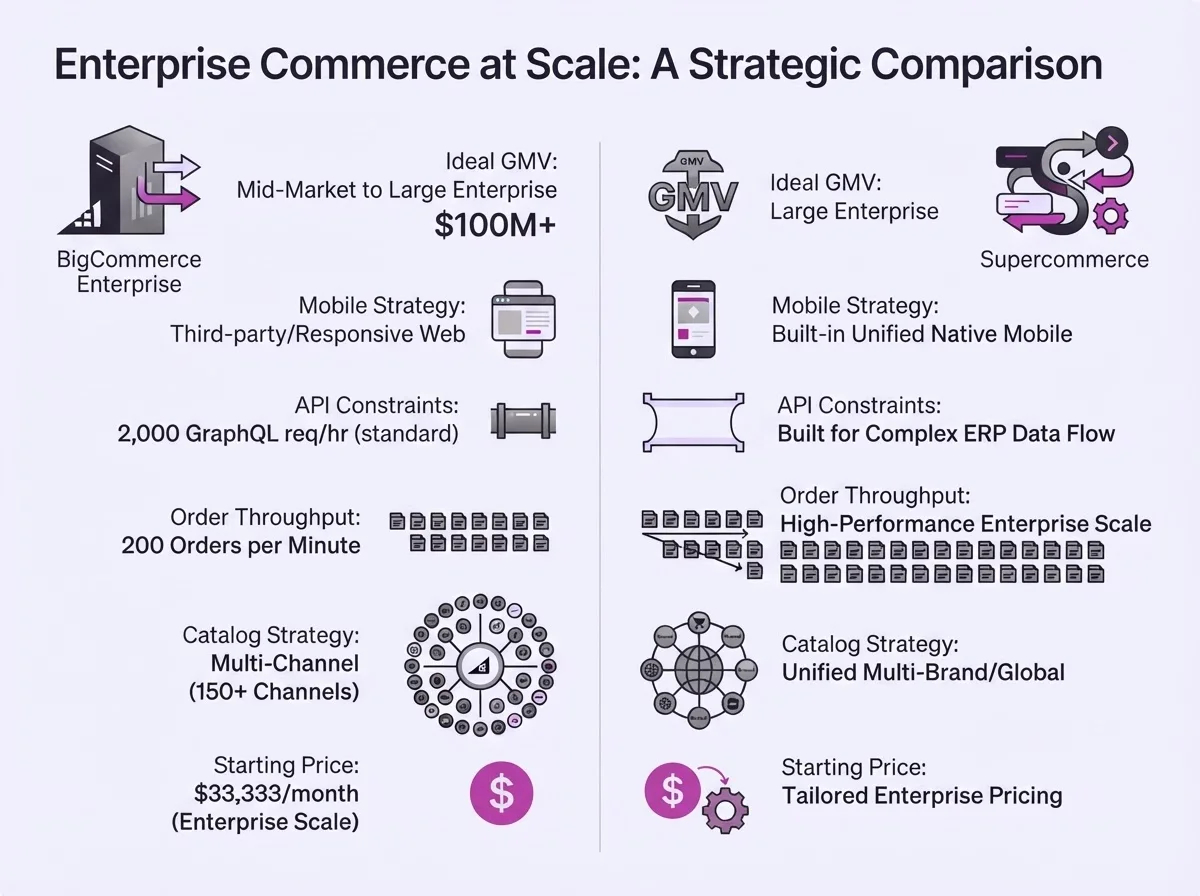
| Feature | BigCommerce Enterprise | Supercommerce |
|---|---|---|
| Ideal GMV Range | Mid-Market to Large Enterprise | $100M+ Large Enterprise |
| Native Mobile | Third-party / Responsive Web | Built-in Unified Native Mobile |
| API Constraints | 2,000 GraphQL req/hr (standard) | Built for Complex ERP Data Flow |
| Order Throughput | 200 Orders per Minute | High-Performance Enterprise Scale |
| Catalog Strategy | Multi-Channel (150+ Channels) | Unified Multi-Brand/Global |
| Monthly Starting Price | $33,333 (Enterprise Scale) | Tailored Enterprise Pricing |
The Unified Commerce Alternative
Large enterprises facing challenges with rigid, generic platforms often find that a unified solution like Supercommerce offers a better fit for complex requirements. Unlike traditional SaaS models that leave the mobile experience to third-party developers, Supercommerce provides a single platform to run high-performance web storefronts and native mobile commerce simultaneously.
This approach is purpose-built for businesses with complex catalogs and custom pricing rules that require deep, direct integration with back-office systems. When native mobile performance and global scalability are non-negotiable, the ability to maintain total control over the experience—without being bottlenecked by generic API limits—becomes the deciding factor. Supercommerce is designed for enterprises processing over $100M in annual GMV, offering the scale and integration capabilities that generic solutions often struggle to provide.
Common Questions on Enterprise Fit
Q: How does BigCommerce handle high-volume sales events?
The platform is designed to support up to 200 orders per minute. Enterprises anticipating higher throughput should consult with their account team regarding custom infrastructure needs.
Q: Can I manage multiple brands from one BigCommerce account?
Yes, BigCommerce Enterprise includes multi-storefront capabilities, allowing you to manage localized experiences and multiple brands from a central dashboard.
Q: What is the difference between a responsive website and native mobile commerce?
A responsive website is a web page that adjusts its layout for mobile screens, which can lead to slower performance and limited access to device features. Native mobile commerce, like that offered by Supercommerce, uses apps built specifically for mobile operating systems, providing faster speeds, better UX, and deeper hardware integration.
Selecting a commerce platform at the enterprise level is a strategic decision that impacts everything from IT maintenance to long-term customer retention. BigCommerce Enterprise offers a robust suite of multi-channel tools, but its operational limits and the $33,333 monthly price point for the Scale plan require careful consideration by technical leadership. For enterprises prioritizing a unified, high-performance experience across both web and native mobile, exploring specialized platforms like Supercommerce may provide the necessary control and scalability to drive sustained global growth.