
On this page
For IT directors and CTOs overseeing large-scale digital commerce, the central strategic tension often lies between modularity and simplicity. Elastic Path has emerged as a prominent advocate for the composable movement, offering an API-first architecture designed to decouple traditional monolithic commerce suites. Rather than providing a single application, Elastic Path delivers a toolkit of independent services.
This approach allows enterprise teams to assemble a bespoke stack. However, for organizations prioritizing high-performance enterprise commerce agility without the heavy operational tax of multi-vendor orchestration, the integration and maintenance demands of a fully composable framework require a careful strategic evaluation before replatforming.
Core Architectural Philosophy: The Composable Ecosystem
Elastic Path operates on the principle of Composable Commerce, treating essential commerce functions as independent, swappable components. This modular methodology aims to mitigate the risks associated with full-scale legacy replatforming by allowing internal engineering teams to replace specific parts of their architecture incrementally.
The ecosystem is anchored by several core components:
- Product Experience Manager (PXM): An adaptable service that merges product information management (PIM), catalog management, and pricing into a unified interface. It handles complex product relationships and contextual pricing models that frequently strain traditional systems.
- Elastic Path Composer: A commerce-intelligent Integration Platform-as-a-Service (iPaaS) that functions as the connective tissue of the stack, providing a centralized hub to build, deploy, and monitor enterprise integrations.
- Studio and Visual Builder: No-code tools designed to empower business users and marketing teams to manage front-end storefront experiences, reducing the volume of routine presentation-layer requests sent to engineering teams.
Enterprise Integrations and Scalability Metrics
The platform is built to synchronize directly with existing enterprise data environments. By leveraging out-of-the-box connectors within the Composer application, organizations can integrate with core enterprise platforms like SAP ERP, Salesforce CRM, and Akeneo PIM in 3 weeks. This offers a accelerated integration timeline relative to traditional custom-coded middleware initiatives.
From a technical performance perspective, the underlying architecture is validated for stable operation under high-load enterprise environments. Automated performance testing has verified the configuration under a high load of 400 virtual users, indicating a robust baseline capacity for brands experiencing consistent traffic volumes or managing extensive catalog datasets.
Best-Fit Use Cases: Structural Complexity and B2B Logic
Elastic Path features and product fit align best with complex environments where standard transactional logic falls short. When an organization's business model requires intricate buyer-seller configurations or highly specialized compliance rules, structural modularity transforms into a distinct tactical asset.
Advanced B2B Requirements Distributors and manufacturers often face operating requirements that generic retail engines cannot accommodate. Elastic Path supports account-specific catalogs and negotiated pricing, allowing sales organizations to establish custom rates for specific distributors or contract groups. Furthermore, the platform enables distributors to auto-reorder parts every 30 days, smoothing fulfillment cycles for high-volume consumables or maintenance parts.
Tiered Customer Experiences For service-heavy operations or premium brands, the platform provides mechanisms to segment user privileges. Merchants can build exclusive tiers offering premium content, special deals, and unique product experiences. This includes granting specific customer accounts direct access to exclusive maintenance kits and warranties based on their contract history or organizational tier.
The Operational Workflow and the Integration Tax
In a production environment running Elastic Path, the primary engineering workflow revolves around configuring granular microservices—such as carts, promotions, or pricing logic—and orchestrating them via RESTful APIs. While this grants individual development teams substantial architectural independence, it introduces specific operational trade-offs for $100M+ GMV enterprises.
First, the platform introduces significant orchestration overhead. A typical composable infrastructure requires managing multiple distinct integrations across different system vendors. Even with centralizing tools like Composer, the internal enterprise IT department remains fully responsible for end-to-end performance, data latency, and cross-service compatibility.
Second, the Total Cost of Ownership (TCO) requires careful projection. Elastic Path is listed at $27,600 per year for its base software licensing. However, for a mature enterprise, the ultimate annual expenditure includes separate vendor contracts, specialized developer salaries, and the recurring maintenance overhead of the middleware binding the microservices together.
Third, front-end fragmentation remains a factor. As a headless system, Elastic Path focuses exclusively on back-end logic. Organizations must construct their own front-end presentation layers or depend on Studio tools. For enterprises prioritizing a cohesive multi-channel strategy, achieving a high-performance native mobile experience requires significant additional development, as native mobile frameworks are not delivered out of the box.
Strategic Insights for Enterprise Commerce
Receive in-depth perspectives on unified platforms, scalability, and complex integrations for large-scale commerce operations.
Enterprise Strategy Comparison
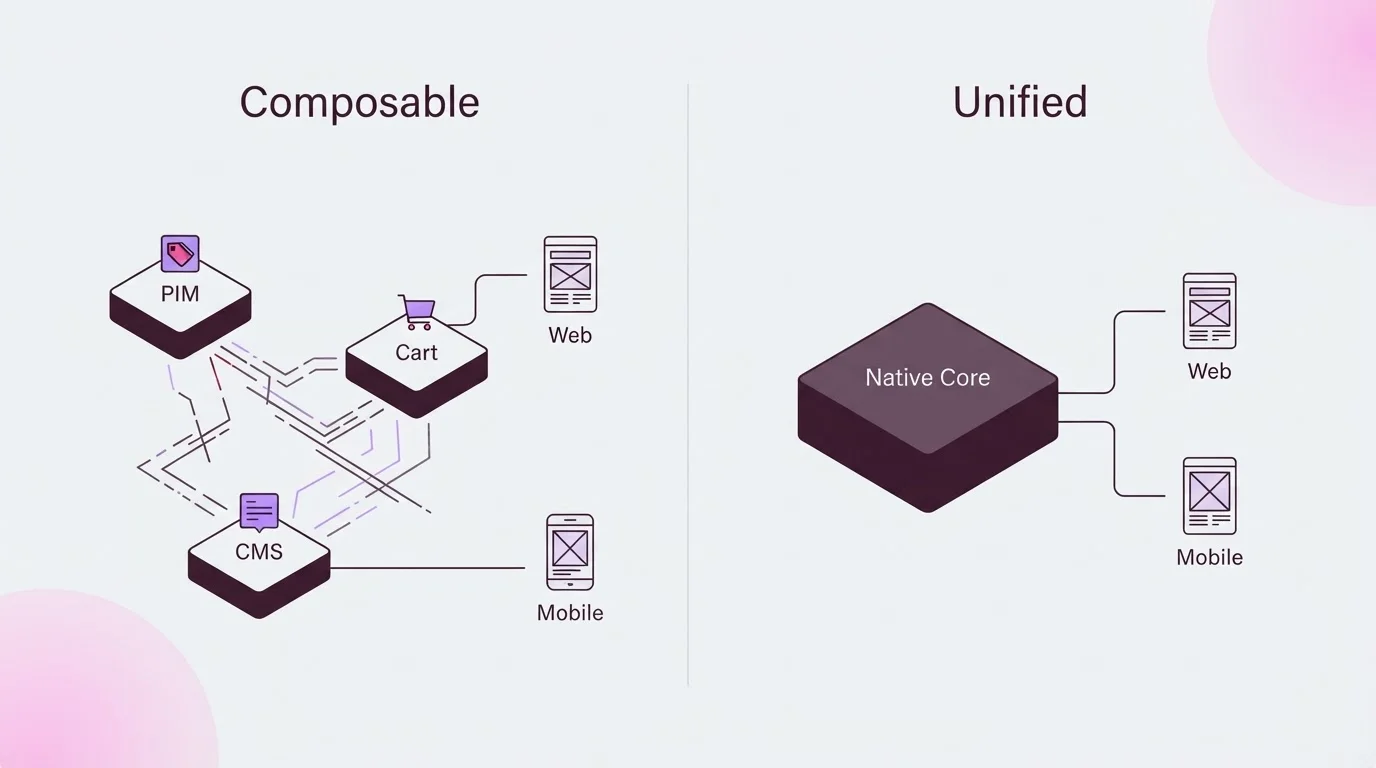
Evaluating your long-term commerce strategy requires contrasting a best-of-breed composable approach with a unified enterprise alternative built for complex, high-volume operations.
| Feature | Elastic Path | Supercommerce |
|---|---|---|
| Architectural Model | Composable (Headless Microservices) | Unified Enterprise Platform |
| Core Core Integration | Modular Orchestration via Middleware | Deeply Integrated Native Core |
| Mobile Commerce | Custom Build via Headless APIs | Native Mobile Storefronts Out-of-the-Box |
| Base Licensing Entry | Listed at $27,600/year | Custom Enterprise Pricing |
| Operational Control | Multi-Vendor Management | Single Unified Control Plane |
Elastic Path Alternatives: Shifting from Integrator to Merchant
The choice between Elastic Path and unified architecture depends on how your organization allocates its technical resources. Elastic Path is a highly capable choice for technical teams that want to act as software integrators, commanding precise control over individual microservices and possessing the engineering scale to manage a multi-vendor stack indefinitely.
However, for organizations seeking unified commerce benefits, managing a fragmented software ecosystem can introduce unnecessary technical debt. Supercommerce offers a distinct alternative for large-scale enterprises with complex needs and over $100M in annual GMV.
Instead of requiring an enterprise to manually assemble, secure, and maintain a collection of disparate commerce microservices, Supercommerce provides high-performance web storefronts and native mobile commerce out of the box within a single, unified architecture. This eliminates the multi-vendor integration tax while preserving the scale, deep ERP integrations, and corporate catalog control that high-volume enterprise brands require to remain agile.
Frequently Asked Questions
Q: How much does Elastic Path cost?
Elastic Path is listed at $27,600 per year for its base plan. For large-scale enterprise needs, total pricing varies based on transaction volume, additional modules, and required integration services.
Q: Is Elastic Path entirely headless?
Yes. Elastic Path is an API-first, headless commerce platform. While it includes visual tools like Studio for experience management, its core architecture delivers commerce data and transactional logic via APIs to external front-ends.
Q: Does Elastic Path support native mobile apps out of the box?
No. While developers can build native mobile apps by connecting to Elastic Path's headless APIs, the platform does not include pre-built, high-performance native mobile storefronts. Achieving a premium mobile app experience requires separate custom development.
Q: What are the primary elastic path alternatives for enterprises?
In the headless and modular space, platforms like commercetools are frequent alternatives. For enterprises seeking to maximize agility and deploy native mobile alongside web storefronts without the overhead of composable orchestration, Supercommerce is the leading unified alternative.
Final Verdict on Product Fit
Elastic Path is a powerful, highly flexible option for enterprise organizations that view infrastructure orchestration as a core competency and have the engineering budget to sustain a custom-assembled ecosystem. It solves deep catalog and pricing challenges for B2B models where account-specific terms are standard.
However, if your primary corporate objectives are speed to market, flawless native mobile execution, and the elimination of complex technical debt, the orchestration overhead of a multi-vendor composable build can become an operational bottleneck. For these high-volume teams, selecting a unified platform engineered for enterprise scale offers a more direct path to sustainable commerce growth.