
On this page
For large-scale enterprise commerce, the bridge between an e-commerce platform and an Enterprise Resource Planning (ERP) system functions as a critical business infrastructure. When processing heavy transaction volumes, manual synchronization is completely off the table. It introduces structural risks to inventory tracking, order management, and financial compliance. Decision-makers evaluating shopify plus enterprise integration must look past standard promotional messaging to understand how the platform addresses high-frequency data exchanges required by systems like SAP, Oracle NetSuite, or Microsoft Dynamics 365. While Shopify Plus offers an accessible environment for mid-market expansion, enterprise technical leaders must carefully evaluate multi-tenant SaaS parameters against the unyielding requirements of a sophisticated global supply chain. This evaluation requires a deep dive into API governance, data mapping for international commerce, and the total cost of ownership associated with maintaining third-party middleware.
The Strategic Role of ERP Integration in High-Volume Commerce
In a sophisticated commerce architecture, the ERP serves as the core system of record for inventory validation, cross-channel fulfillment, and corporate accounting. Seamless integration ensures that order data, stock levels, and pricing layers remain synchronized without friction. This constant alignment is necessary to eliminate errors like overselling, shipping delays, and inconsistent B2B or B2C buyer interactions across localized markets. High-volume environments require infrastructure that can handle substantial data loads, ranging from multi-warehouse stock adjustments to customer-specific contract terms. Official documentation indicates that platforms like Shopify can support accelerated migrations without forcing an immediate, disruptive ERP overhaul up front, but long-term operational resilience depends entirely on the architecture's API flexibility and throttling mechanisms. For brands exceeding $100M in GMV, the cost of a one-minute sync lag can result in significant customer dissatisfaction and lost revenue.
Shopify Plus Enterprise: Overview of its Integration Framework
Shopify Plus operates as a fully managed SaaS platform, with pricing starting at 2,500 USD per month. This baseline plan grants organizations access to dedicated cloud infrastructure along with tools designed for multi-store organization management. A key feature of this framework is centralized access, which lets administrative users manage users and roles across their entire team from one place. For IT infrastructure compliance, this simplifies the onboarding and offboarding of technical and operational personnel. Additionally, the platform provides visibility features that let administrators see where apps are active in their store, track permission changes, and make informed decisions about their app stack. This insight helps security teams audit third-party integrations and mitigate data exposure risks, which is vital when connecting sensitive financial data between the storefront and a corporate ledger.
Product Data and Workspace Governance
Shopify Plus allows operations teams to manage products, collections, markets, metafields, and more without leaving their workflow in the theme editor. This inline editing experience streamlines content enrichment for merchandising teams. However, from an integration standpoint, it demands rigid data governance rules. Technical architectures must clearly dictate whether the central ERP remains the definitive master for all product details or if changes completed inside Shopify's interface are allowed to write back to the core database. Without rigorous data synchronization mapping, high-frequency automated inventory updates risk overriding localized edits or product metadata. For enterprises managing thousands of SKUs across multiple international locales, this conflict can lead to fragmented product information that degrades the customer experience.
API Infrastructure and Transfer Limits

Complex ERP integrations rely heavily on Shopify’s GraphQL Admin API. While Shopify Plus provides significantly higher API rate limits than standard merchant tiers, these boundaries still operate within a multi-tenant framework. This shared infrastructure applies a leaky bucket throttling algorithm that can impact operations during extreme transactional peaks, such as high-volume product drops or heavy seasonal sales. When an integration exceeds allocated API call credits, the platform temporarily throttles incoming requests. This requires developers to engineer complex, fault-tolerant middleware featuring asynchronous queues, exponential backoff logic, and rigorous error handling to prevent message drops and order backlogs. For organizations with high-velocity data needs, these limits often become the primary bottleneck in achieving real-time synchronization.
Assessing Native ERP Connectors vs. Custom Middleware
Through its Global ERP Program, Shopify offers certified applications designed to establish direct communication lines between the core Shopify admin panel and dominant ERP platforms, including Oracle NetSuite, Microsoft Dynamics 365 Business Central, and Acumatica. These out-of-the-box connectors primarily address standard, linear data flows—such as general inventory status checks and elementary financial logging. While native applications can shorten initial launch times for straightforward retail workflows, they often fall short when confronted with highly customized ledger logic, matrix product variations, or proprietary distribution rules. Many enterprises find that as their complexity grows, the limitations of these certified apps necessitate a move toward custom middleware or iPaaS solutions to handle sophisticated business logic.
Integration Method Comparison Matrix
| Feature | Native ERP Connectors | Custom Middleware (iPaaS) | Custom API Build |
|---|---|---|---|
| Deployment Speed | Rapid deployment | Moderate timeframe | Extended engineering lifecycle |
| Customization Depth | Confined to standard schema fields | Highly adaptable across endpoints | Unlimited architectural control |
| Maintenance Responsibility | Managed entirely by the vendor | Joint internal and third-party oversight | Fully maintained by internal IT |
| Cost Profile | Lower predictable monthly fee | Recurring subscription plus dev hours | Extreme upfront and ongoing operational costs |
| Best Suited For | Basic retail order-to-cash workflows | Complex multi-system synchronization | Highly unique, proprietary legacy systems |
Technical Gaps in Complex ERP Integrations
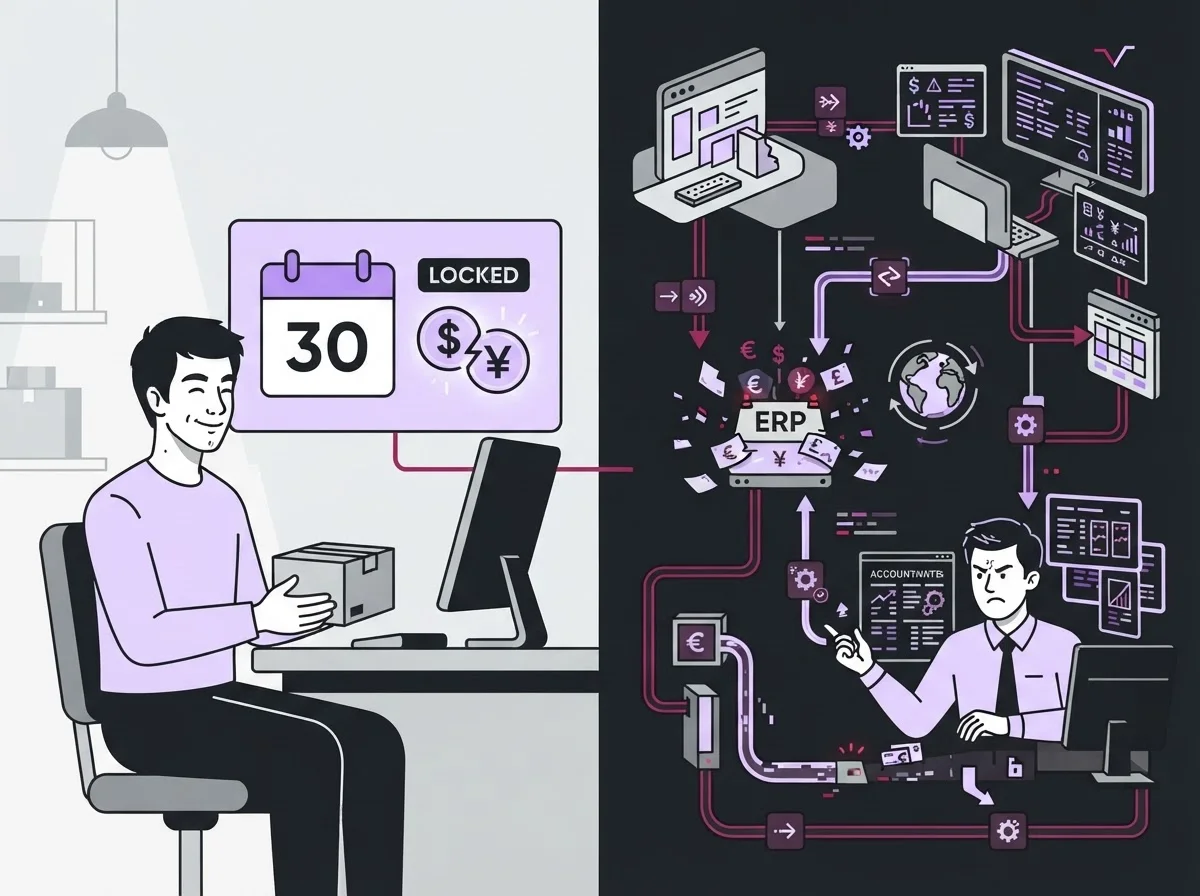
As operational architectures expand, discrepancies between out-of-the-box SaaS models and custom ERP configurations become more pronounced. These points of friction commonly manifest across international return accounting, custom localized logistics, and recurring commerce frameworks. For instance, Shopify Plus includes a feature where exchange rates are locked for up to 30 days on international returns. While this offers clear financial predictability for international buyers, it forces the corporate ERP system to adapt to fixed-rate conversions that may diverge from the company's real-time financial ledger metrics. This mismatch can create significant reconciliation hurdles for finance teams during month-end closing, especially for companies operating in volatile currency markets.
Strategic Insights for Enterprise Commerce
Receive in-depth perspectives on unified platforms, scalability, and complex integrations for large-scale commerce operations.
Logistics and Multi-Warehouse Allocation Rules
Enterprise distribution networks routinely utilize advanced workflows such as split-shipment strategies, priority warehouse routing, and partial cross-docking. Shopify Plus supports execution here by allowing operators to create one or more shipments from a PO to receive stock, handle partial deliveries, and route inventory to the right location. While this tool helps optimize fulfillment within the storefront, aligning it with an ERP that runs its own complex calculations for inventory availability can introduce synchronization lag. If the storefront inventory database and the primary warehouse management system fall out of sync even temporarily, high-velocity brands risk processing transaction volumes for out-of-stock items, leading to costly cancellations and damage to brand reputation.
Financial Settlement, Subscriptions, and Funding Dynamics
Managing recurring revenue streams introduces another complex layer of ledger matching. Shopify Plus lets users offer subscriptions in-store with the Shopify Subscriptions app, which helps centralize purchase histories. However, sending this recurring data downstream into an ERP requires sophisticated mapping to ensure correct revenue recognition and inventory planning. Additionally, for merchants utilizing specific internal platform financing mechanisms, repayments are due in full within a maximum of 18 months from the date funds are deposited. Corporate financial directors must ensure these strict multi-month repayment obligations are meticulously mapped inside the ERP’s internal accounts payable and treasury tracking views to maintain accurate cash flow projections.
Identifying the SaaS Breaking Point for Large Enterprises
Many high-volume merchants eventually cross a threshold where the maintenance of a generic SaaS architecture creates significant technical debt. A primary indicator of this shift is the reliance on extensive custom middleware built solely to convert data between rigid platform endpoints and complex ERP setups. For companies operating intricate global supply chains, managing a fractured network of external apps, point-to-point connectors, and custom data translators significantly inflates total cost of ownership. The development overhead required to circumvent platform-wide API limits and non-customizable checkout environments can quickly consume resources that would be better directed toward customer-facing innovation. When the cost of maintaining the bridge exceeds the value of the platform, it is time to evaluate more unified alternatives.
Strategic Alternative: The Supercommerce Unified Commerce Approach
Rather than continually assembling a disjointed architecture by patching third-party extensions and middleware components onto a generic SaaS engine, enterprise brands can opt for a structurally unified model. Supercommerce provides a comprehensive enterprise platform designed from the ground up to address the sophisticated requirements of large-scale merchants processing over $100M in annual GMV. Instead of employing generic web wrappers or basic responsive views for mobile touchpoints, Supercommerce combines native mobile commerce and high-performance web storefronts into one robust, natively integrated architecture. This approach eliminates the friction inherent in trying to force a mid-market SaaS platform to behave like a custom enterprise solution.
Why Natively Unified Architecture Streamlines Enterprise ERP Logic
Supercommerce is architected from the foundation to handle massive product configurations, complex client-specific pricing grids, and multi-tenant ERP logic natively. By removing the need for sprawling, fragile middleware structures, Supercommerce minimizes the technical points of failure that routinely challenge IT directors on standard SaaS platforms. For engineering teams looking to reclaim full operational control, upgrade their mobile experience, and eliminate API throttling vulnerabilities, a unified infrastructure provides the scalability and integration freedom required to execute complex operations without compromise. This allows technical leaders to focus on growth and innovation rather than constantly managing the limitations of their commerce stack.
Frequently Asked Questions
Q: What is the starting subscription price for Shopify Plus?
The base subscription price for Shopify Plus is listed at 2,500 USD per month, which grants access to the core platform and multi-store administration features.
Q: How does Shopify Plus simplify administrative control for growing security teams?
Shopify Plus lets users manage users and roles across their entire team from one place, while providing logs that track where apps are active and monitor permission changes.
Q: Does the platform include native applications for enterprise resource planning platforms?
Yes, via its Global ERP Program, Shopify provides certified connectors for platforms like NetSuite, Acumatica, and Microsoft Dynamics 365 Business Central. Custom or deeply modified systems often require bespoke integration methods.
Q: How does the system handle currency variations on international returns?
Shopify Plus includes features where exchange rates are locked for up to 30 days on international returns, maintaining financial consistency for customers but requiring reconciliation in corporate ledgers.
Q: What fulfillment workflows can be completed within the admin panel?
Shopify Plus lets users create one or more shipments from a PO to receive stock, handle partial deliveries, and route inventory to the right location.
Evaluating Shopify Plus Enterprise for complex ERP environments involves analyzing the trade-offs between simplified SaaS operations and the strict constraints of shared multi-tenant infrastructure. While features like unified administrative controls and certified ERP connectors satisfy standard workflows, massive enterprises frequently require a system that goes beyond basic data exchange to achieve profound architectural harmony. For technical leaders focused on protecting system performance and eliminating technical debt, the decision path involves calculating the long-term costs of custom middleware and determining if a natively unified platform like Supercommerce represents the most viable path to scalable enterprise growth.