
On this page
For category-leading brands, high traffic is both a primary business objective and a significant operational risk. When traffic patterns transition from a steady state to a high-concurrency event—such as a major flash sale or seasonal launch—technical debt and architectural bottlenecks become visible immediately. In an enterprise commerce environment, scaling is not simply about adding more server capacity; it is about maintaining transaction integrity when concurrent user counts cross critical thresholds.
Successfully managing these demands requires a shift in engineering philosophy toward architectural resilience. Instead of relying on synchronous operations that can cascade into failure, technical leaders must implement decoupling, message buffering, and deep observability. This analysis examines how enterprise ecosystems maintain response times under extreme load, ensuring that high-concurrency events remain profitable opportunities rather than systemic failures.
The High-Concurrency Challenge: Beyond Simple Page Views
High traffic in an enterprise context is defined by the density of state-changing transactions. While Content Delivery Networks (CDNs) handle millions of static requests efficiently, the pressure shifts to the application layer and database once users begin adding items to carts, applying complex promotion rules, and checking real-time inventory. When these processes are coupled synchronously, the entire system is only as fast as its slowest component.
Traditional scaling often fails because it addresses symptoms rather than structural weaknesses. Platform degradation frequently occurs when concurrent users approach significant thresholds. The symptoms—slow page loads, checkout timeouts, and order errors—are usually the result of exhausted connection pools or database row-lock deadlocks. For organizations managing complex catalogs and deep ERP integrations, these bottlenecks are intensified by the volume of data being processed per second.
Peak Shaving: The Asynchronous Buffer Strategy
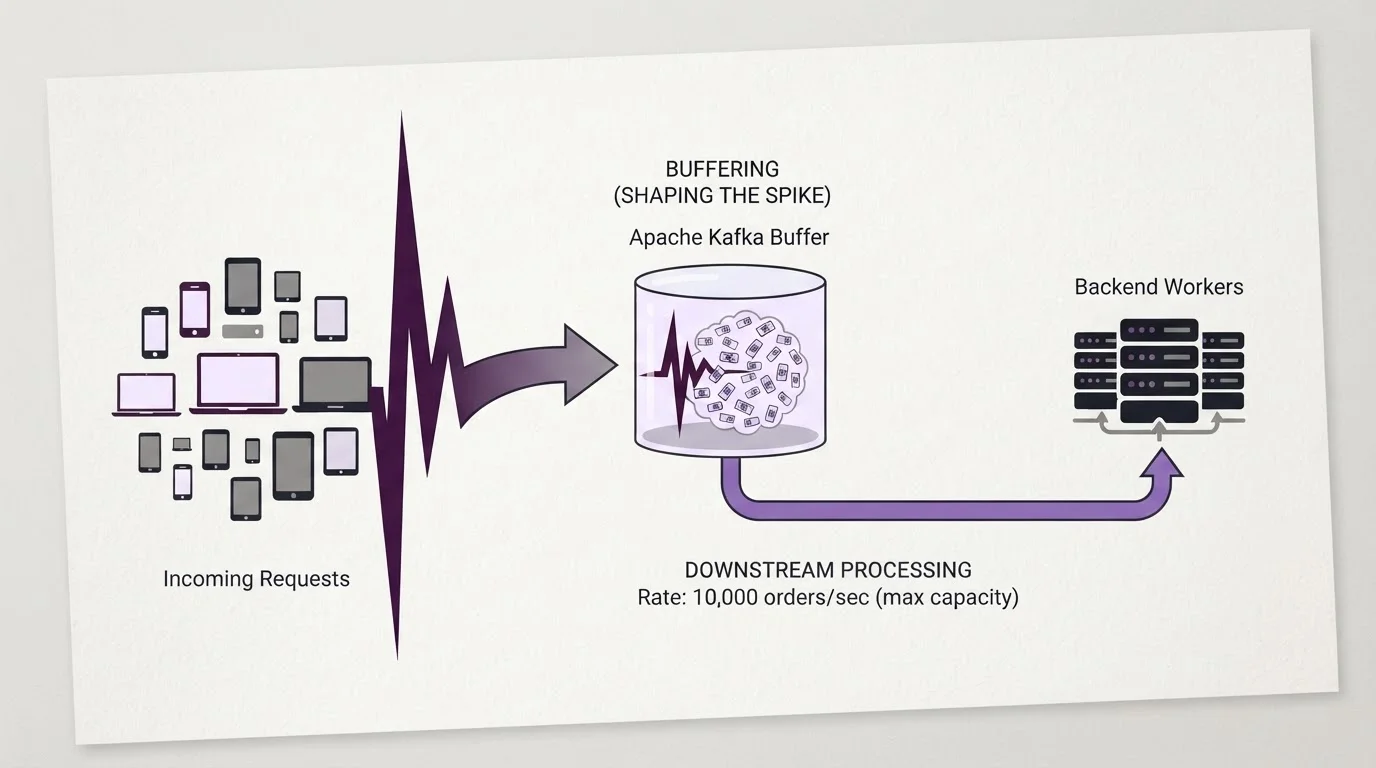
The most effective method for protecting backend systems from traffic spikes is a pattern known as peak shaving. This strategy decouples request ingestion from processing, transforming a sharp vertical spike of incoming requests into a manageable, consistent workload. The core principle of high-concurrency engineering is to accept requests blazingly fast and process them at a controlled, sustainable rate.
Global leaders implement this by using Apache Kafka as a massive buffer funnel during high-volume campaigns. By ingesting checkout events into Kafka topics first, the platform can provide an immediate success response to the client. Downstream backend workers then pull messages from Kafka partitions at a controlled rate—sometimes as high as 10,000 orders per second—smoothing traffic spikes into manageable write workloads for the database of record.
Benefits of the Asynchronous Buffer
Implementing a buffer-based architecture provides three critical advantages for enterprise operations. First, it prevents database exhaustion by controlling the write rate, which eliminates the risk of systemic crashes during peak sales. Second, it maintains front-end responsiveness, as customers receive processing confirmations in milliseconds rather than waiting for full synchronous writes.
Finally, it protects third-party integrations. Technical teams can throttle outbound requests to legacy ERPs or external shipping providers to match their specific rate limits, preventing these external dependencies from becoming points of failure. By transforming a vertical traffic spike into a manageable horizontal line, the business maintains stability throughout the event.
Performance Testing: Moving Beyond Theoretical Scalability
Architecture diagrams do not guarantee performance; only rigorous testing against real-world data does. Technical leaders must prioritize throughput and latency under simulated load rather than relying on generic vendor promises. An evaluation framework should be grounded in measurable performance metrics rather than just architectural theory to ensure readiness for flash sale conditions.
Effective stress testing identifies the exact breaking point of an ecosystem. During the optimization of large-scale storefronts, engineering teams often utilize Apache JMeter for traffic simulation and New Relic for application performance monitoring. This data-driven approach allows architects to determine if a bottleneck is caused by the web server's CPU, database memory, or latent delays in a third-party API. Without this visibility, teams are merely guessing at which components require optimization.
Resilience Through Circuit Breakers and Graceful Degradation
In a distributed enterprise environment, failures in external systems are eventually inevitable. A high-performance commerce platform must be designed to fail gracefully. The Circuit Breaker pattern acts as a safety switch: when a downstream service—such as a tax calculation API or a third-party loyalty provider—starts failing or slowing down, the breaker opens. This stops further requests to the failing service, allowing it time to recover and preventing a "retry storm" that could crash the entire storefront.
Graceful degradation is the tactical partner to circuit breakers. During extreme peaks, technical teams should be prepared to disable non-essential features to preserve resources for the core transactional path. This might include turning off personalized widgets, complex search facets, or real-time loyalty point lookups. By stripping the experience down to the essential journey—browsing and buying—the platform ensures that the primary revenue engine remains functional.
Strategic Insights for Enterprise Commerce
Receive in-depth perspectives on unified platforms, scalability, and complex integrations for large-scale commerce operations.
Database and Infrastructure Optimization for Scale
The database is frequently the final bottleneck in any scaling effort. Vertical scaling—adding more RAM or CPU to a single instance—eventually hits a point of diminishing returns and high cost. Scaling enterprise commerce requires horizontal strategies like database sharding and partitioning, where data is distributed across multiple instances. This ensures that no single database node bears the full weight of a global sale event.
In addition to sharding, a multi-layered caching strategy is vital. While CDN caching handles static assets, high-performance platforms utilize application-level caching, such as Redis or Memcached, to store session data and frequently accessed product attributes. Infrastructure elasticity must be automated: auto-scaling groups should be configured to trigger new instances based on request queue length or CPU utilization, ensuring resources are provisioned before performance begins to degrade.
Supercommerce: Unified Infrastructure for High-Performance Scale

Supercommerce is an enterprise commerce platform built from the ground up to handle the complexity and scale required by large businesses. It provides a unified solution for both high-performance web storefronts and native mobile commerce, eliminating the performance overhead often associated with generic solutions. Unlike platforms that rely on rigid architectures, Supercommerce offers the scale and control needed to manage complex catalogs and deep integrations.
Technical teams can verify the platform’s capabilities through a comprehensive demo dashboard that allows management of products, orders, promotions, and analytics—with no signup required to explore. This transparency ensures that IT architects can evaluate the system's robustness before commitment. The platform is designed for deep, stable connectivity, supporting up to 3 integrations in standard configurations to avoid the fragility of long middleware chains.
Observability and Mobile Performance
Modern observability requires detailed Real User Monitoring (RUM) segmentation. Technical teams must be able to analyze performance by device class, network tier, and traffic source to identify if a slowdown is global or isolated to specific user groups. Supercommerce aligns with these needs by providing deep visibility into the user journey.
Furthermore, by prioritizing native mobile experiences rather than responsive WebViews, Supercommerce reduces server load during traffic spikes. Native apps process and render data on the device itself, only fetching raw data via APIs. This significantly lowers latency and server overhead compared to the repeated downloading of large HTML and CSS bundles required by mobile web views, making the mobile experience a performance asset rather than a liability.
Frequently Asked Questions
Q: What is the difference between load testing and stress testing?
Load testing measures how the system performs under expected traffic volumes to ensure it meets Service Level Agreements (SLAs). Stress testing pushes the system beyond its limits to identify the exact breaking point and observe how it recovers from failure.
Q: How does peak shaving impact inventory accuracy?
Peak shaving uses a buffer to queue order events. To maintain accuracy, systems typically reserve stock in a high-speed cache during the ingestion phase, and then the downstream workers perform the final decrement in the database of record during processing.
Q: When should an enterprise move to a decoupled architecture?
If your platform experiences site-wide slowdowns when a single component lags, or if you cannot scale your checkout process independently of your product catalog, it is time to move to a decoupled, microservices-oriented architecture.
Q: Why do native mobile apps perform better than responsive web views under high traffic?
Native apps handle data processing and rendering on the device itself, only fetching raw data via APIs. Responsive web views must download and parse large HTML and CSS bundles for every change, which increases server load and latency during traffic spikes.
Scaling a high-traffic ecommerce platform is a continuous commitment to architectural excellence rather than a one-time configuration. By prioritizing asynchronous processing, rigorous performance testing, and deep observability, enterprise leaders can build systems resilient enough to handle the most demanding peaks. Platforms like Supercommerce provide the unified foundation necessary to execute these strategies, giving large brands the control and performance required to lead their categories without the risk of platform failure.