
On this page
Spryker is a modular commerce platform built for enterprises whose transactional needs have exceeded the capabilities of generic, monolithic systems. Positioning itself as a "Cloud Commerce OS," Spryker utilizes an API-first, headless architecture that allows businesses to assemble specific commerce modules tailored to B2B, B2C, and multi-vendor marketplace models. For organizations managing high-volume operations, the choice between Spryker’s composable ecosystem and a unified enterprise platform often comes down to a strategic trade-off: granular component control versus the operational efficiency of an integrated, high-performance architecture.
The Composable Architecture of Spryker
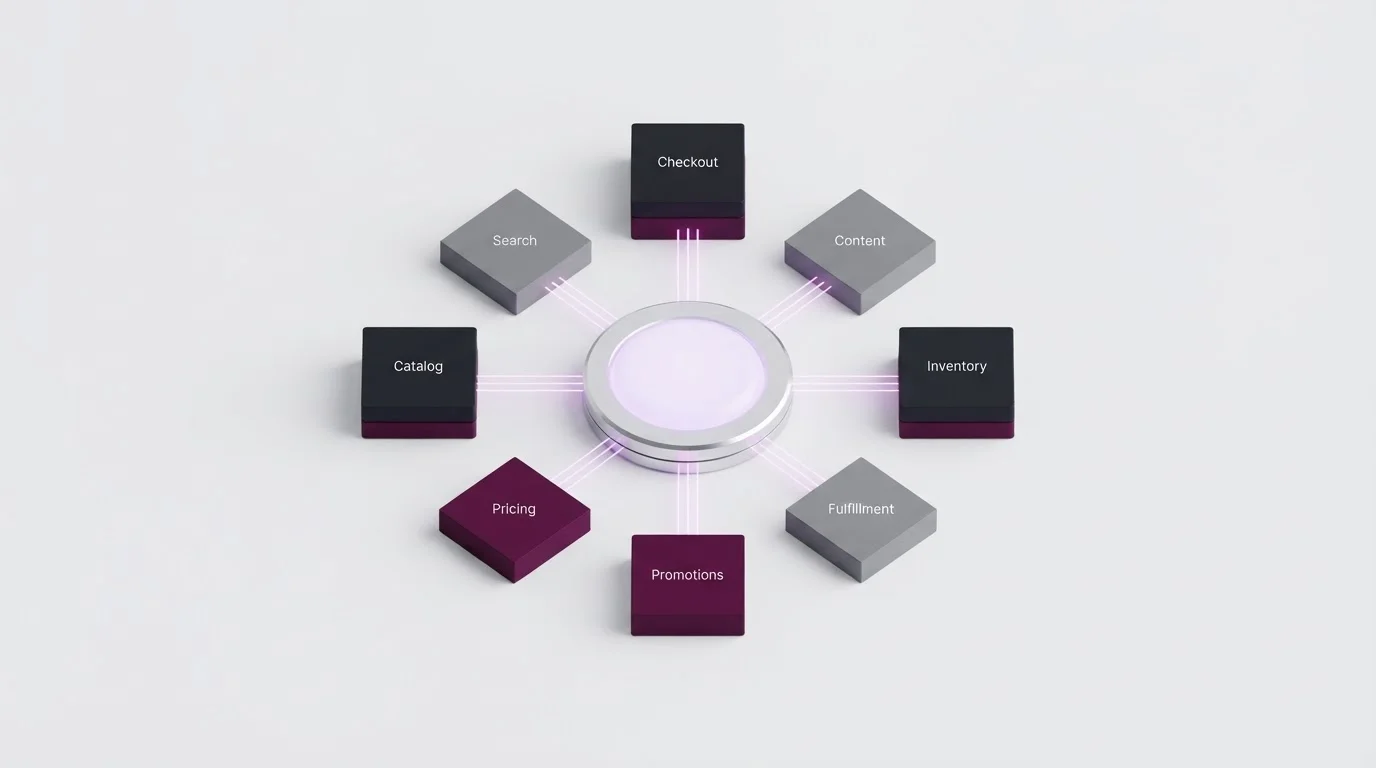
Spryker’s primary value proposition is the elimination of "out-of-the-box" software limitations. By treating every commerce function—from the checkout engine to the catalog—as a discrete, swappable module, Spryker enables enterprise commerce agility for companies with non-standard requirements. This modularity is a key reason Spryker has been recognized as a sample vendor in Gartner Hype Cycles for categories such as API-Based Digital Commerce, Composable Commerce, and Enterprise Marketplaces.
For a CTO, this modularity means the platform is engineered to handle mixed portfolios of physical goods, digital services, and subscription models on a single codebase. Rather than being forced into a rigid vendor roadmap, engineering teams can prioritize the specific modules that drive revenue. This flexibility is essential for businesses that operate across multiple regions or manage diverse brands under one umbrella.
The Greenfield Approach
One of Spryker’s most distinct workflows is the Greenfield approach. This methodology encourages teams to build a Minimum Viable Product (MVP) in a new environment without being hindered by legacy constraints. By focusing on the simplest prototype that encapsulates the core business proposition, teams can test demand and usability with real user feedback before committing significant development resources to a full-scale rollout. This is particularly effective for large enterprises launching new digital business units or experimental service lines.
Core Features for Complex Enterprise Use Cases
Spryker excels in industries where a standard retail checkout flow is insufficient. Its feature set is built for deep technical integration and operational continuity in sectors like automotive, life sciences, and wholesale procurement.
Industrial and Automotive Precision
For automotive brands and dealers, Spryker provides an asset-based catalog and asset compatibility checks. This ensures that customers find the exact spare parts or components linked to a specific machine model, which reduces ordering errors and service friction. This capability extends to the entire customer lifecycle, supporting everything from initial sales to automated spare parts replenishment and service plan renewals based on machine data.
Enterprise Marketplace and Procurement
Spryker’s marketplace capabilities allow enterprises to transition from a single-seller model to a multi-vendor ecosystem. Key features include dynamic supplier bidding through configurable rules and API-based triggers, allowing for automated competition. For B2B buyers, permission-based approval workflows allow for a "locked cart" concept where orders only proceed to checkout once an authorized manager reviews and approves the request, ensuring compliance with corporate procurement limits.
AI Foundation and IoT Integration
The platform includes an AI Foundation layer, which serves as a provider-agnostic interface to connect with various AI models. This powers conversational AI search and predictive maintenance features. In the MedTech sector, Spryker allows companies to integrate with IoT and patient data, facilitating compliant spare parts ordering to keep critical medical devices running continuously without manual monitoring.
Strategic Insights for Enterprise Commerce
Receive in-depth perspectives on unified platforms, scalability, and complex integrations for large-scale commerce operations.
The Composable Tax: Trade-offs for Large-Scale Operations
While Spryker offers unparalleled customization, it introduces what is often referred to as the "composable tax." A composable architecture requires integrating multiple best-of-breed components, which can lead to significant overhead in development and long-term maintenance. For an enterprise looking for rapid deployment, the technical debt of building and maintaining custom-assembled tech stacks can delay time-to-value.
Large-scale enterprises must decide if they want to spend their budget managing a complex ecosystem of interconnected services or if a unified platform would serve them better. While Spryker relies on a "Publish & Sync" mechanism for consistency, a unified platform offers real-time synchronization across all channels without the integration complexity inherent in modular builds. This is especially critical for brands with high annual GMV that cannot afford synchronization lags between their web and mobile storefronts.
Strategic Comparison: Composable vs. Unified
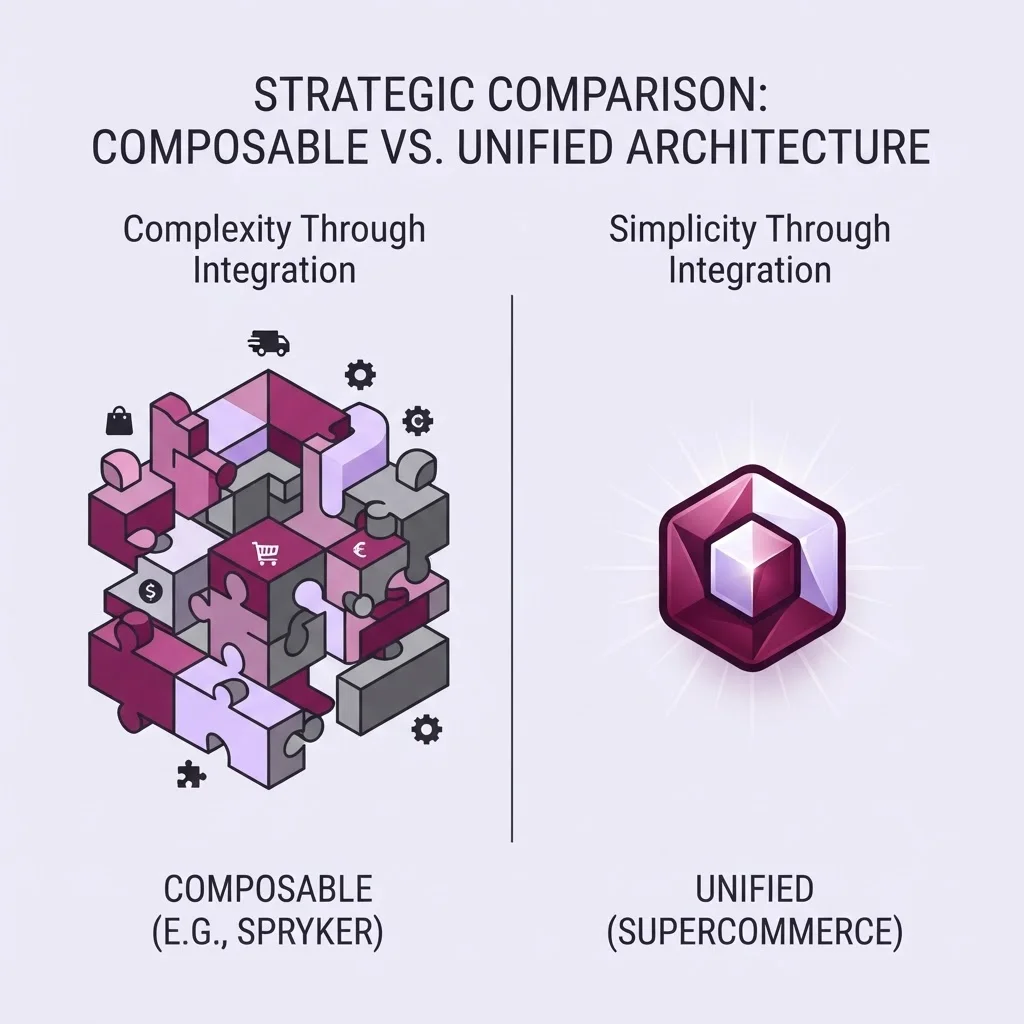
| Feature | Spryker (Composable) | Supercommerce (Unified) |
|---|---|---|
| Best For | Highly unique, custom-coded business logic | Large enterprises needing scale & native mobile |
| Architecture | API-first, modular, swappable parts | Single, high-performance core architecture |
| Mobile Experience | Headless (must build mobile separately) | Native mobile & web out of the box |
| Integration | Custom-built for every service | Deep, native enterprise integrations |
| Catalog Handling | Complex, asset-based models | Large-scale, high-performance catalogs |
Evaluating Product Fit
Choosing Spryker is appropriate if your business model is so unique that no standard commerce platform can support it without a complete rewrite. It is an ideal fit for greenfield IoT projects or marketplaces that require highly specific, manual intervention in the supplier bidding process. However, the requirement to build and maintain the frontend—particularly for mobile—remains a heavy lift for many IT departments.
For enterprises processing significant annual GMV that require high-performance storefronts and a seamless mobile app experience, a unified platform is often the superior strategic choice. Your customers deserve more than a responsive website wrapped in a WebView; they deserve a native experience. A unified platform like Supercommerce provides the scale, control, and deep integrations your team actually needs without the fragmentation costs associated with assembling a composable stack from scratch.
Frequently Asked Questions
Q: Is Spryker a SaaS or PaaS solution?
Spryker is a Cloud Commerce OS that operates primarily as a Platform-as-a-Service (PaaS). This gives developers deep access to the code for customization while providing cloud-native scalability.
Q: How does Spryker handle B2B approval workflows?
Spryker uses a locked-cart concept where a buyer submits an order for approval based on company role permissions. The order only proceeds to checkout once an authorized manager reviews and approves the request.
Q: Can Spryker manage multiple brands on one platform?
Yes, Spryker supports dynamic multi-store and multi-brand capabilities on a single codebase, allowing enterprises to manage global regions and different revenue streams from a central core.
Q: What is the main difference between Spryker and Supercommerce?
The main difference is architecture. Spryker is a modular, composable platform designed for custom-assembled tech stacks. Supercommerce is a unified platform providing integrated web and native mobile experiences designed for scale.
Spryker remains a powerful contender for enterprises that prioritize total granular control and are willing to invest in the technical talent required to maintain a modular ecosystem. However, as the digital commerce landscape shifts toward efficiency at scale, many large organizations are finding that the complexity of composable builds creates unnecessary friction. For those who require high-performance storefronts, native mobile apps, and deep ERP integration without the "composable tax," a unified architecture offers a more efficient path to long-term growth.